
Explore the fundamental role and various applications of diodes in modern electronic systems, focusing on their structure, functionality, and impact on energy efficiency.
Understanding Diodes: Essential Components in Electronic Control and Energy Efficiency
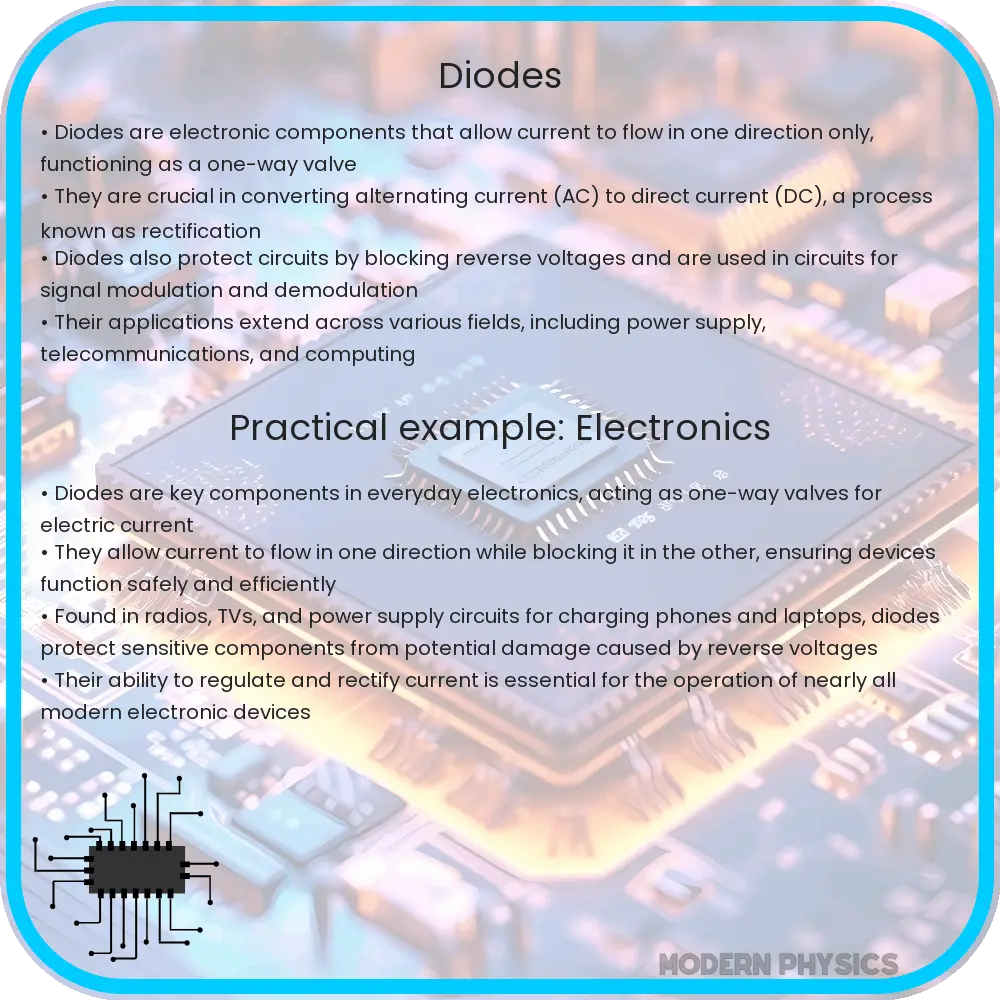
Diodes are a staple component in modern electronic circuits, acting primarily as a one-way valve for electrical current. By allowing current to flow in one direction while blocking it in the opposite direction, diodes play a crucial role in directing and controlling electrical energy. This unique functionality makes them indispensable in applications ranging from power conversion to signal demodulation.
The Basic Structure and Function of Diodes
A diode is a small electronic device comprised of a semiconductor material, commonly silicon, doped with impurities to create a p-n junction. This junction is critical as it separates two regions within the semiconductor: one with an excess of positive carriers (holes), known as the p-type, and the other with an excess of negative carriers (electrons), referred to as the n-type.
When a voltage is applied across a diode in the forward direction (positive to the p-type and negative to the n-type), the diode allows current to flow. However, if the voltage is reversed, the diode obstructs the flow of current, effectively acting as an insulator.
The Principle of Current Flow and Voltage in Diodes
The key to understanding how a diode operates lies in its I-V (current-voltage) characteristic curve. This curve demonstrates that the diode will begin conducting electricity only when the forward voltage exceeds a certain threshold – typically about 0.6 to 0.7 volts for silicon diodes. This is known as the forward voltage drop. Below this threshold, only a negligible leakage current flows.
Forward Bias Condition: Under forward bias (positive voltage at the anode, negative at the cathode), the p-n junction’s depletion zone narrows, allowing electrons and holes to recombine on either side of the junction, facilitating current flow across the diode.
Reverse Bias Condition: Conversely, when the diode is reverse-biased, the depletion zone widens, preventing any significant current from flowing, except for a very small leakage current known as the reverse saturation current.
Applications in Electronic Control and Energy Efficiency
Diodes are integral in a variety of applications that enhance control over electronic systems and improve energy efficiency:
- Rectifiers: Diodes convert alternating current (AC) into direct current (DC). This rectification process is fundamental in power supplies for all electronic devices.
- Voltage Regulation: Zener diodes, a special kind of diode, can maintain a constant voltage across themselves when reverse-biased, which is essential for protecting sensitive electronic components from overvoltage conditions.
- Signal Demodulation: Diodes are used to extract the audio signal from the carrier wave in radio receivers, a process known as demodulation.
Each of these applications takes advantage of the diode’s ability to control the flow of electrical currents, demonstrating the versatility of this simple, yet powerful, component in both analog and digital electronics. The adaptation of diodes in various configurations also allows for the creation of more complex functionalities such as logic gates and amplifiers in digital circuits.
Improving Energy Efficiency with Diodes
Aside from their controlling capabilities, diodes play a significant role in enhancing energy efficiency, particularly in power supply systems. By minimizing the loss of energy during the conversion and regulation processes, high-efficiency diodes reduce the overall consumption of power and heat dissipation. This not only saves energy but also extends the lifespan of electronic devices.
Moreover, the development of advanced semiconductor materials such as gallium nitride (GaN) and silicon carbide (SiC) has led to the production of diodes that can operate at higher voltages, frequencies, and temperatures with superior efficiency. These improvements are crucial for high-power applications such as electric vehicles and renewable energy systems, where energy efficiency is paramount.
In summary, diodes are fundamental components that contribute significantly to the control, efficiency, and functionality of electronic circuits. Understanding their basic operation, characteristics, and applications can provide a deeper appreciation of their role in modern electronics. As technology advances, the evolution of diode materials and designs continues to enhance their performance in myriad electronic and power applications, marking an exciting frontier in the field of electronics engineering.
Exploring Further: Diode Types and Innovations
While the basic diode structure serves many purposes, several specialized types of diodes have been developed to meet specific needs in electronic circuits:
- Schottky Diodes: Known for their low forward voltage drop and high-speed switching capabilities, these diodes are ideal for high-frequency applications and voltage clamping.
- Light Emitting Diodes (LEDs): Perhaps the most visually recognizable diodes, LEDs convert electrical energy into light and are used in everything from indicator lamps to large display screens.
- Photodiodes: Operating in reverse bias, these diodes convert light into an electrical current, serving crucial roles in solar panels and optical communication systems.
Each type of diode brings its own strengths to electronic designs, expanding the reach of diode technology into new and innovative applications.
Conclusion
Diodes, with their simple yet robust framework, are essential elements in the vast domain of electronics. From managing the flow of current in basic devices to enhancing energy efficiency in complex power systems, diodes prove to be versatile and indispensable. By understanding the principles of their operation and recognizing their diverse applications, users and designers can better harness the potential of diodes to innovate and optimize electronic systems.
The continual advancement in semiconductor technology not only improves the existing diode functions but also paves the way for new types of more efficient and powerful diodes. This progress is crucial for meeting the growing demands of modern electronic devices and systems, ensuring that diodes will remain a cornerstone of electronic engineering for years to come. Educating oneself about this fundamental component not only enriches knowledge but also opens up myriad possibilities for practical applications and creative solutions in the field of electronics.