
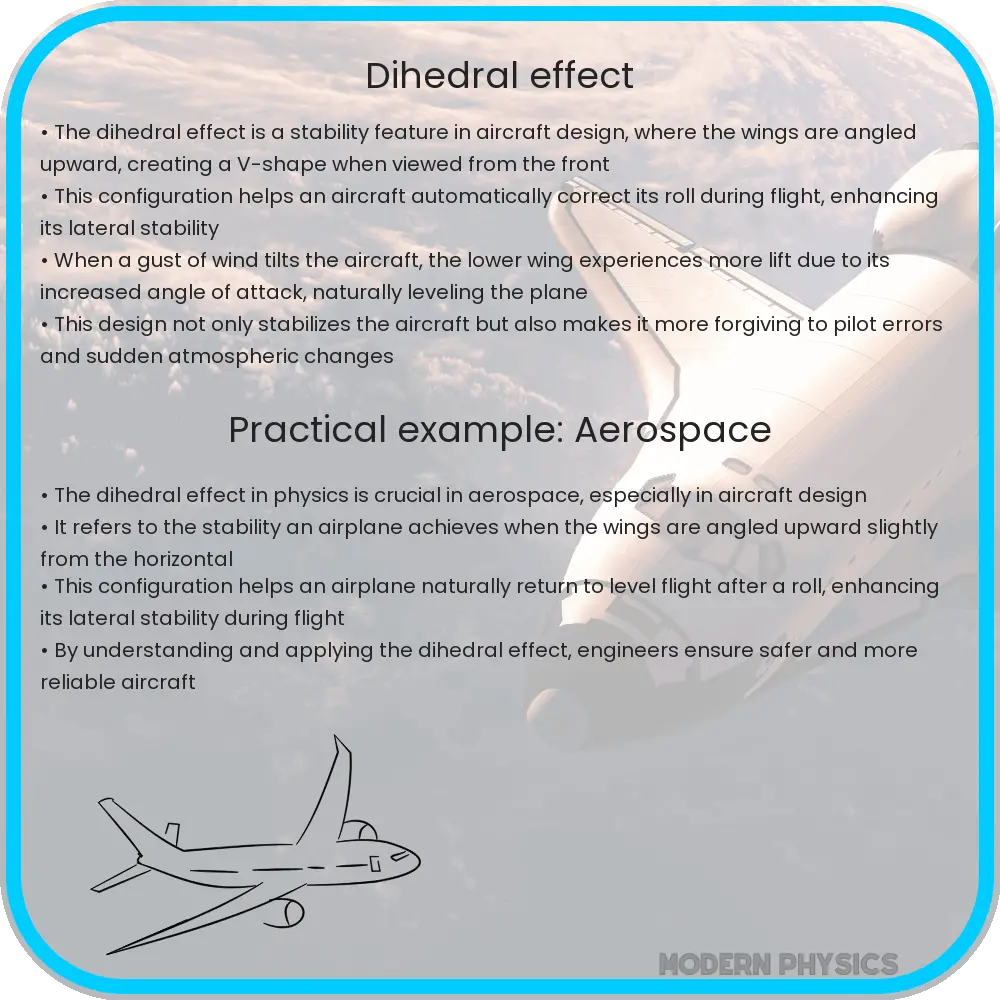
The dihedral effect involves the angle between an aircraft’s wings and the horizontal plane, influencing stability and lift by automatically correcting roll during flight.
Dihedral Effect: Understanding Its Role in Stability and Lift
The dihedral effect is a crucial concept in aero-hydrodynamics, playing a significant role in the stability of an aircraft or aquatic vehicle. This phenomenon pertains to the angle formed between the wings of an aircraft and the horizontal plane. In simple terms, if the wings tilt slightly upwards, this is called a positive dihedral angle. Contrastingly, if they tilt downwards, it is a negative dihedral angle. The dihedral angle influences stability, which is essential for the safety and performance of the aircraft.
Why Is Dihedral Angle Important?
Dihedral angle contributes primarily to an aircraft’s roll stability – its ability to remain level with the horizon during flight without pilot intervention. Stability in an aircraft mitigates the risk of unwanted side-to-side rolling motion, which could undermine the aircraft’s performance and hinder control by the pilot.
When an aircraft with a positive dihedral angle is subjected to a gust of wind from the side, it leads to an automatic tilting correction. Essentially, the wind pushes one wing up, and due to the increased lift on the lower wing and reduced lift on the higher wing, the aircraft naturally rolls back towards its original level position. This inherent self-corrective capability is a key attribute of adding dihedral to the wings of an airplane.
Mathematical Description of Dihedral Effect
The relationship between dihedral angle and stability can be approached through basic aerodynamic principles. Lift, the upward force counteracting gravity, is crucial in this context. The lift equation for each wing can be expressed as:
Li = 0.5 * ρ * V2 * A * Cli
where:
- Li is the lift on wing i (can denote left or right wing),
- ρ represents air density,
- V is the velocity of the aircraft relative to the air,
- A stands for the wing area,
- Cli is the coefficient of lift dependent on the angle of attack and the dihedral angle.
During a roll induced by a disturbance, the wing moving upwards (say the right wing) experiences a decrease in effective angle of attack due to the lateral flow of wind over the wings. Conversely, the down-going wing (left wing) sees an increased effective angle of attack. These changes alter the lift coefficients Clr and Cll, stabilizing the aircraft automatically.
Application in Hydrodynamics
The principles of dihedral effect are not confined to the air; they also extend to aquatic vehicles such as boats and submarines. The similar principle of tilt correction applies: a strategically angled hull helps maintain stability in water, preventing excessive roll due to waves or wind. Just as in the air, hydrodynamic lift can be affected by the angles of component surfaces, contributing to the stable maneuvering and operation of the vehicle.
Understanding the dihedral effect allows for better design and control of both aircraft and watercraft, essentially contributing to safer, more efficient operations. By managing how devices respond to natural disturbances, engineers can create designs that are not only stable but also resilient in varying operational conditions.
Effects on Performance and Maneuverability
While dihedral angles contribute significantly to stability, they also have an impact on the performance and maneuverability of an aircraft. A higher dihedral angle generally means better stability but can reduce the aerodynamic efficiency and increase drag. On the other hand, a lower dihedral angle enhances maneuverability but at the cost of reduced natural stability, thereby requiring more effort and skill from the pilot to maintain control.
Therefore, finding the right balance in dihedral angle is crucial for the desired aircraft performance, and it varies based on the intended use of the aircraft. For instance, fighter jets, which require high maneuverability, typically have a lower dihedral angle compared to commercial airliners that prioritize stability for a smoother passenger experience.
Recent Innovations Influenced by the Dihedral Effect
Modern advancements in aerospace and marine engineering continue to leverage the lessons learned from the dihedral effect. In unmanned aerial vehicles (UAVs), for instance, researchers are experimenting with variable dihedral angles to adapt to different flying conditions, enhancing both stability and efficiency. Similarly, in maritime engineering, dynamic dihedral angles are being considered in the design of high-speed yachts and catamarans to improve stability without compromising on speed or fuel efficiency.
Conclusion
The dihedral effect plays a pivotal role in the design and functionality of both aircraft and aquatic vehicles. By understanding and manipulating the dihedral angle, engineers can achieve a desired balance between stability and maneuverability, which is crucial for the specific purposes of different types of vessels. This phenomenon not only ensures the safety and effectiveness of transport systems but also offers insights into more sophisticated control scenarios for future technological innovations.
In conclusion, whether it applies to large passenger planes gliding smoothly above the clouds or to sleek yachts braving the rolling waves, the dihedral effect is a fundamental principle in aeronautics and hydrodynamics. Its proper application promises safer journeys and more efficient vehicle performance across various media. As technology continues to advance, the exploration and application of the dihedral effect will undoubtedly lead to more innovative designs and solutions in the world of transportation and beyond.