
Explore how Diffractive Optical Elements revolutionize precision, efficiency, and versatility in optics, with insights into applications and future trends.
Diffractive Optical Elements: Enhancing Precision, Efficiency, and Versatility
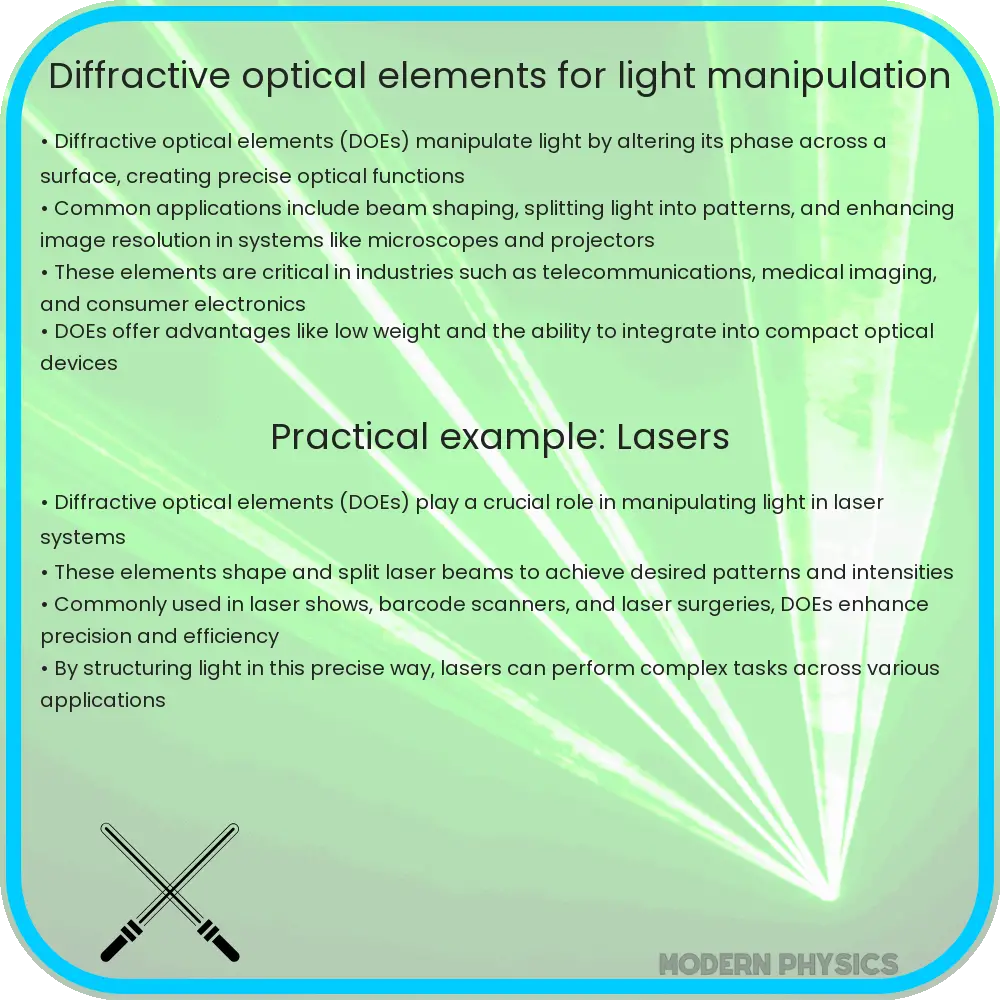
Diffractive Optical Elements (DOEs) represent a groundbreaking technology in the field of photonics, offering unparalleled precision, efficiency, and versatility. These elements work by manipulating light through diffraction, a process that involves the bending of light waves around obstacles or the spreading of light waves as they pass through small apertures. By structuring the surface of a DOE at the micro or nano scale, light can be shaped, split, or directed in highly controlled ways, opening up new possibilities in optical systems.
Core Principles and Applications
At the heart of DOEs are the principles of wave optics. Unlike traditional optical elements that rely on refraction and reflection, DOEs use diffraction to achieve the desired optical effects. This allows for more compact and lightweight designs that can perform complex light manipulation tasks. Applications of DOEs span a wide range, including laser beam shaping, optical information processing, holography, and even in the creation of optical elements with specific focal properties.
Advantages of Using DOEs
- Precision: DOEs offer exceptional control over light, allowing for precise manipulation of beam shape, phase, and direction. This is critical in applications requiring high-resolution imaging or intricate light patterns.
- Efficiency: By optimizing the diffraction efficiency, DOEs can direct the majority of incident light into useful orders, minimizing energy loss. This efficiency is crucial in energy-sensitive applications such as portable laser devices.
- Versatility: The ability to custom-design the diffractive pattern on DOEs enables a wide range of functionalities to be integrated into a single optical element. This versatility makes DOEs invaluable in complex optical systems that require multiple light manipulation capabilities.
Material and Fabrication Techniques
The fabrication of DOEs requires precise control over the material’s surface at the micro or nano scale. Common materials used include fused silica, polymers, and semiconductor materials. Techniques such as electron beam lithography, laser beam writing, and photolithography are employed to create the intricate patterns necessary for diffractive optical effects. The choice of material and fabrication method depends on the application’s specific requirements, including wavelength of operation, environmental durability, and optical efficiency.
Innovations and Future Directions in DOE Technology
The field of diffractive optical elements is ripe with innovation, driven by advancements in computational methods and nanofabrication technologies. One promising area is the integration of DOEs with other optical technologies, such as waveguides and photonic crystals, to create more compact and multifunctional optical devices. Additionally, the development of dynamic DOEs, which can change their diffractive properties in real time, opens up new possibilities for adaptive optics systems that can respond to changing environmental conditions or requirements.
Challenges and Considerations
Despite their many advantages, DOEs also present certain challenges. The precision required in fabrication can make the production of complex elements costly and time-consuming. Furthermore, the diffraction efficiency of a DOE can vary significantly with wavelength, which may limit its performance in broadband applications. Addressing these challenges requires ongoing research into more cost-effective fabrication methods and designs that can maintain high efficiency across a broader spectrum of light.
Conclusion
Diffractive Optical Elements are at the forefront of optical engineering, offering a level of precision, efficiency, and versatility that traditional optical components cannot match. Their ability to precisely control light opens up a myriad of applications in fields as diverse as telecommunications, medical imaging, and consumer electronics. As the technology continues to evolve, with improvements in fabrication techniques and the development of new materials, the potential applications for DOEs will only expand. The future of optical technology appears to be closely intertwined with the advancement of DOEs, heralding a new era of compact, efficient, and highly functional optical devices that will transform our technological landscape.