
Explore Delbrück Scattering in QED: a deep dive into photon-nucleus interactions, its experimental challenges, and astrophysical significance.
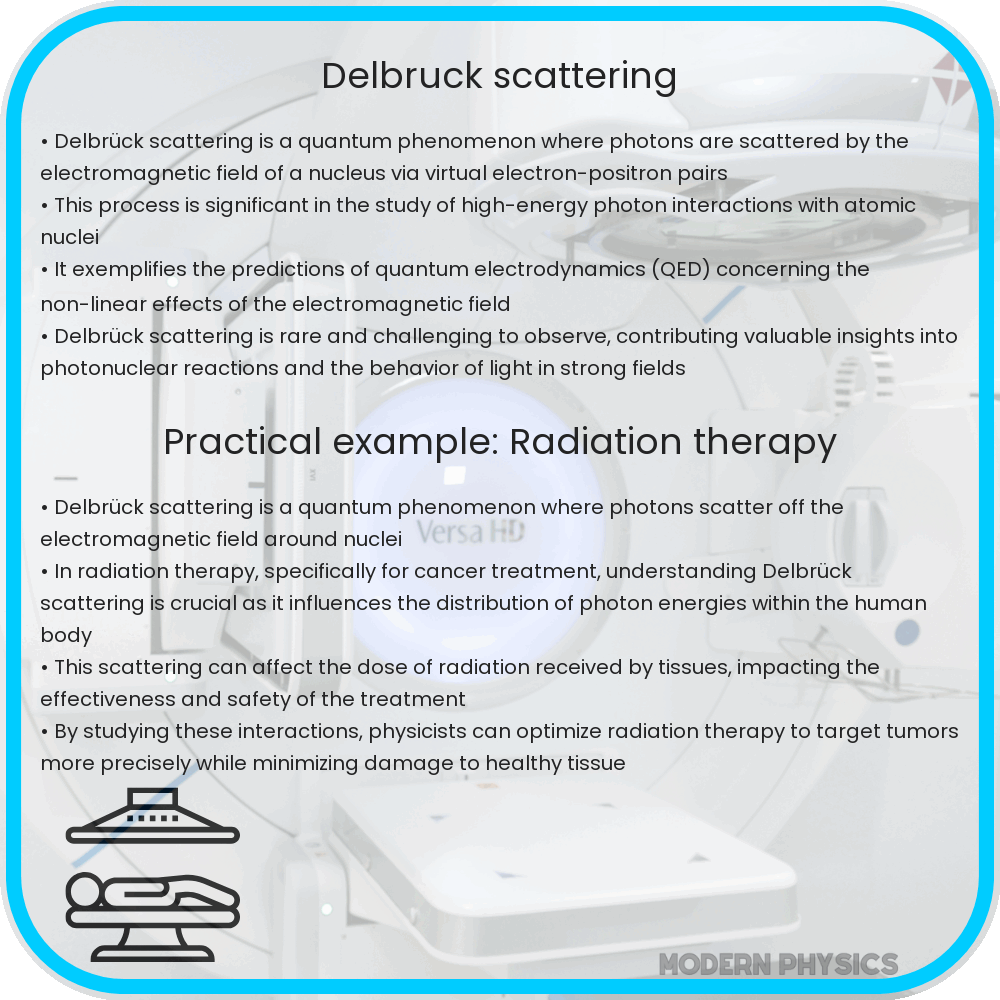
Delbrück Scattering: An Insight into Quantum Electrodynamics
Delbrück scattering, named after the German physicist Max Delbrück, is a fascinating phenomenon in quantum electrodynamics (QED) that involves the scattering of photons by the intense electric field of a nucleus without the need for charged particle intermediaries. This process is a testament to the intricate and counter-intuitive nature of quantum mechanics and QED, showcasing the interaction between light and matter in a unique way.
Understanding Quantum Electrodynamics (QED)
At its core, QED is the quantum field theory that describes how light and matter interact. It provides a framework for understanding the electromagnetic force, one of the four fundamental forces of nature, through the exchange of photons. In this realm, particles such as electrons are no longer seen as just particles, but also as waves that interact with the quantized electromagnetic field.
The Mechanism of Delbrück Scattering
Delbrück scattering occurs when a high-energy photon (γ-ray) travels close to a heavy nucleus, such as lead (Pb). The intense electric field of the nucleus affects the vacuum around it, essentially polarizing it. This polarization leads to the creation of virtual electron-positron pairs, which, although they do not exist long enough to be observed directly, influence the path of the incoming photon. The photon can be scattered in various directions, a process that does not involve the actual creation or annihilation of particles, but rather the transient fluctuations of the vacuum state itself.
Photon Interaction in Delbrück Scattering
The interaction in Delbrück scattering is purely electromagnetic, governed by the principles of QED. The virtual electron-positron pairs are a direct consequence of Heisenberg’s uncertainty principle, allowing for the brief existence of these particles without violating conservation laws. The scattered photon emerges with its energy and momentum altered, providing a unique window into the quantum vacuum and the effects of strong electromagnetic fields.
Delbrück scattering is not only a theoretical curiosity but also has practical implications in various fields, including nuclear physics and astrophysics. The study of this scattering process helps in understanding the behavior of γ-rays in high-energy environments, such as those found near neutron stars or in nuclear reactors.
Experimental Observations and Theoretical Challenges
Experimentally observing Delbrück scattering is a challenging task due to the subtlety of the effect and the need for high-energy photons. Advanced particle accelerators and highly sensitive detectors are required to detect the minute changes in photon trajectories. Over the years, experiments have gradually confirmed the predictions of QED regarding Delbrück scattering, adding to the robust evidence supporting the theory. However, the precision required to explore this phenomenon continues to push the boundaries of experimental physics.
Delbrück Scattering in Astrophysics
In astrophysics, Delbrück scattering gains significance in the study of high-energy cosmic phenomena. The interaction of γ-rays with the intense electric fields of celestial bodies can lead to observable effects. For instance, the attenuation of γ-rays in the vicinity of neutron stars or within supernova remnants can be partly attributed to Delbrück scattering, alongside other processes like pair production and Compton scattering. Understanding these interactions is crucial for interpreting astronomical observations and modeling cosmic events.
Future Prospects and Applications
The ongoing research in Delbrück scattering is not just limited to theoretical curiosity. It has potential applications in various fields, including medical physics, where understanding photon interactions at high energies could lead to improvements in radiation therapies. Moreover, the principles learned from studying this quantum phenomenon could influence future technological advancements, particularly in the areas of photonics and quantum computing.
Conclusion
Delbrück scattering, as an intriguing aspect of quantum electrodynamics, provides profound insights into the interaction between light and matter at a quantum level. It exemplifies the strange and fascinating behaviors that arise from the principles of quantum mechanics and relativity. The study of this phenomenon not only reinforces our understanding of fundamental physics but also opens doors to new technological frontiers. As research continues, the implications of Delbrück scattering in both theoretical physics and practical applications are expected to expand, further revealing the intricacies of our quantum universe.