
Explore the complexities of photon dynamics in QED and its applications in astrophysics, medical imaging, and technology with this in-depth article.
Radiative Transfer: Unveiling the Intricacies of Photon Dynamics in Quantum Electrodynamics (QED)
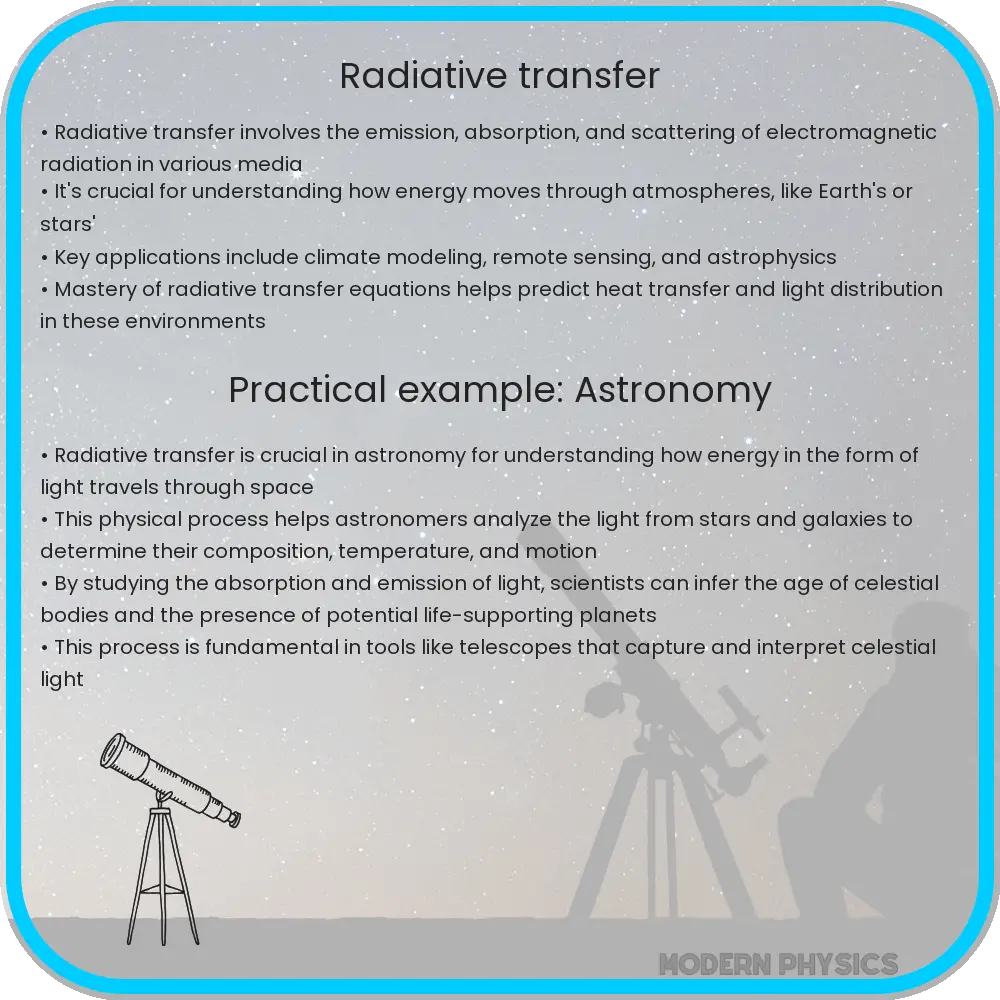
Radiative transfer, a pivotal concept in the realm of quantum electrodynamics (QED), plays a crucial role in our understanding of how photons – the fundamental particles of light – interact with matter. This intricate process is essential in various fields, ranging from astrophysics to medical imaging technologies. The foundational principles of radiative transfer within the framework of QED offer profound insights into the behavior of light and its interaction with the atomic and subatomic world.
QED: A Fundamental Theory of Light-Matter Interaction
Quantum Electrodynamics, at its core, is the quantum theory that describes how light and matter interact. It is a cornerstone of modern physics, providing a comprehensive framework for understanding the electromagnetic interactions between charged particles and photons. QED is particularly important in explaining phenomena such as the scattering of light by electrons (Compton scattering), the creation of electron-positron pairs by photons, and the subtle shifts in atomic energy levels known as Lamb shifts.
Photon Dynamics in QED
The behavior of photons under QED is complex and fascinating. Photons are massless, chargeless particles that travel at the speed of light. They are the mediators of electromagnetic force, carrying energy and momentum between charged particles. In QED, photons can be spontaneously emitted or absorbed by charged particles, changing the energy states of these particles in the process. This fundamental interaction is crucial in processes like the emission of light from atoms (atomic emission spectra) and the absorption of light in photodetectors.
Applications of Radiative Transfer in QED
The principles of radiative transfer in QED have led to significant advancements in various fields. In astrophysics, they help us understand the emission and absorption of light by stars and the interstellar medium. In medical imaging, radiative transfer models are used to interpret data from techniques like Positron Emission Tomography (PET) and Magnetic Resonance Imaging (MRI), where photon interactions are key to producing high-resolution images. Additionally, the study of radiative transfer is crucial in the development of laser technologies and optical communication systems.
Understanding radiative transfer in QED not only enhances our knowledge of fundamental physics but also paves the way for innovative technological applications. The next section will delve deeper into the specific mechanisms and models of radiative transfer, exploring its critical role in modern science and technology.
Detailed Mechanisms of Radiative Transfer in QED
In the detailed analysis of radiative transfer within QED, two key mechanisms stand out: absorption and emission of photons. Absorption occurs when a photon’s energy is taken up by an atom, elevating an electron to a higher energy state. Conversely, emission happens when an electron in a high energy state drops to a lower state, releasing a photon. These processes are quantitatively described by the Einstein coefficients, which provide a statistical measure of the probability of absorption and emission events.
Another critical aspect is the scattering of photons, which can be elastic (Rayleigh scattering) or inelastic (Compton scattering). In Rayleigh scattering, photons are scattered without any change in their energy, typically occurring with atoms and small molecules. Compton scattering, on the other hand, involves a change in the photon’s energy and is significant in interactions with free or loosely bound electrons.
Models and Simulation Techniques in Radiative Transfer
To accurately predict and analyze photon behavior in various scenarios, scientists utilize sophisticated models and simulation techniques. Monte Carlo simulations, for example, are widely used for their ability to model complex, stochastic processes of photon interactions. These simulations are particularly valuable in medical imaging and astrophysical applications, where they help in understanding the transport and scattering of photons in complex environments.
Another important tool is the Radiative Transfer Equation (RTE), which mathematically describes the transfer of radiant energy in a medium. This equation takes into account absorption, emission, and scattering of photons, providing a comprehensive framework for analyzing photon dynamics in various contexts.
Conclusion: The Far-Reaching Impact of Radiative Transfer in QED
Radiative transfer, as conceptualized in the realm of Quantum Electrodynamics, offers invaluable insights into the fundamental interactions between light and matter. It bridges the gap between quantum mechanics and classical physics, enhancing our understanding of the universe from the microscopic to the cosmic scale. The applications of this knowledge are vast, influencing fields as diverse as astrophysics, medical imaging, laser technology, and telecommunications.
As we continue to explore the depths of the quantum world, the study of radiative transfer and photon dynamics will undoubtedly remain at the forefront of scientific inquiry, driving innovation and expanding our comprehension of the natural world. The beauty of QED lies not only in its theoretical elegance but also in its profound impact on practical applications that shape our everyday lives.