
Explore the enigma of dark matter in Quantum Electrodynamics (QED) and its cosmic role, bridging the gap in modern physics and cosmology.
Unraveling the Mysteries of Dark Matter in Quantum Electrodynamics (QED)
Quantum Electrodynamics (QED), a cornerstone of modern physics, offers profound insights into the interactions of light and matter. However, one of the most intriguing aspects of cosmology and particle physics today is the enigmatic nature of dark matter. This invisible substance, undetectable by direct observation, constitutes a significant portion of the universe’s mass. Understanding dark matter’s role within the framework of QED not only challenges our current knowledge but also opens new frontiers in physics.
The Enigma of Dark Matter
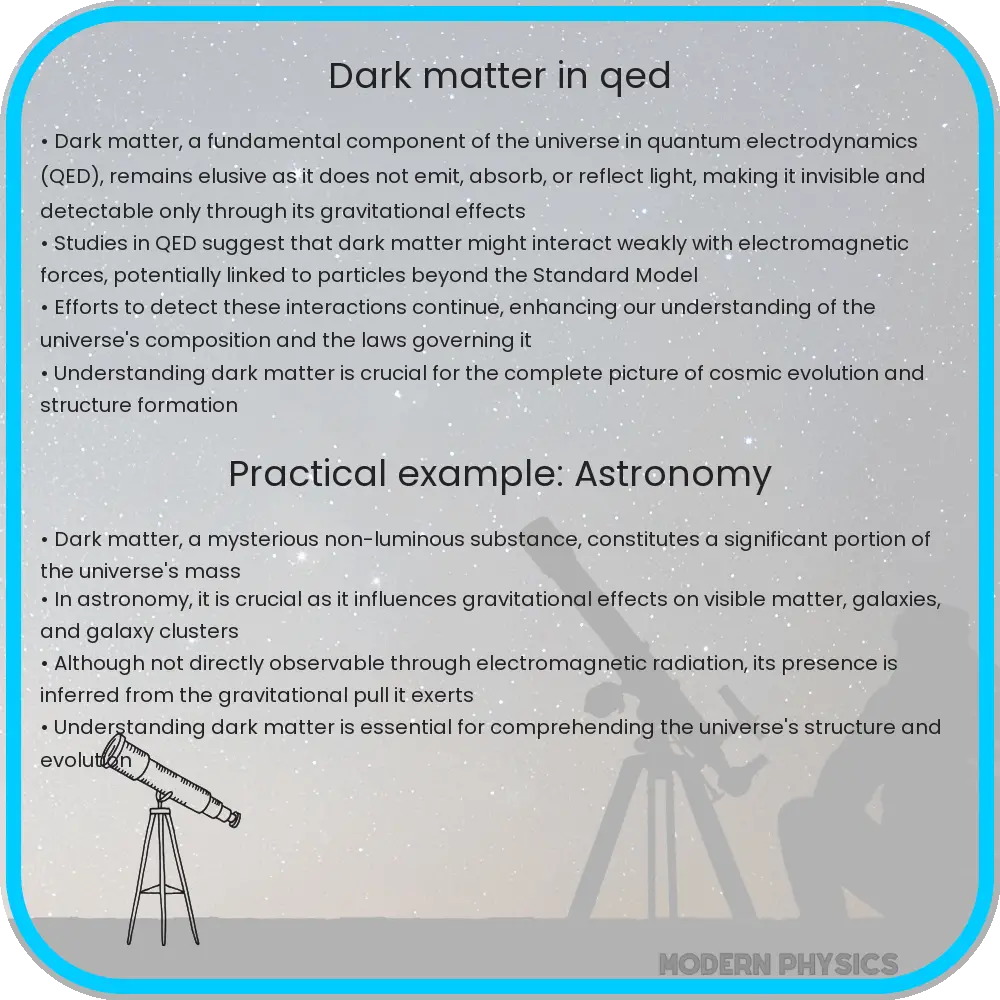
Dark matter’s existence is inferred from gravitational effects on visible matter, radiation, and the large-scale structure of the universe. Unlike ordinary matter, dark matter does not emit, absorb, or reflect light, making it invisible to the entire electromagnetic spectrum. Its detection and study rely on indirect methods, primarily through its gravitational influence on galaxies and galaxy clusters.
Dark Matter and QED: A Theoretical Challenge
QED, which describes how light and matter interact, is part of the larger framework of the Standard Model of particle physics. However, the Standard Model, despite its success in explaining a wide range of phenomena, does not account for dark matter. This gap highlights the need for new theories or extensions of existing ones. The pursuit of understanding dark matter within QED involves exploring beyond the Standard Model, including theories like supersymmetry and extra dimensions.
Dark Matter Particles: Candidates Beyond the Standard Model
Several hypothetical particles have been proposed as dark matter candidates. These include Weakly Interacting Massive Particles (WIMPs), axions, and sterile neutrinos. WIMPs, a popular candidate, are believed to interact through the weak nuclear force and gravity, but not electromagnetically, which aligns with dark matter’s elusive nature. Axions, initially proposed to solve the strong CP problem in quantum chromodynamics, have also emerged as potential dark matter particles due to their weak interaction with ordinary matter. Sterile neutrinos, another candidate, are heavier and interact even less with normal matter compared to the known neutrinos.
Experimental Searches for Dark Matter
Efforts to detect dark matter particles involve a range of techniques. Direct detection experiments, like those conducted in underground laboratories, aim to observe dark matter particles as they pass through detectors. Indirect detection involves searching for signatures of dark matter particle annihilations or decays in cosmic rays or gamma rays. Additionally, collider experiments, such as those at the Large Hadron Collider (LHC), attempt to create dark matter particles in high-energy collisions.
Linking Dark Matter to Cosmology
Dark matter plays a pivotal role in cosmology, influencing the structure and evolution of the universe. Its gravitational effects were crucial in the formation of galaxies and galaxy clusters, acting as a cosmic scaffold around which ordinary matter congregated. Without dark matter, the observable structure of the universe would be markedly different, and our understanding of cosmic evolution would be incomplete. Current cosmological models, like the Lambda-Cold Dark Matter (ΛCDM) model, integrate dark matter to explain the observed large-scale structure of the universe, cosmic microwave background radiation patterns, and other phenomena.
Challenges in Bridging QED and Dark Matter
Integrating dark matter into the framework of QED and the Standard Model remains a complex challenge. One significant hurdle is the lack of interaction between dark matter and electromagnetic forces, a cornerstone of QED. This non-interaction suggests that dark matter either doesn’t interact with light at all or does so very weakly through unknown forces or particles. This gap necessitates the exploration of new physics or extensions of the Standard Model that can accommodate these elusive interactions.
The Future of Dark Matter Research
Advancements in technology and observational methods are paving the way for more profound discoveries in dark matter research. Future space telescopes and ground-based observatories aim to provide more detailed observations of cosmic phenomena influenced by dark matter. In parallel, advancements in particle physics experiments and detectors might offer new insights or direct evidence of dark matter particles. The synergy of cosmological observations and particle physics experiments is crucial in unraveling the mysteries of dark matter.
Conclusion
In conclusion, the quest to understand dark matter within the realm of Quantum Electrodynamics and cosmology is one of the most captivating challenges in modern physics. Despite its elusive nature, dark matter’s gravitational footprint on the universe is undeniable. Bridging the gap between dark matter and the Standard Model, particularly within the domain of QED, is essential for a more complete understanding of the universe. This endeavor not only tests the limits of our current theories but also opens the door to potentially groundbreaking discoveries that could redefine our comprehension of the cosmos. The future of dark matter research, teeming with possibilities and challenges, promises to shed light on this cosmic mystery and pave the way for a new era in physics and cosmology.