
Explore the revolutionary impact of Quantum Electrodynamics (QED) in quantum computing, enhancing speed, precision, and complexity in computations.
Exploring the Frontiers of Quantum Computing with QED
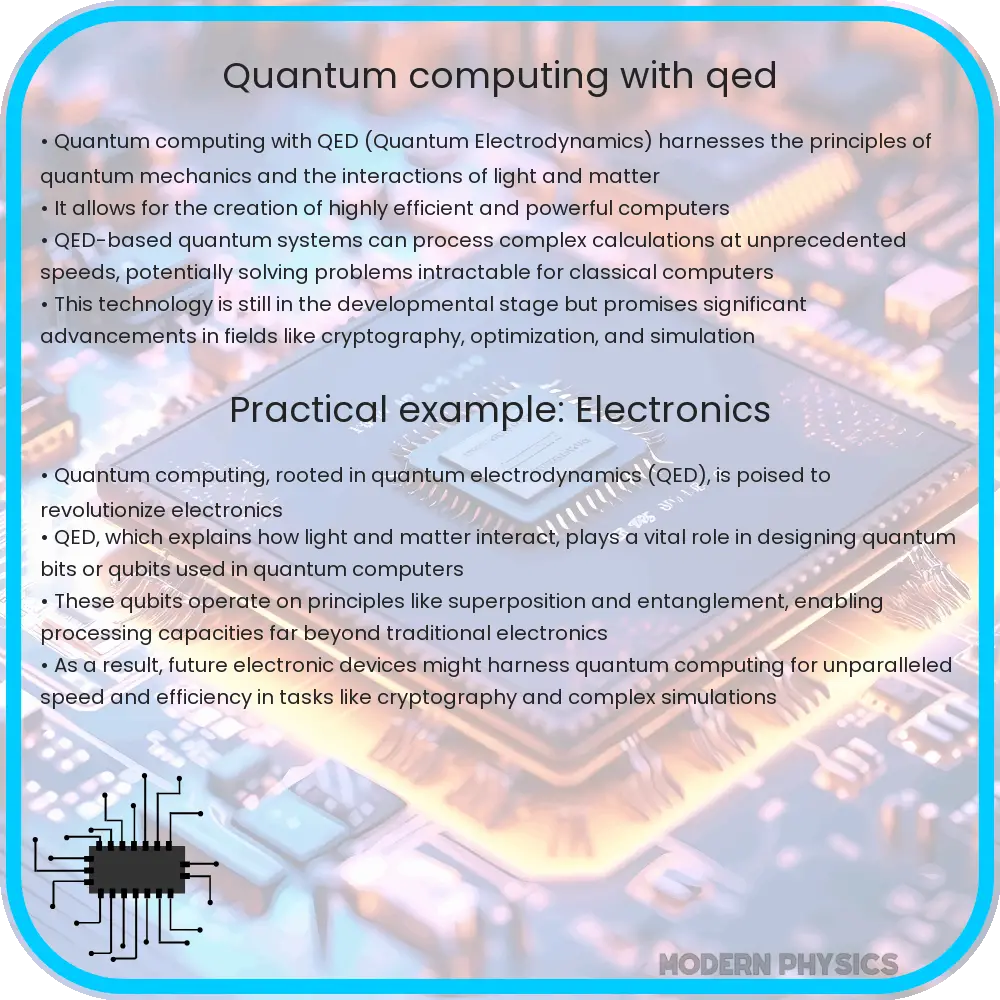
The realm of quantum computing represents a radical departure from classical computing, promising to revolutionize the way we process information. At the heart of this revolution lies Quantum Electrodynamics (QED), a theory that marries the principles of quantum mechanics with the theory of electromagnetism. The synergy of quantum computing and QED offers unprecedented opportunities in terms of speed, precision, and complexity of computations.
Speed: Leveraging Quantum Superposition and Entanglement
One of the most significant advantages of quantum computing, augmented by QED, is the dramatic increase in computational speed. Quantum bits (qubits), unlike classical bits, can exist in a superposition state, representing both 0 and 1 simultaneously. This property allows quantum computers to perform many calculations at once, exponentially speeding up data processing. Furthermore, the phenomenon of quantum entanglement, a cornerstone of QED, enables qubits that are entangled to be in a correlated state, regardless of the distance separating them. This leads to incredibly fast information processing capabilities that are virtually impossible for classical computers to match.
Precision: Harnessing the Subtleties of Quantum States
Quantum computing’s precision is another area where it excels, particularly when combined with QED. The sensitivity of quantum states to their surroundings allows for extremely precise measurements. This precision is crucial in fields like quantum chemistry, where the behavior of electrons and other subatomic particles can be modeled with exceptional accuracy. The ability to simulate complex quantum interactions at a subatomic level opens up new avenues in materials science and drug discovery.
Complexity: Managing Multifaceted Quantum Systems
The complexity that quantum computers can handle is vastly superior to that of traditional computers. QED plays a pivotal role in this, as it provides a framework for understanding and manipulating complex quantum systems. Quantum algorithms, utilizing the principles of QED, can solve problems that are currently intractable for classical computers, like factoring large numbers, optimizing large systems, and simulating intricate quantum phenomena. This complexity management is not just theoretical; it has practical implications in cryptography, logistics, and beyond.
In conclusion, the integration of quantum computing with Quantum Electrodynamics is not just a theoretical exercise; it represents a paradigm shift in computational capabilities. The increased speed, precision, and ability to handle complex systems that this union promises could unlock new possibilities across various scientific and technological fields.
Enhancing Computational Models with Quantum Algorithms
The implementation of quantum algorithms in QED-based quantum computing marks a significant step forward. Algorithms such as Shor’s for factoring and Grover’s for database searching demonstrate the practical applications of quantum mechanics in solving complex problems more efficiently than classical algorithms. These quantum algorithms, leveraging the peculiarities of quantum mechanics, provide solutions to problems in cryptography, optimization, and big data analysis, thus reshaping the landscape of computational sciences.
Challenges and Future Directions
Despite its immense potential, the path to fully operational QED-enhanced quantum computing is fraught with challenges. Key among these is the issue of quantum decoherence, where the quantum states lose their coherence properties due to interactions with the environment, thereby affecting computational accuracy. Additionally, creating and maintaining stable qubits for extended periods remains a significant technical hurdle. Researchers are exploring various solutions, including error correction algorithms and advancements in quantum hardware, to overcome these challenges.
Implications for Industry and Research
The impact of QED-enhanced quantum computing extends beyond theoretical research. Industries such as pharmaceuticals, materials science, and finance stand to benefit immensely. For instance, the ability to simulate complex molecular structures can expedite drug development, while in finance, optimized quantum algorithms can revolutionize risk assessment and portfolio management. The implications for cryptography are particularly profound, as quantum computing can potentially break many of the current cryptographic protocols, urging a shift towards quantum-resistant cryptography.
Conclusion: A Quantum Leap into the Future
In summary, the fusion of quantum computing with Quantum Electrodynamics heralds a new era in computational capability. Its promise of unparalleled speed, precision, and complexity management opens up a world of possibilities in various fields. While challenges such as quantum decoherence and qubit stability persist, ongoing research and development are paving the way for practical applications. As we stand at the cusp of this technological revolution, it is clear that QED-enhanced quantum computing is not just a scientific curiosity but a transformative force poised to redefine the boundaries of what is computationally possible.