
Explore the Cosmological Lithium Problem: a major discrepancy between observed and predicted lithium-7 in the universe, challenging astrophysics and cosmology.
Cosmological Lithium Problem: Unraveling the Mystery
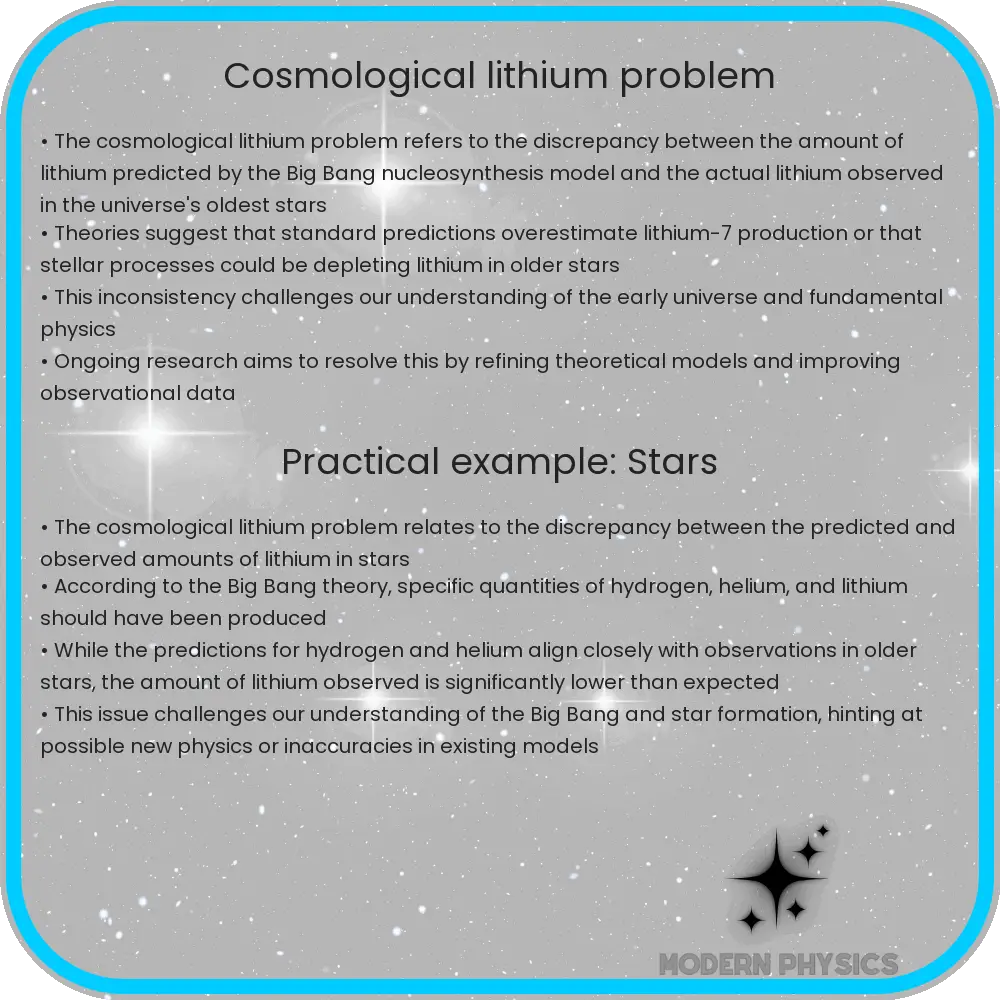
The Cosmological Lithium Problem refers to the significant discrepancy between the predicted and observed amounts of lithium-7 (7Li) in the universe. This enigma resides at the heart of astrophysics and cosmology, challenging our understanding of the early universe and the processes during Big Bang nucleosynthesis (BBN).
According to the Big Bang theory, the universe began approximately 13.8 billion years ago from an extremely hot and dense state. Within minutes, it expanded and cooled to a degree where the formation of the first light elements could occur. Theoretical models predict specific abundances of these primordial elements, such as hydrogen, helium, and lithium. While observations for hydrogen and helium largely align with predictions, lithium presents a puzzling exception.
Standard BBN models predict a certain amount of 7Li based on the density of baryonic matter (normal matter consisting of protons and neutrons). However, when astronomers measure lithium in the oldest stars, which serve as cosmic proxies for the early universe, they find only about one-third to one-half of the expected lithium. This discrepancy between the predicted and observed lithium abundances is what is referred to as the Cosmological Lithium Problem.
Theories and Potential Resolutions
Several theories have been proposed to resolve the Cosmological Lithium Problem, each suggesting different modifications to the standard model of cosmology or particle physics:
- Modified Nuclear Reactions: Some scientists propose alterations in the nuclear reactions that occurred during BBN, particularly those involving lithium. However, changing these reactions could affect the predictions for other elements, which currently match observations well.
- Decaying Dark Matter: Another theory suggests that non-standard properties of dark matter, such as the decay of massive dark matter particles into lighter particles, could have altered the primordial lithium production.
- New Physics: The problem might hint at new physics beyond the standard models, possibly involving new particles or interactions that were significant in the early universe.
Despite extensive research, none of these theories has yet provided a definitive solution, making the Cosmological Lithium Problem one of the most intriguing mysteries in modern cosmology.
Implications and Ongoing Research
The Cosmological Lithium Problem is not just a minor discrepancy; it is a critical issue that challenges our understanding of the early universe. Solving this problem could lead to significant advancements in cosmology, particle physics, and our overall comprehension of the universe’s history. Researchers continue to explore various avenues, including:
- Astronomical Observations: By observing more metal-poor stars in different environments, scientists hope to refine the measurements of lithium and better understand its cosmic distribution.
- Nuclear Physics Experiments: Improved experiments on the nuclear reactions that produce and destroy lithium can provide more accurate predictions for its primordial abundance.
- Cosmological Simulations: Advanced simulations of the early universe, incorporating various theories beyond the standard model, can help in understanding how different processes might have affected lithium’s abundance.
Moreover, interdisciplinary collaborations are increasingly becoming essential as the solution may lie at the intersection of cosmology, particle physics, and nuclear physics. The pursuit of the solution continues to drive technological advancements and deeper theoretical investigations.
Conclusion
The Cosmological Lithium Problem remains one of the most compelling mysteries in astrophysics and cosmology. It underscores the limitations of our current understanding and the complexity of the universe. While it poses a significant challenge, it also offers a unique opportunity to refine our theories and deepen our knowledge of the cosmos. The resolution of this problem could revolutionize our understanding of the Big Bang, the nature of matter, and the fundamental forces that shape the universe. As research progresses, we may be on the cusp of a new era in cosmology, where the mysteries of the early universe become windows into new physics and unexplored realms of the cosmos. Until then, the Cosmological Lithium Problem serves as a poignant reminder of the universe’s vastness and the enduring human quest to comprehend it.