
Learn about cloud cameras: devices designed for atmospheric monitoring, aiding in weather forecasting and climate research.
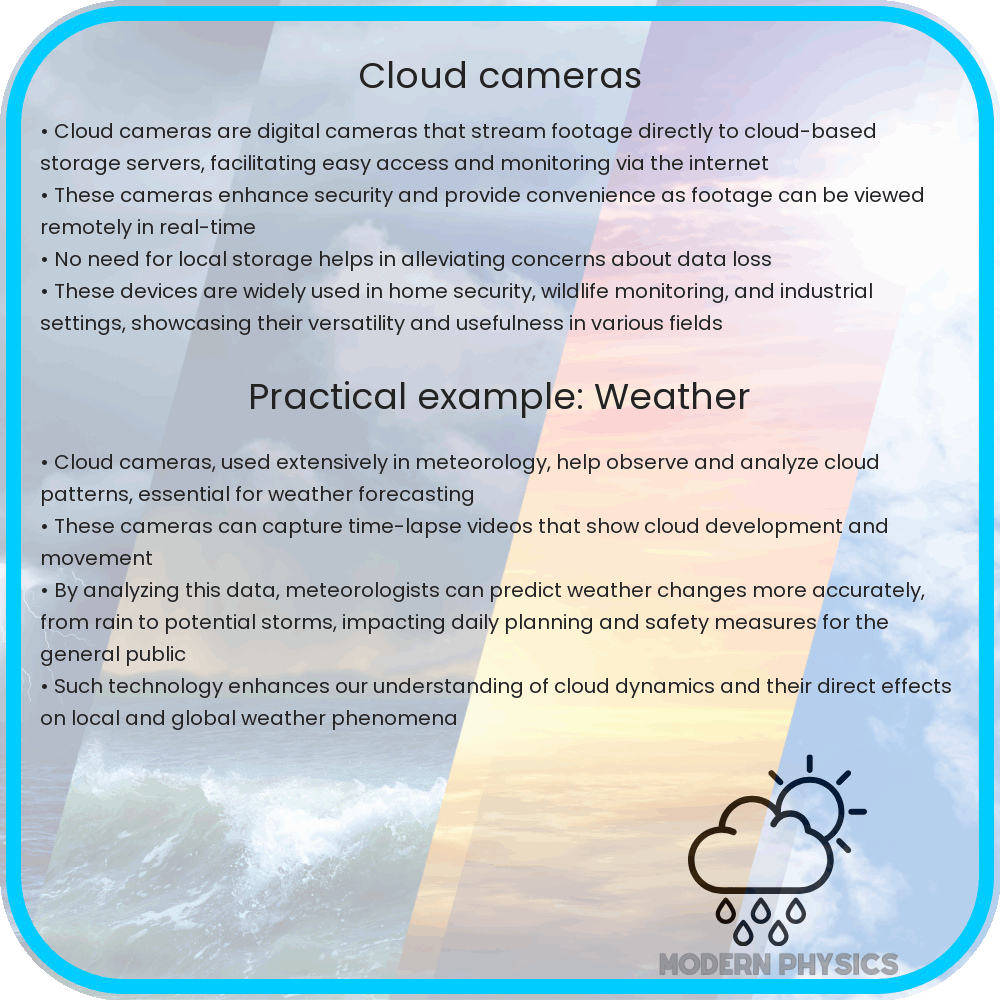
Introduction to Cloud Cameras and Their Role in Atmospheric Monitoring
Cloud cameras are specialized devices equipped with imaging technology specifically designed for capturing images and videos of the sky, primarily focusing on clouds. These devices are a crucial part of modern atmospheric monitoring, offering valuable data for weather observation, climate research, and environmental science. Beyond their applications in meteorology, cloud cameras help in scientific research by providing insights into cloud formations, types, and dynamics, which are critical for understanding weather patterns and predicting climate changes.
How Cloud Cameras Work
Cloud cameras operate on the principle of digital imagery. These cameras are usually mounted at strategic locations such as weather stations, research facilities, or on satellites. They are designed to withstand various environmental conditions and can capture high-definition images of the atmosphere throughout different times of the day. Using filters and sensitive imaging sensors, cloud cameras can capture a wide range of cloud types at various altitudes, providing continuous monitoring of the sky.
Cloud images captured are then processed using sophisticated algorithms to analyze cloud properties such as type, coverage, altitude, and reflectivity. This data is integral in improving the accuracy of weather forecasting models and enhancing our understanding of cloud physics and atmospheric conditions.
Applications of Cloud Cameras in Weather Forecasting and Research
Weather forecasting is perhaps the most direct application of data collected from cloud cameras. Meteorologists use cloud imagery to identify weather patterns, track storm developments, and predict precipitation events. By analyzing how clouds change over time, forecasters can provide more accurate and timely weather predictions, crucial for both everyday weather updates and severe weather alerts.
In scientific research, cloud cameras contribute to the study of cloud dynamics and classifications. Researchers analyze captured images to observe the lifecycle of clouds, investigate how they affect solar radiation and study their impact on both local and global climates. This information is crucial for developing models to predict future climatic conditions and understand the Earth’s energy balance.
Technological Advances in Cloud Camera Systems
The development of cloud camera technology has paralleled advances in digital imaging and data processing. Modern cloud cameras not only record visual spectra but also gather data in the infrared and ultraviolet ranges, providing a more comprehensive analysis of cloud properties. Enhanced imaging technologies allow for the detailed observation of cloud texture and structure, important for classifying cloud types automatically.
- Time-lapse photography: By capturing sequences of images over time, cloud cameras can create time-lapse videos that illustrate how cloud fields evolve, move, and dissipate.
- Machine learning algorithms: These are increasingly used to automate the analysis of vast amounts of imagery data, identifying patterns and predicting changes faster than human analysis alone could achieve.
- Integration with other meteorological instruments: Cloud cameras often work in conjunction with other devices such as weather radars and satellites, providing a multi-dimensional view of the atmosphere that enhances overall weather monitoring and forecasting accuracy.
Challenges and Future Trends in Cloud Camera Technology
Despite the advancements in cloud camera technology, there are several challenges that remain. These include issues related to data storage, as high-definition images accumulate rapidly, requiring significant storage capacity. Additionally, the accuracy of data analysis can be affected by variable lighting conditions, camera angles, and lens distortions. Overcoming these challenges is crucial for improving the reliability and utility of cloud cameras.
Looking towards the future, we can anticipate several exciting trends in cloud camera technology. Improvements in artificial intelligence will likely lead to smarter algorithms capable of more precise and faster analysis. Moreover, the integration of cloud cameras with emerging technologies like 5G and IoT (Internet of Things) could facilitate real-time data processing and enhanced connectivity between devices. Such advancements will undoubtedly enrich the field of atmospheric monitoring, making it more dynamic and responsive.
Conclusion
Cloud cameras serve as indispensable tools in the realm of atmospheric monitoring, sharply extending our capabilities to observe and analyze the skies above. From aiding daily weather forecasts to enriching scientific research concerning climate patterns, these devices play a pivotal role in our ongoing quest to understand and predict atmospheric changes. As technology continues to evolve, the scope and accuracy of cloud cameras will only enhance, promising to unlock deeper insights into meteorological phenomena and more effectively safeguard against environmental changes. Thus, embracing and advancing cloud camera technology remains a priority for researchers and engineers alike, ensuring a better-informed society capable of thriving under the ever-changing skies.