
Understand the critical role of physics in climbing gear, focusing on how equipment like ropes, carabiners, and harnesses are designed for safety and efficiency.
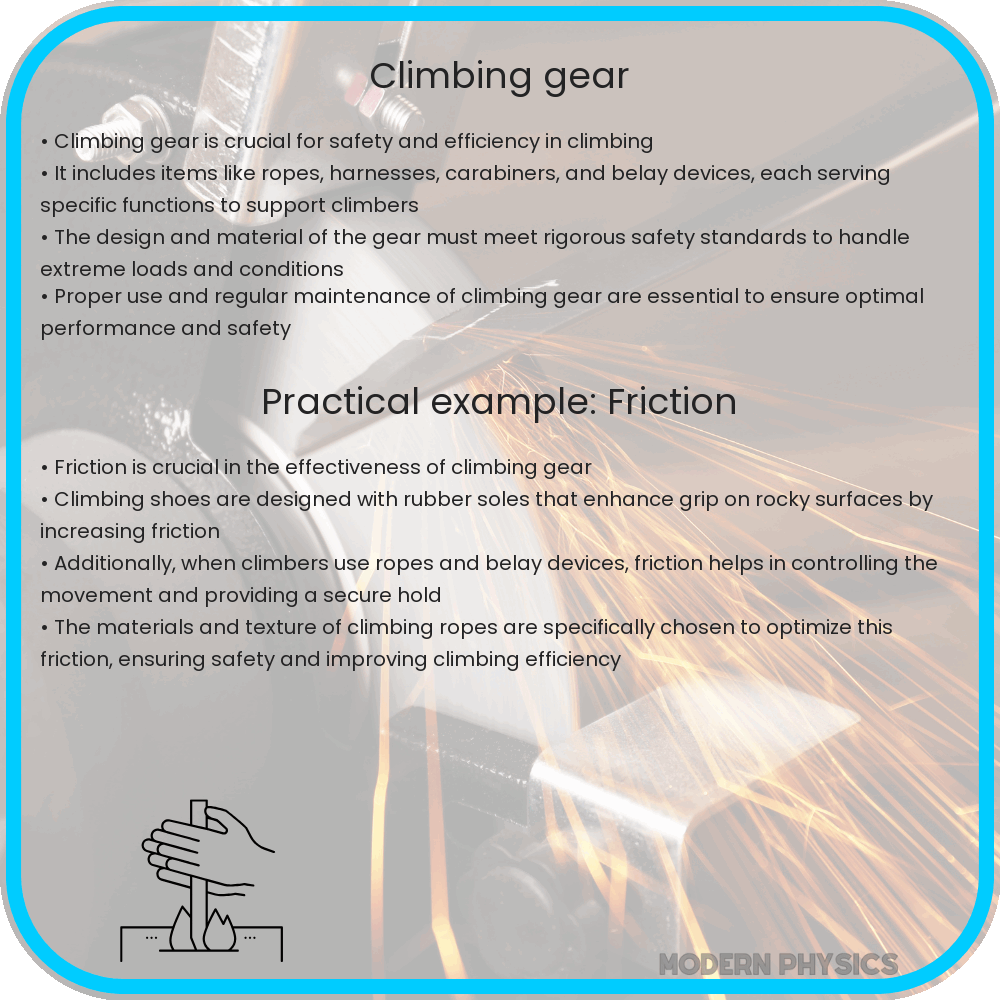
The Science Behind Climbing Gear: Dynamics, Safety, and Efficiency
Climbing is not only a test of endurance and strength but also a field where physics plays a crucial role. The equipment used in climbing, from ropes to carabiners, pulleys to harnesses, operates on fundamental physical principles. Understanding these can enhance safety and efficiency in climbing.
Dynamics of Climbing Ropes
The most vital piece of equipment for a climber is the rope. The primary function of a climbing rope is to absorb the energy of a fall, thereby reducing the force transmitted to the climber and the anchor. This energy absorption is mainly facilitated through the rope’s elasticity, often referred to as its dynamic quality.
Climbing ropes can stretch under load, which helps in cushioning the fall. This stretchiness is quantified by the rope’s “impact force” rating—a lower rating indicates a rope that can stretch more, absorbing more energy and thereby exerting less force on the climber and anchors. The impact force, \( F \), of a rope can be expressed by the equation:
\[ F = \frac{m \times g \times h}{x} \]
where:
- m is the mass of the climber
- g is the acceleration due to gravity (~9.81 m/s2)
- h is the fall height
- x is the elongation of the rope due to the fall
This dynamic stretching capability is crucial for dissipating the energy generated during a fall, but it also needs to be controlled. Excessive stretch can mean a longer fall, while too little can mean a harsh, potentially damaging stop.
Importance of Carabiners
Carabiners are metal loops with spring-loaded gates, used to quickly and reversibly connect components in the safety-critical systems of climbing gear. Not only must these components be strong enough to handle physical stresses, but they also need to be designed for ease of use and minimal error potential.
The choice of a carabiner, including its shape, size, and the type of gate, can significantly affect the performance and safety. For instance, different shapes distribute the force differently through the carabiner. An oval shape distributes force more evenly and is often used for general purposes, while a ‘D’ shape is stronger by concentrating more force on the non-gate side, making it suitable for critical connections.
Engineering in Harnesses and Belays
The harness is another critical component, designed to be both durable and comfortable. Harnesses distribute the fall force across a wider area of the body to minimize injury. Engineering the right harness involves understanding load distribution and material strength to ensure that the climber remains safe and unrestricted by their movement.
Belay devices are used to control the rope during the climbing. These devices help in managing the rope during ascents and descents and provide the necessary friction to stop the rope in case of a fall. The physics of friction is crucial here; belay devices can offer varying resistance levels depending on the climber’s weight, the rope’s condition, and the type of climbing.
Each piece of climbing gear incorporates a fascinating interplay of physics and engineering principles. The efficiency and safety of climbing depends largely on how well these tools perform under extreme conditions. Thus, understanding the dynamics of climbing gear not only boosts a climber’s confidence but also enhances their overall climbing performance.
Pulleys: Simplifying Complex Climbs
Pulleys play a pivotal role in reducing the burden of heavy loads during climbing, particularly in rescue scenarios or when hauling gear. By using a system of pulleys, climbers can distribute weight and exert less force while lifting or relocating equipment. This mechanical advantage is a principle of physics where forces are multiplied by routing rope through one or more pulleys, thereby making tasks easier and safer.
Material Science in Climbing Equipment
The choice of materials in climbing gear is critical for ensuring maximum performance and safety. Modern climbing ropes are typically made from nylon, which offers great strength, durability, and elasticity. Carabiners are generally made from aluminum or steel, balancing strength with lightweight properties. Harnesses combine robust webbing and padding materials to provide support while maintaining comfort during prolonged use.
Future Innovations in Climbing Technology
As technology advances, so does climbing equipment. Innovative materials and smarter designs continually emerge, aiming to improve safety and enhance climbers’ experience. For instance, there is ongoing research into creating more wear-resistant and lighter materials for ropes and harnesses. Additionally, the development of “smart” carabiners equipped with sensors that alert climbers to critical wear or unsafe conditions is on the horizon.
These advancements not only promise to revolutionize the climbing industry but also contribute to safer and more efficient climbing practices, merging cutting-edge engineering with traditional climbing know-how.
Conclusion
In conclusion, climbing is as much about physical prowess as it is about understanding and applying the principles of physics and engineering. Each piece of gear, be it the dynamic rope or the robust carabiner, is a testament to the intricate balance between strength, functionality, and safety designed to withstand and adapt to the unyielding laws of physics. Through intelligent design and technological innovation, climbing gear continues to evolve, offering climbers both reassurance and a challenge to push the boundaries of what is possible. Climbers, equipped with knowledge and the right gear, are better prepared to tackle the heights safely and efficiently, demonstrating the profound impact of physics and engineering in conquering the vertical world.