
Explore the intriguing world of Cherenkov Radiation: its detection, applications in particle physics, nuclear reactors, and medical physics, and its role in advancing HEP.
Introduction to Cherenkov Radiation
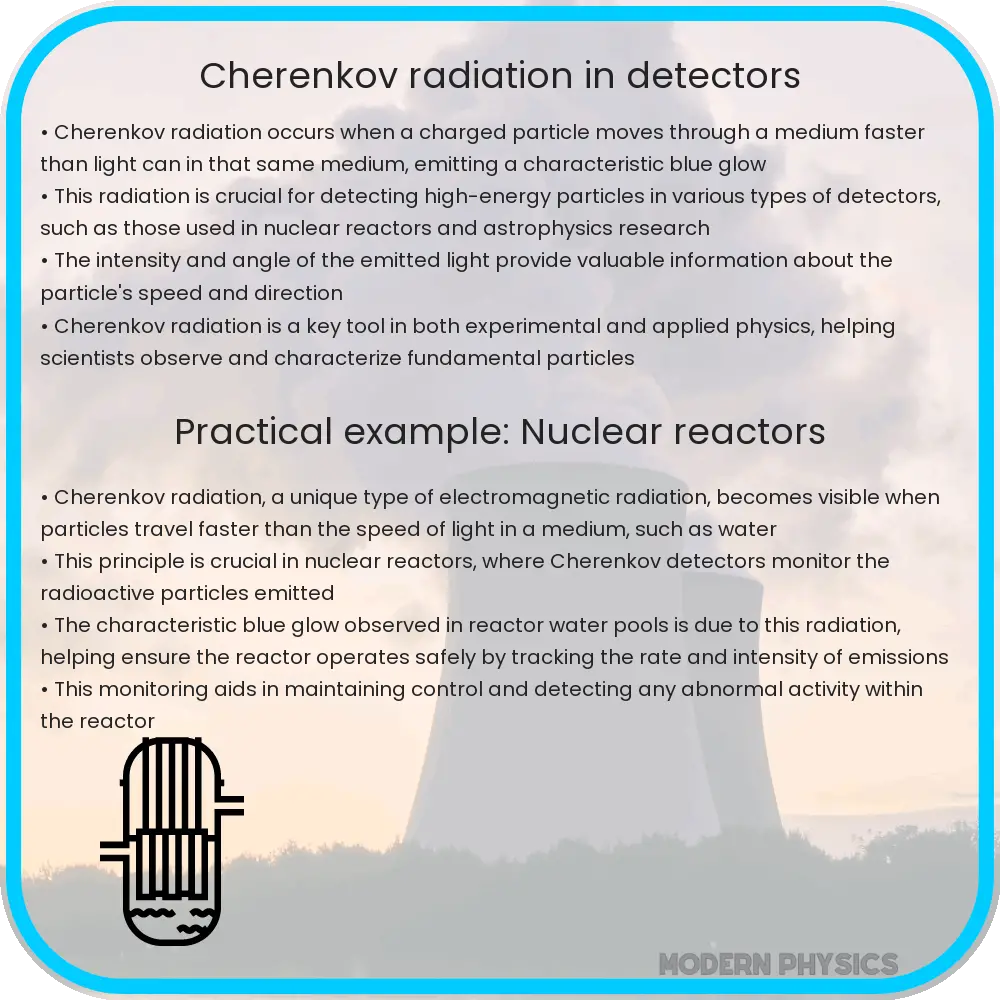
Cherenkov Radiation is a unique phenomenon in the field of particle physics, observed when a charged particle, such as an electron, travels through a dielectric medium (like water or glass) at a speed greater than the speed of light in that medium. Named after Soviet physicist Pavel Cherenkov, who first characterized it in 1934, this type of radiation is distinguished by its eerie blue glow, a common sight in nuclear reactors and high-energy physics experiments.
Detection of Cherenkov Radiation
The detection of Cherenkov Radiation is crucial for various applications in physics, particularly in the study of high-energy particles and processes. Detectors, often called Cherenkov counters, are designed to measure the angle and intensity of this radiation, which can be used to determine the velocity and identity of the particles producing it. Modern detectors use photomultiplier tubes or photodiodes to capture the faint light emitted by these fast-moving particles.
Uses of Cherenkov Radiation
- Particle Physics: Cherenkov detectors are instrumental in particle accelerators and cosmic ray experiments, helping physicists to identify and study high-energy particles.
- Nuclear Reactors: The characteristic blue glow of Cherenkov Radiation is used to monitor the activity and safety of nuclear reactors.
- Medical Physics: In the medical field, Cherenkov Radiation is applied in certain types of radiation therapy to visualize the beams and ensure accurate delivery to tumors.
- Astronomy: Astrophysicists use Cherenkov telescopes to detect cosmic rays and study astronomical phenomena beyond the reach of traditional telescopes.
Advances in High Energy Physics (HEP)
High Energy Physics (HEP) has seen significant advancements thanks to Cherenkov Radiation. Innovations include the development of large-scale Cherenkov detectors, like those used in neutrino observatories and dark matter searches. These tools have expanded our understanding of the universe, contributing to breakthroughs in particle physics and cosmology. Additionally, advancements in materials and detection technology continue to enhance the sensitivity and efficiency of Cherenkov radiation detectors, opening new avenues for research and application.
Technological Developments in Cherenkov Radiation Detection
Recent technological advancements have greatly enhanced the detection and application of Cherenkov Radiation. Improved materials for detectors, such as faster scintillators and more efficient photodetectors, have increased the accuracy and efficiency of measurements. Moreover, digital signal processing and machine learning algorithms are being integrated to better analyze the data collected from Cherenkov radiation, enabling more precise particle identification and event reconstruction.
Future Prospects and Challenges
The future of Cherenkov Radiation research holds promising prospects, particularly in exploring the unknown realms of particle physics and astrophysics. As technology advances, scientists aim to develop more compact, efficient, and sensitive detectors, which could revolutionize the way we detect and study cosmic phenomena. However, challenges remain, including the need for better resolution, higher detection efficiency, and the ability to operate in diverse and extreme environments.
Additionally, interdisciplinary applications of Cherenkov Radiation, such as in biophysics and environmental science, are beginning to emerge. These new applications could lead to innovative diagnostic tools and methods for investigating complex biological and ecological systems.
Conclusion
Cherenkov Radiation, a fascinating phenomenon with its distinct blue glow, continues to be a cornerstone in the field of high-energy physics and beyond. Its detection and applications have significantly contributed to our understanding of the microscopic and cosmic worlds. With ongoing advancements in technology and methodology, the exploration of Cherenkov Radiation promises to unlock further mysteries of the universe, enhance nuclear safety, and even open new frontiers in medical and environmental sciences. The future of Cherenkov Radiation research and its applications is bright, with potential impacts reaching far beyond the confines of traditional physics.