
Cherenkov Radiation is an optical phenomenon where charged particles emit a blue glow when moving faster than light in a medium.
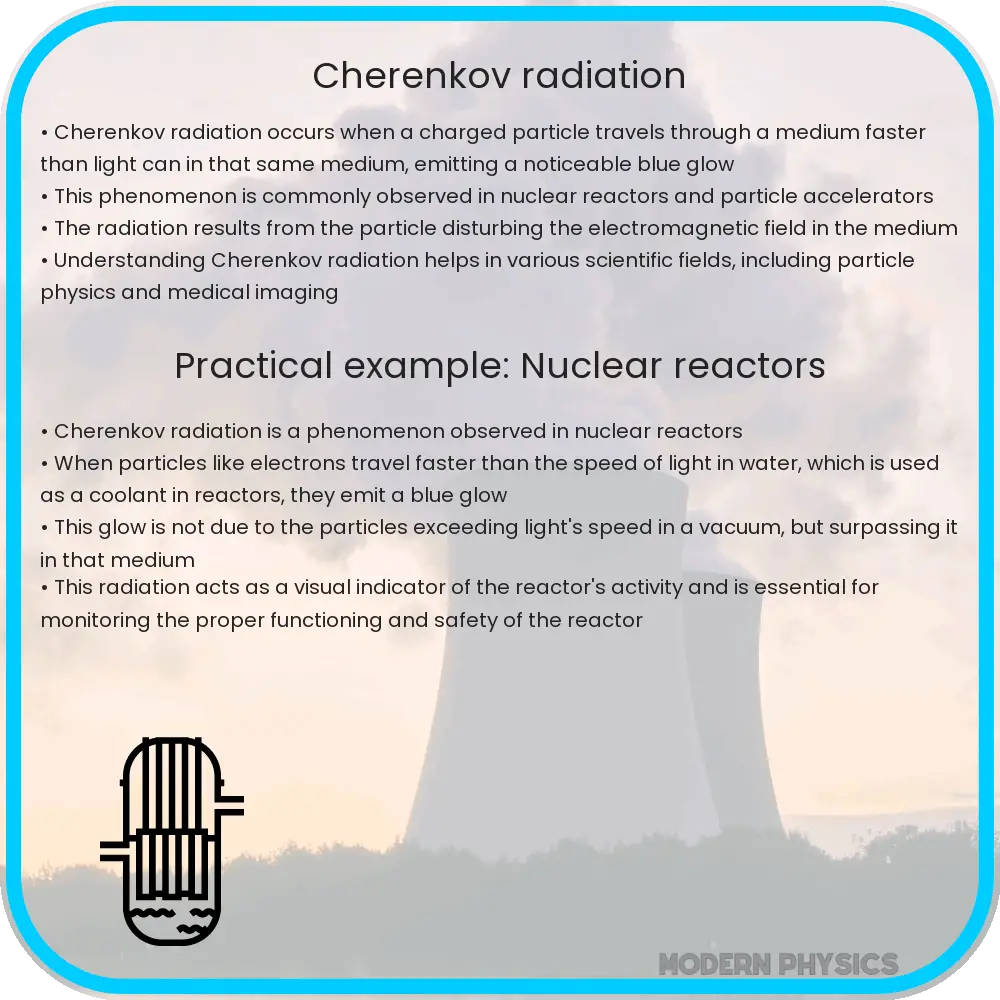
Understanding Cherenkov Radiation
Cherenkov Radiation is a mesmerizing phenomenon typically evidenced by a characteristic blue glow. This type of radiation occurs when charged particles such as electrons travel through a dielectric medium (like water or glass) at a speed greater than the speed of light in that medium. While nothing can surpass the speed of light in a vacuum (denoted as c, approximately 299,792 kilometers per second), the speed of light in other media can be substantially lower, thereby allowing faster-than-light travel within those media.
Key Concepts of Cherenkov Radiation
The fundamental aspect of Cherenkov radiation is the relationship between the velocity of the charged particles and the speed of light in a material. The phenomenon is named after Pavel Alekseyevich Cherenkov, who first observed the radiation in 1934 and later shared the Nobel Prize in Physics in 1958 with Igor Tamm and Ilya Frank for its theoretical explanation.
- Threshold Speed: For Cherenkov radiation to occur, the speed of the charged particle must exceed the phase velocity of light in the given medium. This critical speed is given by:
$$ v > \frac{c}{n} $$
where v is the particle’s speed, c is the speed of light in vacuum, and n is the refractive index of the medium.
- Blue Glow: The visible blue glow, a hallmark of Cherenkov radiation, arises from the spectrum of light emitted. As the particles move through the medium, they disrupt the electromagnetic field, causing photons to be radiated at various wavelengths. The shorter (blue) wavelengths, being more pronounced due to scattering effects, dominate the visible spectrum.
- Angle of Emission: The emitted light forms a characteristic cone shape around the direction of the particle’s path, with the vertex angle (θ) dependent on the particle’s speed and the medium’s properties. This angle can be calculated using the formula:
$$ \cos(\theta) = \frac{c}{nv} $$
This equation implies that the cone angle becomes narrower as the particle speed increases relative to the light speed in the medium.
- Applications: Cherenkov radiation is not merely a subject of academic interest but has practical applications in various fields such as nuclear reactors monitoring, medical imaging, particle physics experiments, and astrophysics. Its ability to detect high-speed particles makes it invaluable in ensuring the safe operation of nuclear reactors, and in the identification and study of cosmic rays.
Visualizing Cherenkov Radiation
Cherenkov radiation’s captivating blue glow can easily be visualized in controlled environments, such as nuclear reactors or research facilities equipped with particle accelerators. Typically, in nuclear reactors, Cherenkov radiation is observable when high-speed electrons emitted by radioactive materials travel through the cooling water that surrounds the reactor core. This provides not just a functional tool for monitoring reactor conditions but also a stunning visual phenomenon illustrating the principles of physics in action.
Conclusion
Cherenkov radiation offers a thrilling glimpse into the dynamics of charged particles and the properties of light in various media. By exceeding the light speed in a medium, these particles allow us to literally see their otherwise invisible effects. This phenomenon encapsulates the beauty and complexity of physical laws, proving instrumental in numerous technological advancements and scientific explorations. For anyone fascinated by the interplay of light, speed, and matter, Cherenkov radiation serves as a spectacular intersection of theoretical physics and practical application, illuminating our understanding of the universe.