
Learn about chemical lasers, their operation, unique characteristics, and diverse applications in military, industrial, and medical fields.
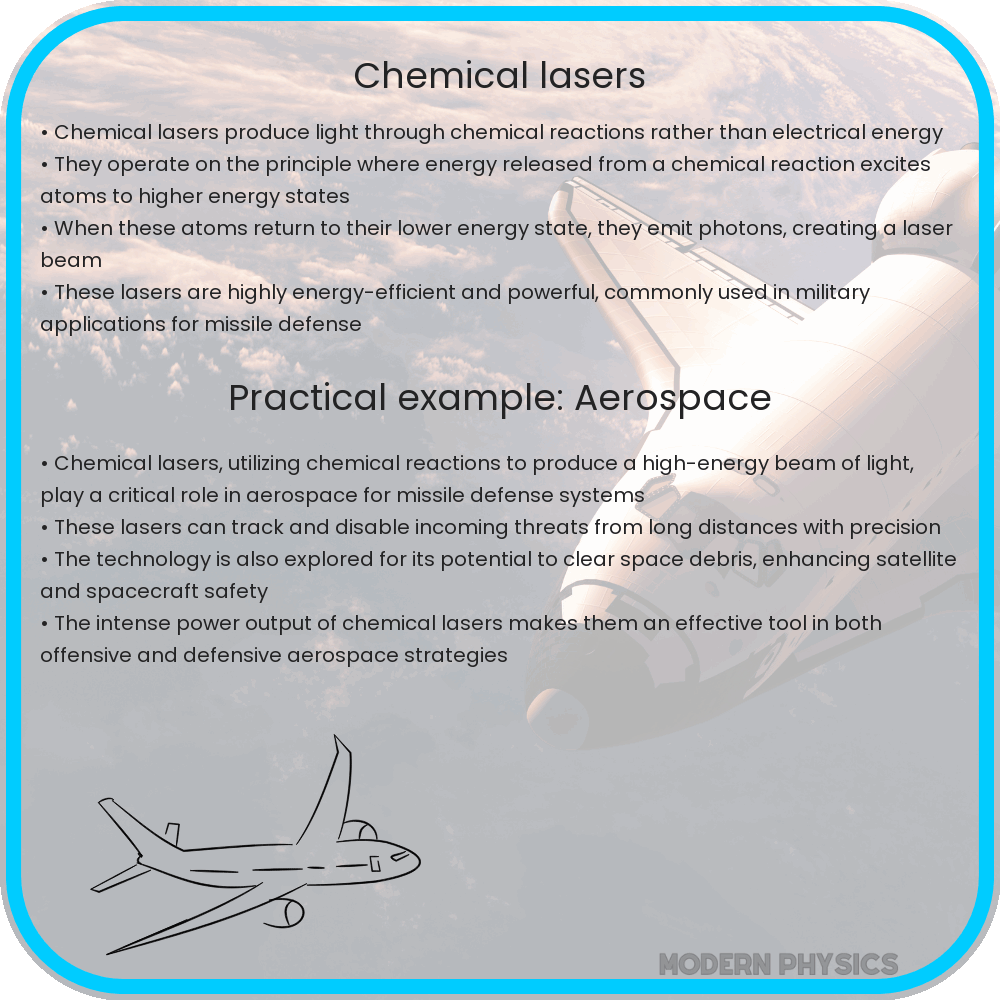
Introduction to Chemical Lasers
Chemical lasers stand as a fascinating integration of chemical energy and laser technology, producing coherent light through chemical reactions. Unlike traditional lasers, which rely on electrical power or other external energy sources to excite electrons, chemical lasers leverage the energy released from exothermic chemical reactions. This makes them extraordinarily powerful and efficient in specific applications, primarily in military and industrial settings.
How Chemical Lasers Work
The functionality of chemical lasers is rooted in the principles of molecular energy transitions. Typically, a reaction between specific chemicals releases energy in the form of heat and light. This energy, when properly channeled, excites molecules in a medium (gas or liquid), boosting electrons into higher energy states. As these electrons return to their ground state, they emit photons, leading to stimulated emission – the core process behind all lasers.
One of the most common types of chemical lasers is the Hydrogen Fluoride (HF) laser. In HF lasers, a reaction between hydrogen and fluorine gases produces excited HF molecules. These molecules, when returning to their lower energy states, emit photons that contribute to the laser beam. The general reaction can be expressed as:
- H2 (g) + F2 (g) → 2HF* (excited state)
- HF* → HF + photon
Characteristics of Chemical Lasers
Chemical lasers are distinguished by several unique characteristics:
- Precision: The emitted laser beam can be finely controlled, which allows for extremely precise targeting. This precision is invaluable in applications like missile defense systems and surgical procedures.
- Power: Chemical lasers can achieve significantly higher power levels compared to other laser types. This is primarily due to the high energy density of the chemical reactions involved.
- Wave Dynamics: The wavelength of the laser light in chemical lasers depends on the specific molecules involved in the reactions. HF lasers, for instance, typically operate in the infrared part of the spectrum, making them ideal for atmospheric transmission.
Applications of Chemical Lasers
Due to their power and precision, chemical lasers have found several critical applications:
- Military: They are used in advanced defense systems for missile defense. Their ability to deliver high energy at great distances makes them suitable for intercepting incoming threats.
- Industrial: In the industrial sector, their precise and powerful beam is used for cutting, welding, and material processing.
- Medical: In medicine, the precise nature of the beam allows for surgeries that require extreme precision, minimizing damage to surrounding tissues.
The expansive reach of chemical lasers demonstrates how complex chemical reactions can be harnessed to produce powerful and precise outcomes in a wide range of fields. The continuous evolution of this technology promises to usher in newer applications and advancements in the future.
Safety and Environmental Considerations
Despite the powerful applications of chemical lasers, they are not without their challenges, especially concerning safety and environmental impact. The chemicals used, such as hydrogen and fluorine, are highly reactive and can be hazardous if not handled correctly. This necessitates rigorous safety protocols during operation and maintenance. Furthermore, the byproducts of the reactions can be harmful to the environment if not properly managed. Developing eco-friendly alternatives and improving containment measures are ongoing areas of research in the field of chemical lasers.
Technological Advancements and Future Prospects
The field of chemical lasers continues to evolve with technological advancements boosting their efficiency and applications. Innovations in chemical formulations and reaction mechanisms are continually being explored to enhance the performance and safety of these lasers. Research into solid-state chemical lasers, for example, aims to reduce the hazards associated with gaseous reactions while maintaining high energy output and precision.
Moreover, the integration of artificial intelligence and machine learning for controlling laser operations could revolutionize how chemical lasers are used, making them more adaptable and efficient in real-time applications. These advancements hold the promise of expanding the use of chemical lasers well beyond current capabilities, potentially making them commonplace in civilian technologies alongside their established military and industrial uses.
Conclusion
Chemical lasers represent a unique intersection of chemistry and photonics, offering high power and precision through the manipulation of chemical reactions. While primarily used in military and industrial contexts today, ongoing research and technological advancements could broaden their applications, including more pervasive use in medical and potentially consumer technologies. Despite their benefits, the handling of hazardous materials and environmental impacts remains a major concern, emphasizing the need for stringent safety practices and sustainable development within this field. As we continue to push the boundaries of what chemical lasers can achieve, their evolving designs promise not only to improve current systems but also to innovate and inspire future applications that could transform our approach to energy and light-based technologies.