
Explore the world of catadioptric systems: their mechanics, advantages in clarity and precision, versatile applications, and future innovations.
Understanding Catadioptric Systems: Enhancing Optical Performance
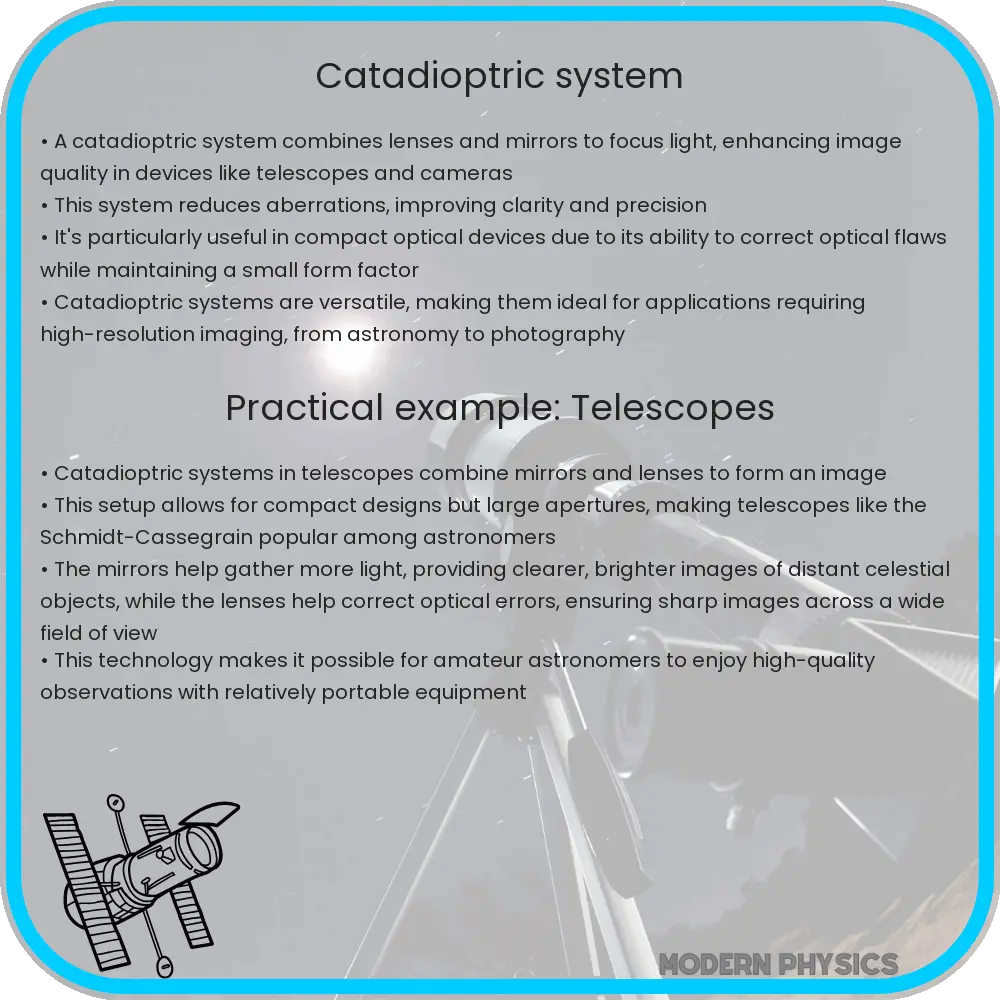
A catadioptric system, a cornerstone in the field of optical engineering, combines the principles of reflection and refraction to create high-quality imaging devices. These systems are found in various applications, from advanced telescopes to surveillance cameras, offering unparalleled clarity, precision, and versatility. This article delves into the mechanics behind catadioptric systems and their diverse applications.
Mechanics of Catadioptric Systems
The essence of a catadioptric system lies in its unique integration of mirrors (catoptrics) and lenses (dioptrics). By combining these elements, the system corrects optical aberrations like chromatic aberration and spherical aberration more effectively than systems using only lenses or mirrors. This correction is crucial for producing high-resolution and clear images.
Advantages in Clarity and Precision
One of the primary advantages of catadioptric systems is their ability to provide exceptionally clear images. The hybrid nature allows for a wider aperture without the bulkiness typically associated with large lens systems. This wider aperture captures more light, enhancing the image’s brightness and clarity, especially in low-light conditions. Additionally, these systems achieve a greater depth of field and sharper focus, making them ideal for precision tasks in photography, microscopy, and astronomy.
Versatility Across Various Fields
Catadioptric systems are not limited to a single application; their versatility extends across numerous fields. In astronomy, they are pivotal in advanced telescopes, allowing astronomers to observe distant celestial objects with remarkable clarity. Surveillance and security industries utilize these systems in cameras for their ability to provide wide-angle views while maintaining image quality. Furthermore, in the realm of photography, catadioptric lenses enable capturing expansive landscapes and detailed close-ups with equal proficiency.
The integration of catadioptric systems in microscopes has revolutionized biological and chemical research. By achieving higher magnification with minimal chromatic aberration, these systems enable scientists to observe minute details in cells and molecules, enhancing our understanding of complex biological processes.
Continued advancements in catadioptric system technology promise to expand their applications even further, potentially revolutionizing fields like virtual reality, where image clarity and depth perception are paramount. The combination of reflective and refractive elements in these systems not only enhances existing optical capabilities but also paves the way for new technological frontiers.
Technological Innovations in Catadioptric Systems
The evolution of catadioptric systems is marked by continuous technological innovations. Recent advancements include the development of ultra-compact catadioptric designs, which are particularly beneficial in space-constrained applications like smartphone cameras and drone imaging systems. These innovations ensure that high-quality imaging is not just reserved for large-scale devices but is also accessible in everyday technology.
Challenges and Future Directions
Despite their many advantages, catadioptric systems face certain challenges. The complexity of combining lenses and mirrors requires precise engineering, making these systems potentially more expensive and delicate than simpler optical devices. However, ongoing research focuses on overcoming these limitations, aiming to make catadioptric systems more robust and cost-effective.
The future of catadioptric systems looks promising, with research delving into adaptive optics and advanced materials. These developments could lead to more powerful telescopes capable of revealing unprecedented details of the universe, and highly efficient surveillance systems offering greater security with minimal intrusion.
Environmental and Ethical Considerations
As with any technology, catadioptric systems present environmental and ethical considerations. The production of high-quality optical components can have environmental impacts, and the use of these systems in surveillance raises privacy concerns. It is crucial for manufacturers and users alike to address these issues, ensuring responsible production and use of catadioptric systems.
Conclusion
In conclusion, catadioptric systems represent a remarkable fusion of optical technologies, offering clarity, precision, and versatility unparalleled in the field of optics. Their wide range of applications, from astronomy to everyday photography, highlights their significance in both scientific and commercial realms. Despite certain challenges, the ongoing advancements in this field promise to further enhance their capabilities and accessibility. As we continue to explore the potential of these systems, it is vital to consider their environmental and ethical implications, ensuring that their benefits are enjoyed responsibly and sustainably. With their continued evolution, catadioptric systems stand as a testament to human ingenuity and our never-ending quest to understand and capture the world around us in ever-greater detail.