
Explore the versatility and efficiency of catadioptric systems in optics, highlighting their precision and adaptability for advanced applications.
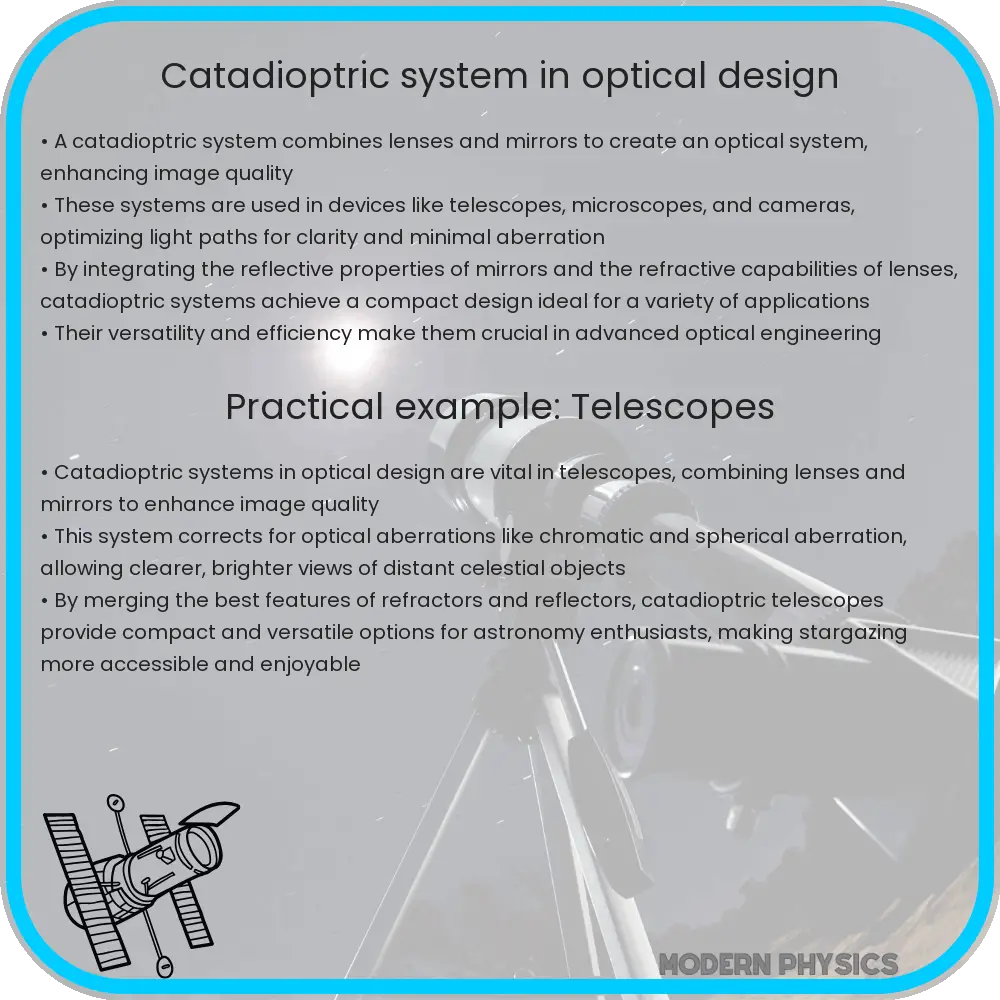
Catadioptric Systems: Enhancing Optical Precision, Adaptability, and Efficiency
At the heart of modern optical engineering, catadioptric systems represent a pinnacle of precision, adaptability, and efficiency. These systems, which ingeniously combine refractive (lenses) and reflective (mirrors) elements, are pivotal in applications ranging from advanced telescopes to surveillance cameras, and from automotive headlamps to sophisticated imaging devices used in biomedical research.
The inherent versatility of catadioptric systems lies in their ability to correct optical aberrations more effectively than purely dioptric (lens-only) or catoptric (mirror-only) systems. By harnessing the complementary strengths of lenses and mirrors, these systems achieve sharper image quality, wider fields of view, and more compact designs. This dual-element approach allows for the manipulation of light paths in ways that single-element systems cannot match, making catadioptric systems ideal for tasks requiring high levels of optical precision.
One of the primary advantages of catadioptric systems is their adaptability. They can be tailored to a vast array of applications, thanks to the flexibility in design choices. Whether the goal is to minimize distortion in wide-angle photography or to capture high-resolution images of distant celestial bodies, catadioptric systems can be customized to meet specific requirements. This adaptability extends to their ability to operate under diverse lighting conditions, from the dim light of outer space to the bright and variable conditions of terrestrial environments.
Efficiency in catadioptric systems is not just about the superior optical performance; it also encompasses their compact and lightweight design. This efficiency makes them particularly attractive for applications where space is at a premium, such as in satellite instrumentation or in handheld optical devices. Moreover, the integration of reflective and refractive elements often results in systems that require fewer components than their purely lens-based counterparts, leading to both a reduction in weight and an improvement in reliability.
- Precision: Ability to produce highly accurate and clear images by correcting aberrations.
- Adaptability: Flexibility to be designed for a wide range of applications and conditions.
- Efficiency: Compact and lightweight design, resulting in a reduction of material and improved performance.
The synergy of lenses and mirrors not only enhances the optical capabilities but also broadens the potential applications of catadioptric systems, making them indispensable tools in the advancement of optical science and technology.
Precision, Adaptability, and Efficiency in Optics Through Catadioptric Systems
The realm of optical engineering has long sought solutions that combine precision, adaptability, and efficiency in a single package. Catadioptric systems, which utilize both mirrors (reflective optics) and lenses (refractive optics), emerge as a pinnacle of such innovation. These hybrid systems offer unparalleled versatility in correcting optical aberrations, enhancing light gathering capabilities, and providing compact solutions for a wide range of applications, from astronomical telescopes to surveillance cameras and beyond.
At the heart of catadioptric systems is their ability to harness the strengths of both reflective and refractive optical components. Mirrors, free from chromatic aberration due to their wavelength-independent reflection properties, provide a broad spectrum performance. Lenses, on the other hand, allow for precise control over the light path, enabling detailed image correction and focusing. By combining these elements, catadioptric systems achieve high levels of precision and quality in image formation, surpassing what could be achieved by purely reflective or refractive systems alone.
Adaptability is another hallmark of catadioptric systems. They can be designed to accommodate a wide range of focal lengths and field of views, making them ideal for applications requiring zoom capabilities or wide-angle perspectives. This adaptability extends to their physical design as well. Catadioptric systems can be more compact and lighter than their purely refractive counterparts, offering significant advantages in portability and ease of use, particularly in fields like photography, where equipment size and weight are critical considerations.
Efficiency in catadioptric systems is not just about optical performance but also cost-effectiveness and energy utilization. The combination of mirrors and lenses minimizes light loss, ensuring brighter and clearer images even in low-light conditions. Additionally, the ability to correct for various aberrations within a single system reduces the need for multiple specialized components, leading to more cost-effective and streamlined optical solutions.
Conclusion
The integration of catadioptric systems in the field of optics represents a significant leap forward in achieving a delicate balance between precision, adaptability, and efficiency. By combining reflective and refractive elements, these systems offer a versatile and high-performance solution to a myriad of optical challenges. Whether it’s in the vast expanse of space exploration, the intricate detail of medical imaging, or the ever-evolving demands of consumer electronics, catadioptric systems stand as a testament to the relentless pursuit of excellence in optical engineering. As technology progresses, we can expect these systems to continue evolving, pushing the boundaries of what’s possible in optical design and application.