
Explore the world of Capacitive Charging: efficient, wireless technology for powering devices, its advantages, challenges, and future prospects.
Understanding Capacitive Charging Devices
Capacitive charging, a breakthrough in the field of wireless power transfer, has emerged as a game-changer for modern electronics. This technology, leveraging the principles of electrical capacitance, offers a highly efficient, wireless, and secure way of charging devices. In this article, we delve into the intricacies of capacitive charging devices, their working mechanism, advantages, and potential applications.
How Capacitive Charging Works
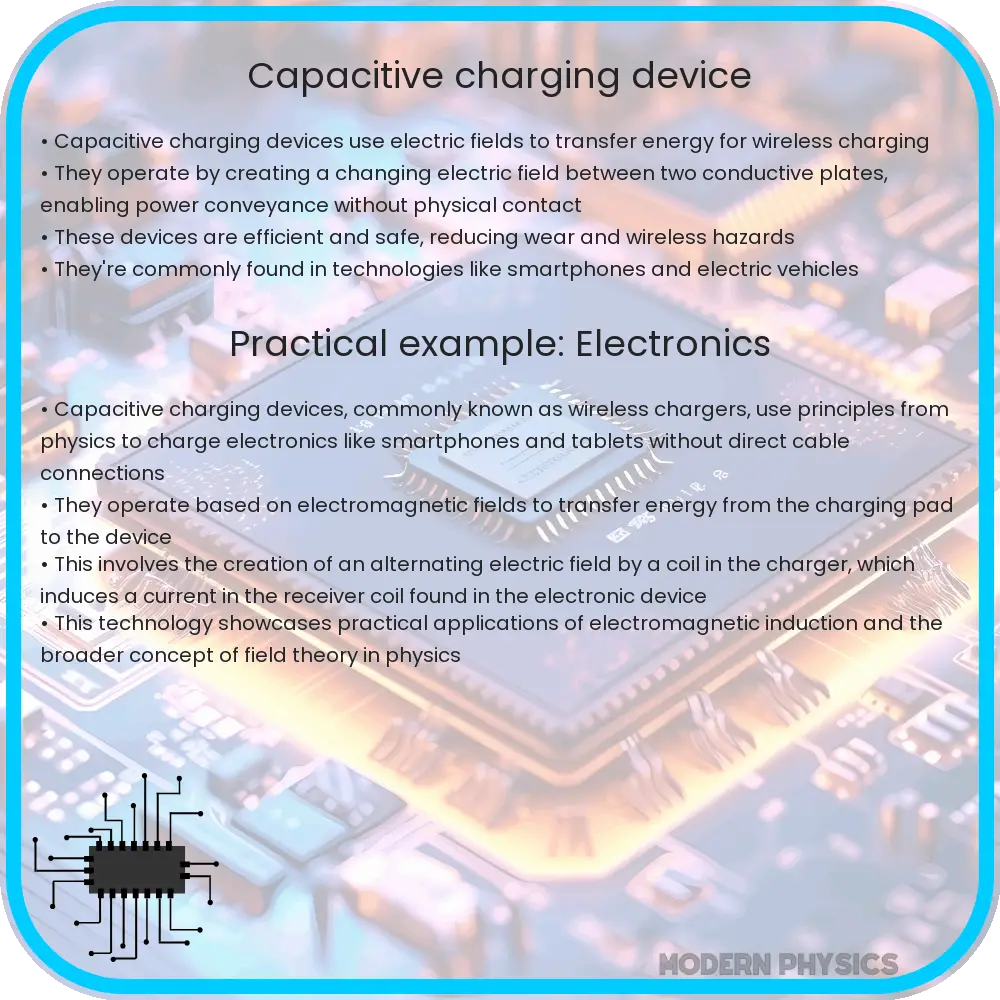
At its core, capacitive charging relies on the concept of electrical capacitance. It involves two conductive plates separated by a dielectric material. When a voltage is applied, an electric field is created between these plates, allowing for the transfer of energy. In capacitive charging systems, one plate is embedded in the charging station, and the other is integrated into the device being charged. The energy transfer occurs when these plates are brought close to each other, enabling wireless charging.
Efficiency and Safety Aspects
One of the key advantages of capacitive charging is its efficiency. The use of a dielectric material minimizes energy loss, making it more efficient than traditional inductive charging methods. Moreover, the absence of exposed conductive parts enhances safety, reducing the risk of electric shocks.
Security Features
Security in capacitive charging is paramount, especially in a world where data theft and electronic intrusion are prevalent. These devices can be engineered to include authentication protocols, ensuring that only authorized devices can initiate a charging session. This feature is crucial in public or shared charging environments.
Potential Applications
The applications of capacitive charging are vast and varied. From smartphones and laptops to electric vehicles and medical devices, this technology holds the promise of revolutionizing how we power our devices. It’s particularly beneficial in scenarios where traditional plug-in charging is inconvenient or impractical, such as in medical implants or wearables.
Advancements and Future Prospects
Recent advancements in materials science and electrical engineering have significantly improved the capabilities of capacitive charging devices. Researchers are continually exploring ways to enhance the distance over which power can be effectively transferred, aiming to make wireless charging more versatile and widespread. As technology progresses, we can expect capacitive charging to become a standard feature in a myriad of electronic devices, paving the way for a truly wireless future.
Challenges and Limitations
Despite its numerous advantages, capacitive charging faces certain challenges and limitations. One of the primary concerns is the limited charging distance. Unlike inductive charging, which can transmit energy over a few centimeters, capacitive charging typically requires a closer proximity between the charger and the device. This limitation can impact the practicality of the technology in certain applications. Additionally, aligning the charging plates correctly is crucial for optimal energy transfer, which can be a challenge in everyday usage.
Innovations in Capacitive Charging
In response to these challenges, significant innovations are being made. For instance, advancements in materials used for the conductive plates and the dielectric medium are helping to increase the efficiency and reduce the sensitivity to misalignment. Moreover, integrating smart technology into capacitive charging systems can enable automatic alignment and power regulation, enhancing the user experience.
Environmental Impact
Another important aspect of capacitive charging is its environmental impact. By enabling more efficient power transfer, it reduces energy waste, contributing to a greener, more sustainable technology landscape. Furthermore, as this technology becomes more prevalent in electric vehicles, it could play a significant role in reducing carbon emissions.
Final Thoughts
Capacitive charging represents a significant step forward in our quest for efficient, safe, and convenient power delivery methods. Its integration into everyday devices and infrastructures could fundamentally change the way we interact with technology. While challenges remain, ongoing research and development in this field are likely to overcome these hurdles, making capacitive charging a ubiquitous feature in the near future.
Conclusion
In conclusion, capacitive charging is an innovative technology that offers efficient, wireless, and secure power transfer. Its potential applications range from personal electronics to large-scale industrial uses. While it faces some limitations in terms of charging distance and alignment requirements, ongoing advancements are addressing these issues. As we continue to embrace wireless technologies, capacitive charging is poised to become a key player in powering our future, offering a glimpse into a world where seamless and convenient charging is the norm.