
Explore the Bethe-Salpeter Equation in QFT: Unveiling quantum binding and particle interactions, with insights into computational challenges.
Understanding the Bethe-Salpeter Equation in Quantum Field Theory
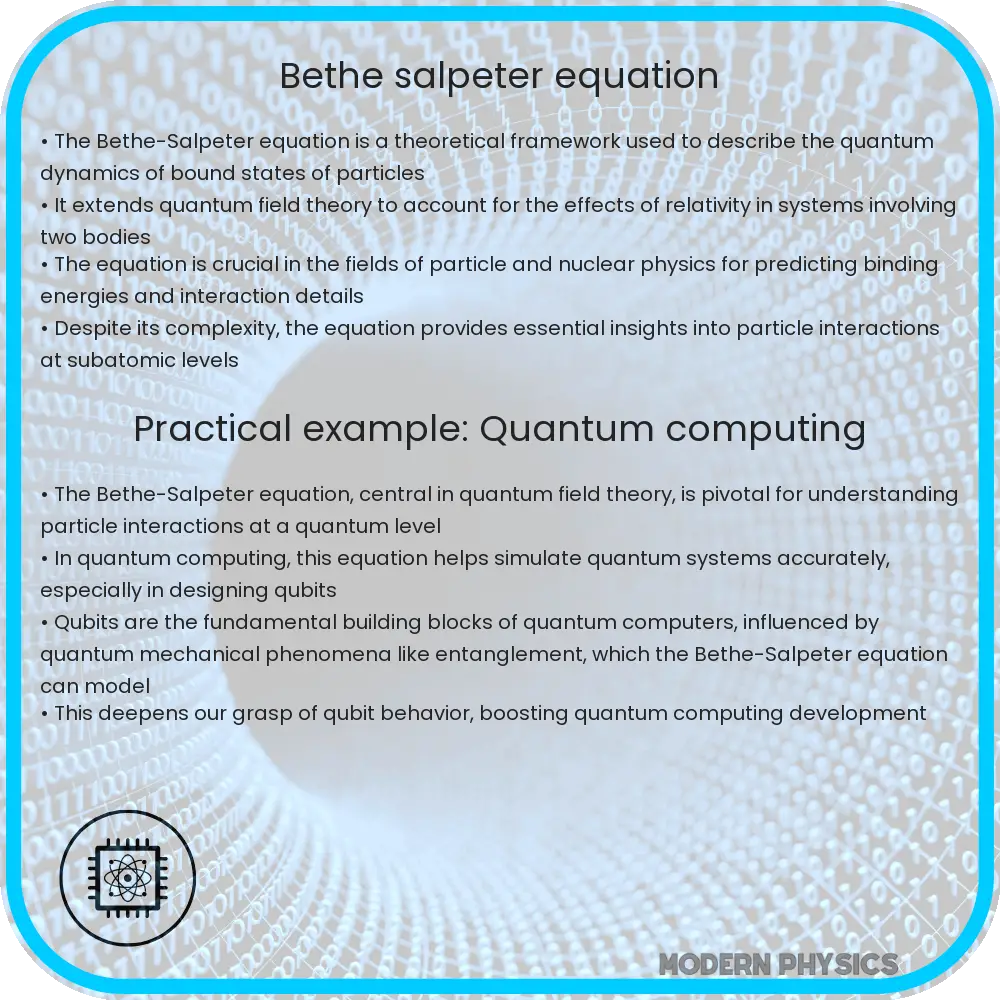
The Bethe-Salpeter Equation (BSE) is a cornerstone in quantum field theory (QFT), offering deep insights into the binding mechanisms of particles. Named after physicists Hans Bethe and Edwin Salpeter, this equation provides a rigorous framework for understanding how two particles interact and bind together under the influence of a quantum field. Its significance lies in its ability to describe bound states in quantum systems, particularly in the context of particle physics and quantum electrodynamics (QED).
At its core, the BSE is an integral equation used to determine the wave function of a bound state of two particles. This wave function encapsulates all the information about the binding and interactions of the particles. The BSE is derived from QFT principles, where particles are treated as excitations in a quantum field, and their interactions are mediated by the exchange of virtual particles. This concept is pivotal in modern physics, providing a foundation for understanding complex phenomena such as the binding of quarks within protons and neutrons, and the formation of atoms from electrons and nuclei.
Quantum Binding and Particle Interaction
The BSE plays a crucial role in elucidating the quantum binding of particles. Quantum binding refers to the phenomenon where particles, such as electrons and quarks, form stable configurations, or bound states, due to their mutual interactions. These interactions are typically mediated by the exchange of gauge bosons, such as photons in the case of electromagnetic interactions. The BSE enables the calculation of the properties of these bound states, including their energy levels, decay rates, and scattering amplitudes.
In the realm of QED, the BSE is instrumental in analyzing the binding of electrons and positrons to form positronium, a quasi-stable bound state. This analysis extends to other fundamental interactions in particle physics, aiding in the understanding of the strong force that binds quarks together in hadrons.
Applications in Quantum Field Theory
The BSE is not just a theoretical construct; it has practical applications in various fields of physics. In particle physics, it provides a framework for predicting the properties of hadrons, such as mesons and baryons. In condensed matter physics, the BSE is applied to study excitons, which are bound states of electrons and holes in semiconductors. This understanding is crucial for the development of advanced materials and technologies.
Moreover, the BSE’s flexibility allows for its adaptation to different interaction potentials and external fields. This adaptability makes it a powerful tool in exploring a wide range of quantum systems, from simple hydrogen-like atoms to complex many-body systems.
Challenges and Advances in Bethe-Salpeter Equation Analysis
Despite its significant applications, the Bethe-Salpeter Equation presents challenges, primarily due to its complexity. Solving the BSE often requires sophisticated mathematical techniques and numerical methods. The equation involves integrals over four-dimensional space-time, making analytical solutions difficult except in the simplest cases. Numerical approaches, while powerful, demand extensive computational resources, especially for systems with strong interactions or in higher-order calculations.
Recent advances in computational physics have enabled more precise solutions of the BSE. These include the development of efficient algorithms and the use of high-performance computing. Researchers have also been exploring approximation methods to simplify the equation without significantly compromising accuracy. These efforts have led to better predictions of particle properties and interactions, contributing to our understanding of fundamental aspects of quantum mechanics and QFT.
Integration with Other Theoretical Frameworks
The Bethe-Salpeter Equation does not exist in isolation but is often integrated with other theoretical frameworks for a more comprehensive understanding of quantum systems. For instance, in the study of hadronic physics, the BSE is used in conjunction with the Dyson-Schwinger Equations, providing a more complete picture of the strong force dynamics. Similarly, in condensed matter physics, the BSE is combined with density functional theory (DFT) to study the electronic properties of materials at a quantum mechanical level.
This synergy between different theoretical frameworks highlights the versatility of the BSE and its importance in the broader context of theoretical physics.
Conclusion
The Bethe-Salpeter Equation stands as a fundamental tool in quantum field theory, offering profound insights into the binding and interaction of particles. While it poses significant computational challenges, ongoing advancements in both theoretical and numerical methods continue to enhance our ability to solve and apply the BSE across various fields. Its integration with other theoretical frameworks underscores its versatility and importance in advancing our understanding of the quantum world. As research continues, the BSE remains a key component in the evolving landscape of quantum physics, contributing to breakthroughs in particle physics, condensed matter physics, and beyond. Its continued study promises to reveal deeper aspects of the quantum realm, potentially leading to new technologies and a more comprehensive understanding of the universe.