
Uncover the unique properties of Beta zeolite, a versatile catalyst with a distinct Si/Al ratio and three-dimensional pore structure enhancing refineries and chemical syntheses.
Understanding Beta Zeolite: Enhancing Catalysis through Advanced Material Engineering
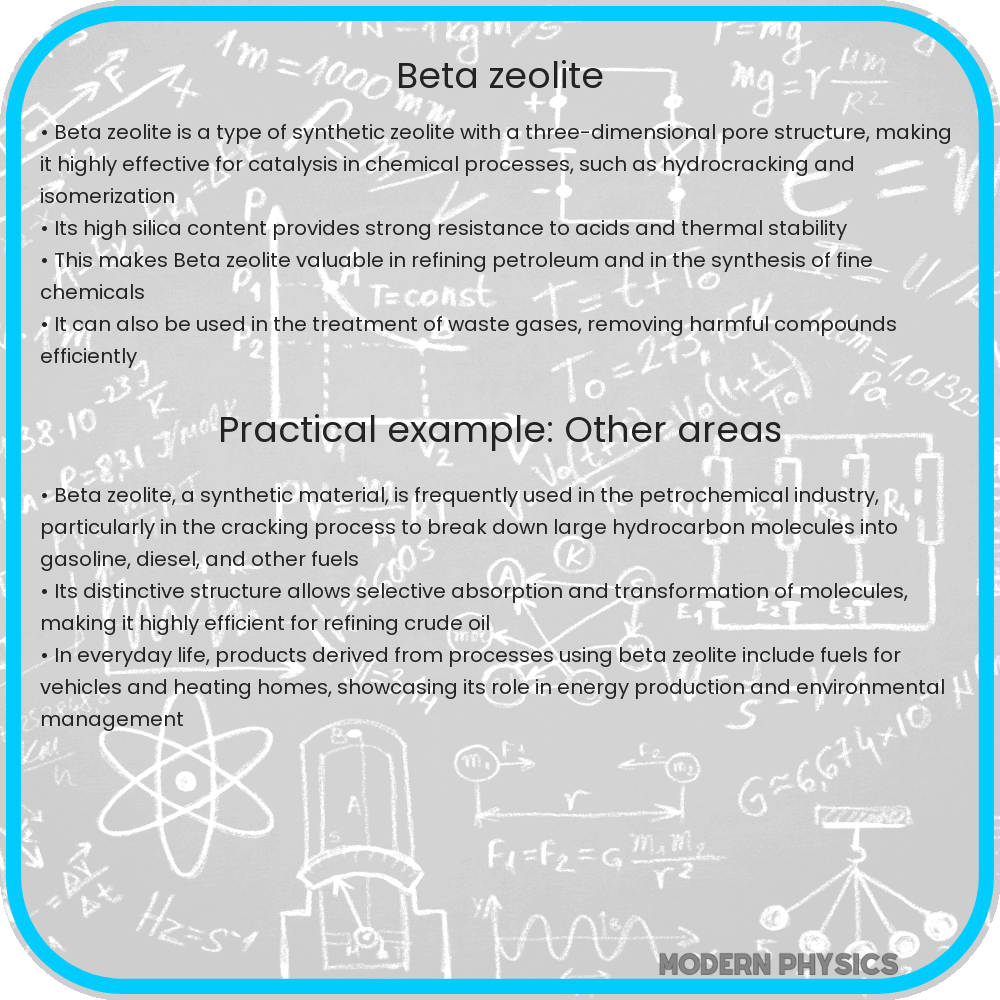
Beta zeolite, a type of zeolite characterized by its three-dimensional pore structure and unique Si/Al ratio, serves as a significant component in the field of catalysis. The properties of Beta zeolite make it highly effective in refining processes, including the cracking of hydrocarbons and the synthesis of fine chemicals. This article explores the catalytic efficiency, stability, and selectivity of Beta zeolite, shedding light on why it stands out in industrial applications.
Catalytic Efficiency of Beta Zeolite
The catalytic efficiency of Beta zeolite primarily arises from its structural features. The framework of Beta zeolite consists of intersecting 12-membered ring channels of approximately 7.6 x 6.4 Å dimensions. This pore structure facilitates the access of reactants to active sites, thereby enhancing the reaction rates. Moreover, Beta zeolite’s high internal surface area allows for greater dispersion of active sites, which contributes to its excellent catalytic performance in processes like isomerization, alkylation, and cracking.
- Isomerization: Beta zeolite can rearrange the carbon skeletons of different molecules, thereby helping in the production of high-octane gasoline.
- Alkylation: In the presence of Beta zeolite, the combination of olefins and paraffins results in the formation of alkylate, a high-value product with superior antiknock properties.
- Cracking: Beta zeolite effectively breaks down larger hydrocarbon molecules into smaller, more valuable ones, which is crucial in petrochemical industries.
Stability of Beta Zeolite
Stability is another paramount factor that contributes to the effectiveness of Beta zeolite in harsh catalytic environments. The high thermal stability and acid stability of Beta zeolite allow it to perform under severe conditions without significant deactivation. This robustness derives from its optimal Si/Al ratio, which confers a strong framework resistant to collapse under high temperature or during exposure to corrosive substances. This makes Beta zeolite particularly useful in processes where catalyst degradation is a common challenge, ultimately leading to longer catalyst life and reduced replacement costs.
Selectivity of Beta Zeolite
Selectivity is a critical aspect of catalysis that determines the quality of the end product. Beta zeolite exhibits remarkable selectivity towards specific reactions due to its unique pore structure and acidic properties. The shape-selectivity of Beta zeolite, which results from its pore dimensions, allows only certain molecules to enter and react, thus minimizing unwanted reactions. Additionally, its acid sites can be tailored during synthesis, enabling control over reaction pathways to favor the production of desired products. This selective nature is particularly beneficial in the synthesis of fine chemicals, where precision in product composition is crucial.
- Synthesis of p-xylene: Beta zeolite selectively catalyzes the formation of p-xylene over other xylene isomers, a critical precursor in the production of polyethylene terephthalate (PET).
- Biodiesel production: Through esterification and transesterification reactions, Beta zeolite helps in converting vegetable oils and animal fats into biodiesel, with higher selectivity for specific fatty acid methyl esters.
Environmental Impact and Sustainability
Considering the environmental impact and sustainability of Beta zeolite, it’s noteworthy that this material supports more efficient and cleaner chemical processes. By enhancing the yield of desired products while minimizing waste and byproducts, Beta zeolite contributes to greener chemical practices. Its ability to be regenerated and reused also lessens the environmental footprint compared to less durable catalysts that require frequent replacement.
- Regeneration: Beta zeolite catalysts can be regenerated through controlled burning off of accumulated residues, thus extending their operational life and reducing waste.
- Reduced emission: By improving reaction selectivity and efficiency, Beta zeolite helps in reducing harmful emissions from industrial processes, aligning with global environmental regulation standards.
Future Prospects in Material Engineering
The ongoing developments in material engineering hold promising prospects for enhancing the properties of Beta zeolite even further. Innovations in nanotechnology and surface science could lead to even higher specificity in catalytic activities, reducing energy consumption across various industrial processes. Investment in research and collaboration between industries and academic institutions will be key to unlocking new potentials of Beta zeolite in catalysis.
- Nano-engineering: Usage of nanotechnology could introduce microscopic adjustments to the pore size and surface areas, potentially revolutionizing catalytic effects.
- Surface modification: Advanced treatments might allow for even more precise control over the acidity and molecular sieving properties of Beta zeolite.
Conclusion
Beta zeolite stands out as a superior catalyst due to its exceptional efficiency, stability, and selectivity in chemical processes, contributing to the advancements in catalysis technology. Its robust structure allows for versatile applications ranging from refining petrochemicals to synthesizing specialty chemicals. The distinctive combination of high catalytic performance, durability against harsh conditions, and environmental sustainability makes Beta zeolite an advantageous choice in modern catalytic applications. Looking forward, continuous improvements and innovations in material engineering may elevate the capabilities of Beta zeolite, paving the way for more sustainable and efficient catalytic processes globally.