
Learn about beta-delayed neutron emission, a nuclear process where an unstable nucleus emits a beta particle followed by one or more neutrons, significant in fields like energy and astrophysics.
Understanding Beta-Delayed Neutron Emission
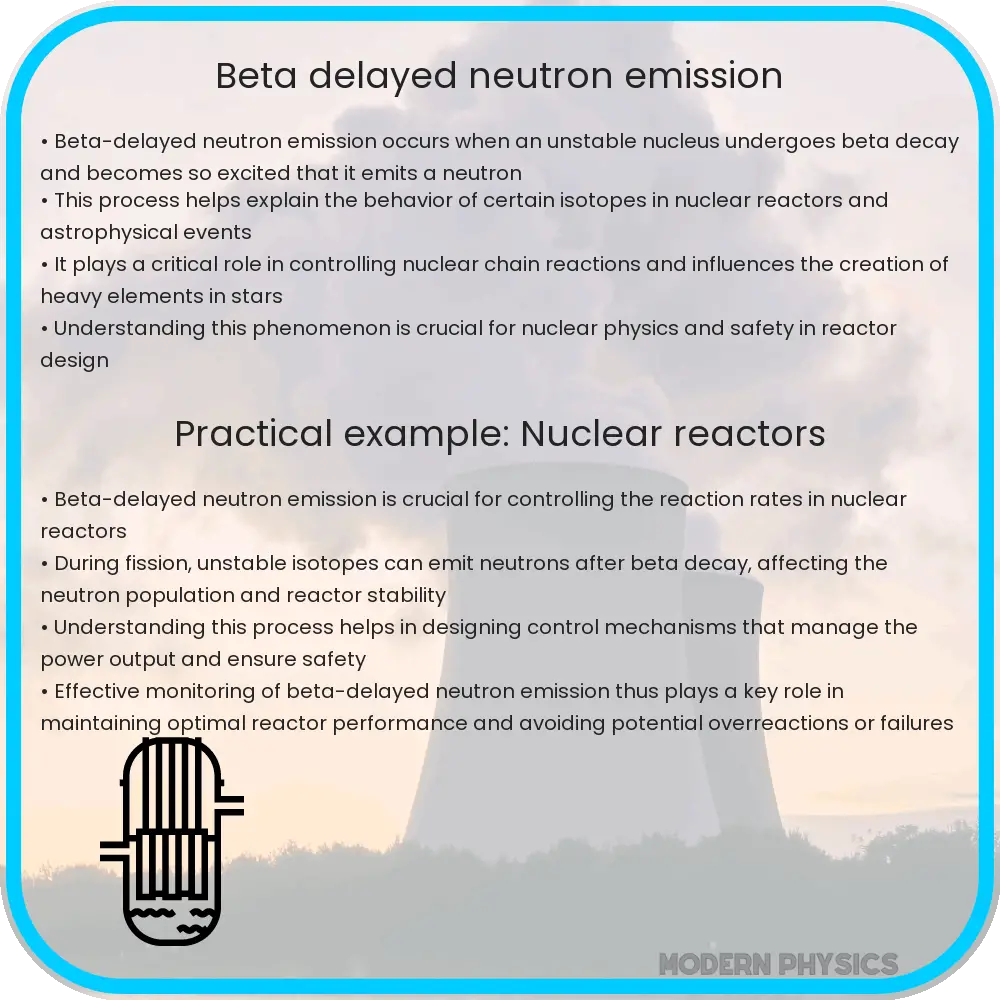
Beta-delayed neutron emission is a fascinating process in nuclear physics where an unstable atomic nucleus emits a beta particle (an electron or positron), which is followed by the emission of one or more neutrons. This phenomenon primarily occurs in neutron-rich nuclei, often far from the Valley of Stability in the chart of nuclides. Understanding this process not only helps in fundamental nuclear research but also has practical applications in various fields including energy production, astrophysics, and nuclear safety.
Basic Mechanisms and Dynamics
The process begins with beta decay, where an unstable neutron-rich nucleus transforms into a more stable configuration by converting a neutron into a proton, an electron (beta particle), and an anti-neutrino. This transformation can result in the daughter nucleus existing in an excited state with energy levels above the neutron separation energy. If these energy levels are sufficiently high, the nucleus may subsequently emit one or more neutrons.
The general reaction can be depicted as:
XZA → YZ+1A + e− + &bar;νe + n
Where X is the parent nucleus, Y is the daughter nucleus, e− represents the beta particle, &bar;νe is the anti-neutrino, and n is the neutron.
Energy Considerations
The likelihood of neutron emission is dependent on the neutron separation energy, which is the energy required to remove a neutron from the nucleus. The excess energy from the beta decay must overcome this neutron separation energy for a neutron to be emitted. This threshold aspect governs the probability and number of neutrons that can be emitted after beta decay.
Role of Beta-Delayed Neutron Emission in Nuclear Reactors
In nuclear reactors, beta-delayed neutron emitters play a crucial role in the control of the fission chain reaction. These neutrons are vital for maintaining reactor stability and control, as they provide a delayed source of neutrons critical to the slow control of the reactor power. The delay allows for mechanical control processes, such as the adjustment of control rods, to safely manage the reactor’s power output.
Astronomical Significance
Beta-delayed neutron emission is also significant in astrophysics, particularly in understanding the rapid neutron capture process (r-process) during supernovae or neutron star mergers. This process is responsible for the creation of about half of the heavy elements in the universe beyond iron. Delayed neutron emission offers critical insights into neutron-rich isotope stability and nucleosynthesis pathways in extreme astrophysical environments.
Moreover, the study of these emissions helps in mapping the so-called “r-process path” in the chart of nuclides, contributing to our understanding of the cosmic origins of elements.
Applications in Nuclear Safety
Beta-delayed neutron emission is not only pivotal in power generation but also plays a significant role in nuclear safety. During nuclear reactor operations, understanding and monitoring these neutron emissions help in assessing the reactor’s condition and potential safety risks. For instance, an increase in delayed neutron activity can indicate a change in the reactor’s fission rate, alerting operators to adjust control mechanisms accordingly. This property is particularly useful in scenarios where immediate response is critical to preventing accidents.
Techniques for Detecting Beta-Delayed Neutrons
Accurate detection of beta-delayed neutrons is crucial for leveraging their benefits in nuclear physics and engineering. Modern detection techniques often involve large-scale detectors that use materials like helium-3 or boron trifluoride. These materials are capable of capturing neutrons effectively, allowing scientists and engineers to analyze neutron emissions with high precision. Enhancements in detection technology continue to improve the accuracy and efficiency of neutron measurement, which is essential for both research and practical applications in nuclear reactors.
Challenges and Future Prospects
Despite its significant applications, studying beta-delayed neutron emission poses challenges, primarily due to the difficulty in handling neutron-rich isotopes and their often short half-lives. Advanced facilities like radioactive ion beam facilities have been crucial in overcoming some of these challenges by enabling more precise studies of neutron-rich nuclei. Looking ahead, ongoing research aims to better understand the theoretical underpinnings of neutron emission and refine the models used to predict these events, which are vital for enhancing the safety and efficiency of nuclear reactors and understanding astrophysical processes.
Conclusion
Beta-delayed neutron emission encapsulates a critical phenomenon in nuclear physics with implications that stretch across various scientific and practical fields. From its role in stabilizing nuclear fission reactions to contributing to our comprehension of the universe’s elemental abundance, its study provides key insights into both the infinitely small and the immensely large. As technology advances, the continued exploration of beta-delayed neutron emissions promises to refine our understanding of nuclear processes and enhance the safety and efficacy of nuclear power generation, highlighting the enduring importance of fundamental science in everyday applications.