
Understanding delayed neutron precursors is crucial in nuclear reactor control and safety mechanisms.
Introduction to Delayed Neutron Precursors
One of the key concepts in nuclear physics, particularly in the operation of nuclear reactors, is the phenomenon of delayed neutron precursors. Neutrons play a crucial role in maintaining the nuclear chain reaction in reactors, which is fundamental for producing energy. Understanding how delayed neutron precursors operate can provide insights into reactor control and safety mechanisms.
What are Delayed Neutron Precursors?
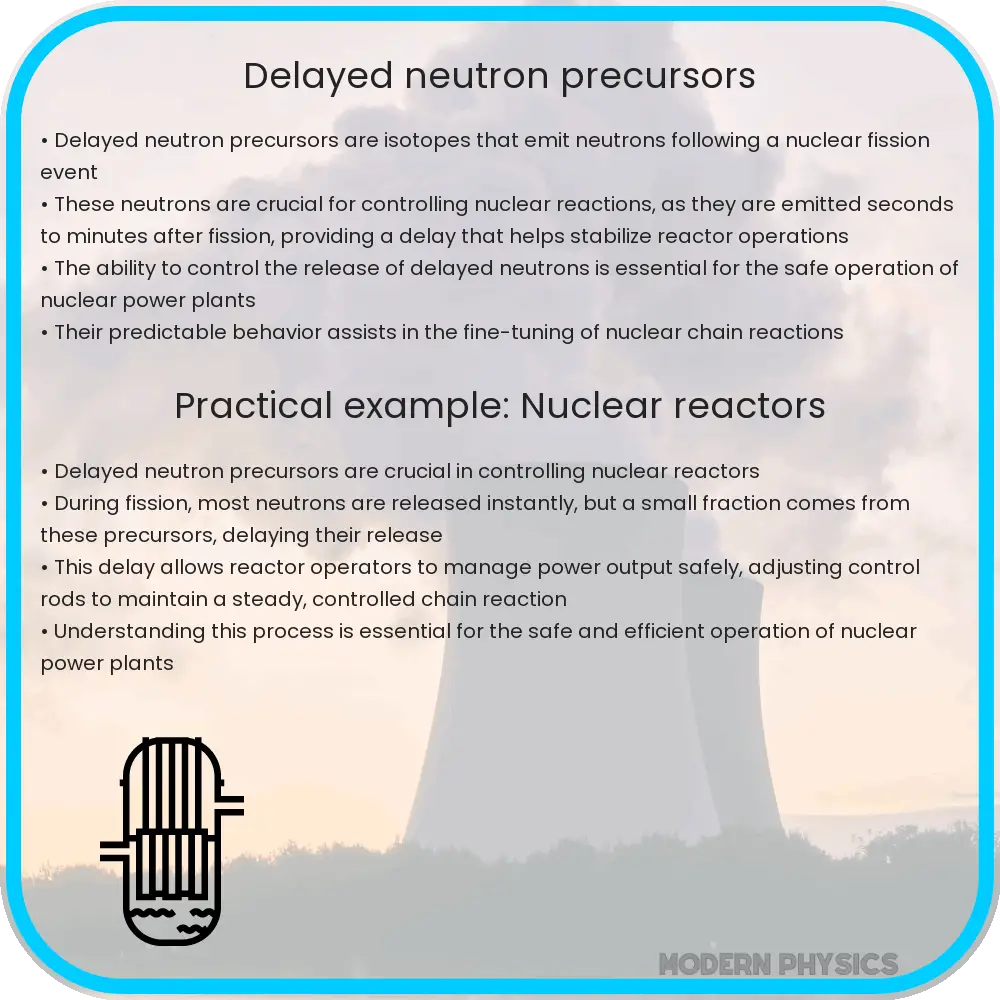
Delayed neutron precursors are isotopes that emit neutrons some time after a nuclear fission event has occurred. In nuclear fission, a heavy nucleus, like Uranium-235, absorbs a neutron and splits into two lighter nuclei, along with a few free neutrons and a large amount of energy. Most of these neutrons are released immediately (prompt neutrons), but a small fraction (about 0.65%) are emitted with a delay, hence the name ‘delayed neutrons’.
The delayed neutrons are not directly produced by the fission event. Instead, they come from the beta decay of fission products, termed as delayed neutron precursors. These precursors are radioactive isotopes that undergo beta decay to transform into another isotope, releasing a neutron in the process.
The Significance of Delayed Neutrons in Nuclear Reactors
While they constitute a small fraction of the total neutrons produced in fission, delayed neutrons play a vital role in the control and safety of nuclear reactors. The time delay associated with their emission provides a valuable window for reactor operators to manage and control the reactor’s power output safely.
- Control: The delay in neutron emission allows for adjustments in the reactor control mechanisms, such as control rods or boron concentration, effectively moderating the reactor’s power output.
- Safety: In emergency situations, the existence of delayed neutrons gives additional time to respond to unforeseen increases in reactivity, helping to prevent potential accidents.
Understanding the behavior of delayed neutron precursors, therefore, is essential for predicting and manipulating the dynamic responses of nuclear reactors under various operational conditions.
Mathematical Description of Delayed Neutrons
The importance of delayed neutrons is encapsulated in their contribution to the reactor’s delayed neutron fraction (β), a parameter that profoundly influences the dynamics of nuclear reactors. Mathematically, the decay and production of delayed neutrons can be described by a group of differential equations, each representing a specific group of delayed neutron precursors with similar decay constants. The general form of the equation describing the rate of change of delayed neutron precursors’ concentration is:
dNi/dt = -λiNi + fiΣ
Here, Ni represents the concentration of the ith group of precursors, λi is their decay constant, and fi is the fraction of fissions producing the ith group of delayed neutron precursors. Σ denotes the total fission rate. Each group’s decay constant and production fraction characterizes the delay and importance of the group in reactor control.
This simplified overview of the processes not only highlights the complexity of control in nuclear reactors but also the precision required in engineering such physical systems for stability and safety.
Real-World Applications of Delayed Neutron Monitoring
The monitoring and analysis of delayed neutron emissions are not only pivotal in reactor control but also in several other real-world applications such as nuclear non-proliferation and nuclear waste management. By accurately measuring the rate and spectrum of delayed neutrons, scientists and engineers can infer important information about the nuclear material’s composition and reactivity.
- Nuclear Non-proliferation: Monitoring delayed neutrons helps in the detection and characterization of illicit nuclear materials. Since different fissile materials produce unique delayed neutron signatures, their identification can be integral to security and regulatory measures.
- Nuclear Waste Management: Understanding the decay behavior of delayed neutron precursors aids in assessing the long-term radioactivity and heat generation in spent nuclear fuel. This information is crucial for designing safe storage and disposal strategies.
Therefore, techniques that enhance the detection and analysis of delayed neutrons contribute significantly to the field of nuclear science and engineering, offering improvements in safety, compliance, and efficiency in various nuclear-related activities.
Challenges in Handling Delayed Neutrons
Despite their usefulness, managing the effects of delayed neutrons presents several challenges, particularly in terms of measurement accuracy and the complexity of the decay processes. The accuracy of delayed neutron measurements can be influenced by environmental factors, instrumentation limits, and the inherent randomness of radioactive decay. Moreover, the mathematical complexity of modeling multiple groups of precursors requires sophisticated computational tools and skilled personnel, which can be resource-intensive.
- Measurement Accuracy: High precision instruments are required to detect and measure the relatively small number of delayed neutrons among the vastly larger number of prompt neutrons, necessitating frequent calibration and maintenance.
- Computational Complexity: Accurately simulating the behavior and interaction of multiple precursor groups demands advanced computational models and robust data handling capacities.
Addressing these challenges is crucial for optimizing reactor performance and ensuring the safe utilization of nuclear technologies. Continuous advancements in technology and methodology are therefore essential to overcome these hurdles and harness the full potential of delayed neutron monitoring in nuclear applications.
Conclusion
Delayed neutron precursors, while a minor component in the grand scheme of nuclear reactions, have a disproportionate impact on the control and safety of nuclear reactors. Their ability to bridge the gap between the immediate and longer-term responses of nuclear systems makes them critically important in various applications from power generation to safety regulations. The ongoing study and refinement of techniques for managing delayed neutrons are vital to enhance the functionality and safety of nuclear reactors around the globe. By fostering a deeper understanding and innovative approaches in this area, engineers and physicists continue to secure and optimize the generation of nuclear energy for future needs.