
Explore Bell’s Spaceship Paradox and its intriguing implications in relativity, challenging classical physics with Einstein’s theories.
Understanding Bell’s Spaceship Paradox in the Realm of Relativity
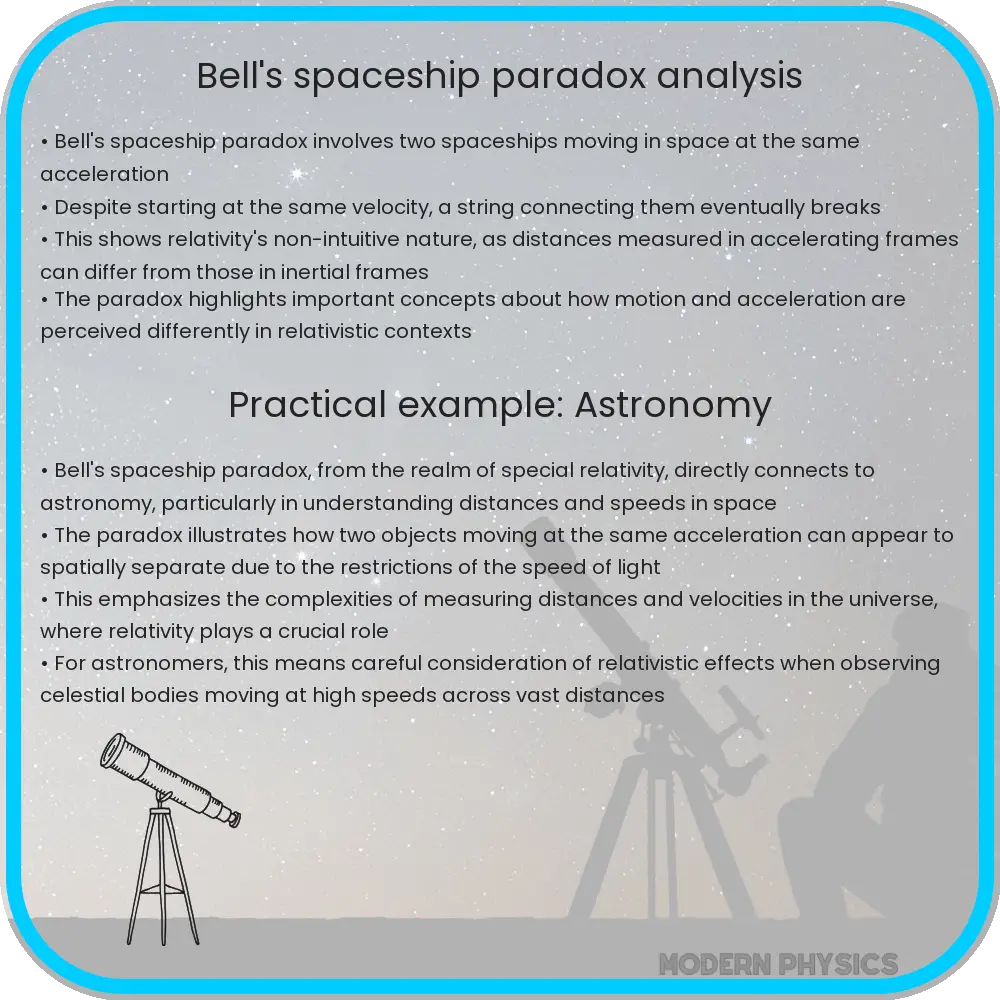
Bell’s Spaceship Paradox presents a fascinating scenario that challenges our intuitive understanding of physics, particularly within the framework of Albert Einstein’s theory of relativity. This paradox, first proposed by physicist John Stewart Bell in 1976, is a thought experiment that examines the effects of special relativity on objects moving at high speeds. Its implications are profound, shedding light on the counterintuitive nature of time, space, and simultaneity at relativistic velocities.
The Scenario of the Paradox
The paradox involves two spaceships, which are at rest relative to each other in space. They are connected by a fragile string. According to the setup, both spaceships are programmed to accelerate simultaneously and at the same rate, as observed from their initial rest frame. The core question that Bell’s paradox aims to address is whether the string between the spaceships will break or remain intact as they accelerate.
Classical Mechanics vs. Relativity
In classical mechanics, the answer seems straightforward. Since both ships accelerate together, the distance between them remains constant, and the string should not experience any additional stress. However, the introduction of special relativity significantly alters this conclusion. Einstein’s theory dictates that the concept of simultaneity is not absolute but relative to the observer’s frame of reference. Consequently, what appears simultaneous in one frame might not be in another, especially when dealing with velocities approaching the speed of light.
Relativistic Effects on Simultaneity and Length Contraction
Under the lens of relativity, as the spaceships accelerate, an observer at rest relative to the spaceships’ initial position would witness a phenomenon known as ‘length contraction.’ This effect, a fundamental aspect of special relativity, suggests that objects contract along the direction of motion as their speed approaches the speed of light. Thus, the distance between the two spaceships would appear to decrease for a stationary observer. Moreover, the simultaneity of their acceleration becomes questionable, further complicating the scenario.
This paradox highlights the unintuitive aspects of special relativity, particularly when it comes to understanding how different observers perceive motion and distance. The next section will delve deeper into the resolutions proposed for Bell’s Spaceship Paradox and its implications in the broader context of modern physics.
Is this conversation helpful so far?
Resolving Bell’s Spaceship Paradox
To unravel Bell’s Spaceship Paradox, it’s crucial to understand the relativity of simultaneity in Einstein’s theory. From the perspective of an observer on one of the accelerating spaceships, the other spaceship appears to accelerate at a different time due to the time it takes for light to travel between them. This relative perception of time leads to the conclusion that the string will indeed break. The breaking of the string can be attributed to the differential aging effect, a key concept in relativity, which causes the spaceships to age differently relative to each other and to a stationary observer.
The Role of Lorentz Transformation
The Lorentz transformation equations play a vital role in understanding this paradox. They provide the mathematical framework for transitioning between different inertial frames of reference in special relativity. These transformations demonstrate how lengths contract and time dilates, reinforcing the idea that the simultaneous acceleration of the spaceships is not a universal truth but depends on the observer’s frame of reference.
Implications in Modern Physics
Bell’s Spaceship Paradox is more than a theoretical curiosity; it has practical implications in modern physics, particularly in the fields of astrophysics and particle physics. Understanding the paradox is essential for interpreting observations in high-speed environments, such as the behavior of particles in accelerators or the dynamics of fast-moving celestial bodies.
Conclusion
Bell’s Spaceship Paradox offers a compelling insight into the peculiarities of special relativity. It challenges our classical notions of simultaneity, distance, and time, illustrating how these concepts become malleable at relativistic speeds. The paradox serves as a reminder that in the realm of high velocities, our intuitive understanding of physics must give way to the more complex and nuanced principles of Einstein’s theory. As we continue to explore the universe at ever-greater speeds, the lessons gleaned from Bell’s Spaceship Paradox will undoubtedly play a crucial role in shaping our understanding of the cosmos and the fundamental laws that govern it.