
Explore the essentials of beam convergence in optics, covering lenses, mirrors, challenges, and innovations, crucial for advancing optical technology.
Understanding Beam Convergence in Optics
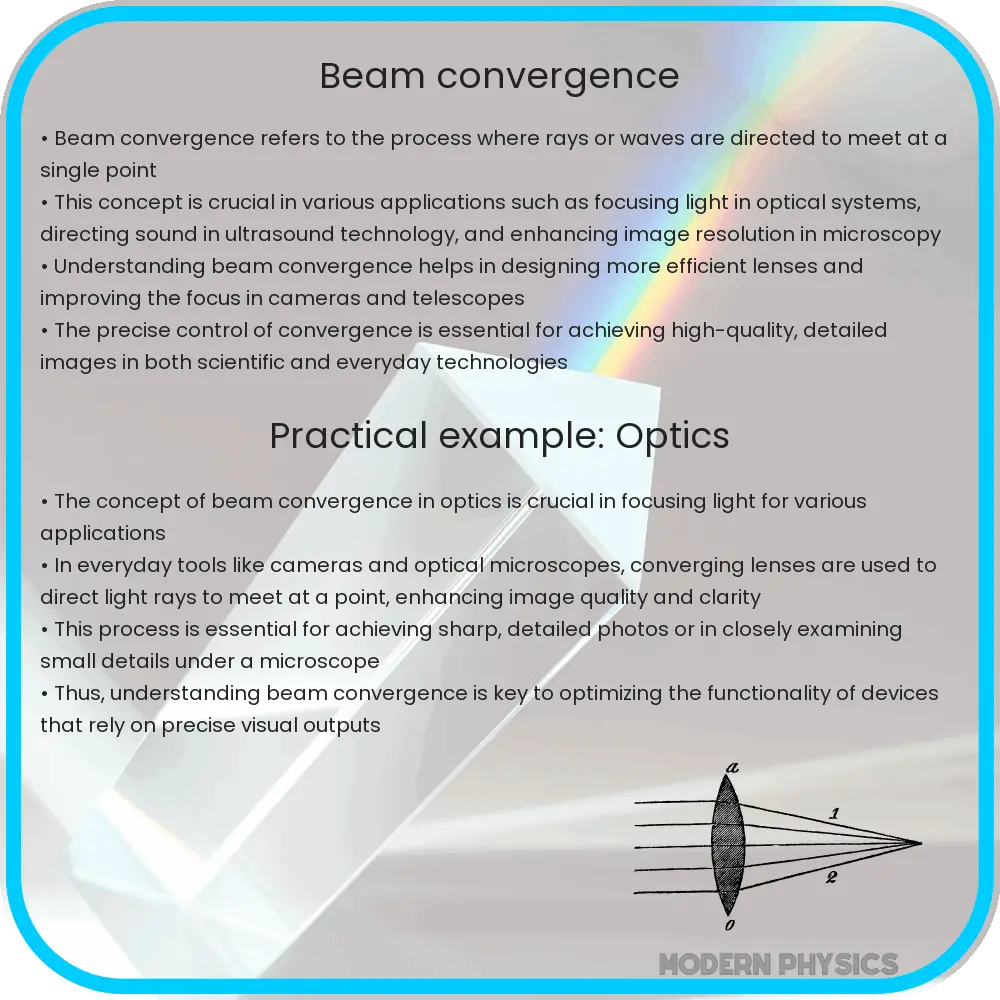
Beam convergence is a fundamental concept in optics that refers to the process by which light rays come together to a point or become more focused. This principle is crucial for a variety of applications, from imaging and microscopy to laser technology and optical communication. At its core, beam convergence is about enhancing precision, clarity, and focus, enabling the manipulation of light to achieve desired outcomes in scientific, industrial, and technological domains.
The Role of Lenses and Mirrors
Lenses and mirrors play a pivotal role in achieving beam convergence. By refracting (bending) or reflecting light rays, these optical elements can alter the path of light to bring it to a focus. The shape and material of the lens or mirror determine how effectively it converges the light. Convex lenses, for example, have surfaces that curve outward, and they are adept at converging light rays to a focal point on the other side of the lens. Similarly, concave mirrors, with their inward-curving surfaces, can reflect light rays to a common focal point.
Mathematical Foundation
The mathematical underpinnings of beam convergence are rooted in geometric optics. The focal length of an optical system, a key parameter, is the distance at which parallel rays of light are converged to a single point. This property is governed by the lensmaker’s equation for lenses:
f = (n-1)(1/R1 – 1/R2 + (n-1)d/(nR1R2))
where f is the focal length, n is the refractive index of the lens material, R1 and R2 are the radii of curvature of the lens surfaces, and d is the thickness of the lens. For mirrors, the formula simplifies, focusing on the radius of curvature and the mirror’s material properties.
Applications and Implications
The ability to control beam convergence is foundational to developing high-precision optical instruments. In microscopy, for instance, beam convergence is essential for achieving high-resolution images of microscopic entities. In telecommunications, optical fibers utilize the principle of beam convergence to transmit light efficiently over long distances. Furthermore, in the realm of lasers, beam convergence is key to focusing energy into a small, precise spot for applications ranging from surgical procedures to material processing.
Understanding the principles of beam convergence, including the roles of lenses and mirrors and their mathematical foundation, is essential for advancing optical technology and its applications. This understanding not only aids in the design of more sophisticated optical systems but also in the refinement of techniques across a wide range of scientific and technological fields.
Challenges and Innovations in Beam Convergence
Despite its foundational role in optics, achieving optimal beam convergence presents challenges. One significant hurdle is aberration, a phenomenon that causes light rays to deviate from their intended path, resulting in a less focused beam. Spherical aberration, for instance, occurs when rays passing through the edges of a spherical lens or mirror focus at different points than those passing through the center. Advanced optical designs, including aspherical lenses and the use of corrective optical elements, are critical in mitigating these effects to maintain precision and clarity.
Technological Advancements and Future Directions
Recent technological advancements have introduced innovative approaches to enhance beam convergence. Adaptive optics, a technology that adjusts the shape of mirrors or lenses in real-time to correct for optical aberrations, has revolutionized fields such as astronomy and vision science. Moreover, the development of metamaterials, materials engineered to have properties not found in naturally occurring materials, offers new possibilities for controlling light with unprecedented precision, potentially leading to breakthroughs in optical computing and beyond.
Conclusion
Beam convergence is a cornerstone of optical science, enabling the precise manipulation of light for a myriad of applications. From the fundamental roles of lenses and mirrors to the complex mathematical models that describe light behavior, the principles of beam convergence are integral to advancing optical technology. Despite challenges such as aberrations, ongoing innovations in optical design and materials science continue to push the boundaries of what is possible, opening new horizons for research and technology. As we continue to explore the depths of the optical sciences, the pursuit of greater precision, clarity, and focus in beam convergence remains at the forefront, promising to illuminate the path to future discoveries and innovations in the field.