
Explore the Axion Dark Matter Experiment (ADMX): a pioneering quest to uncover dark matter through innovative detection methods and global collaboration.
Introduction to the Axion Dark Matter Experiment
One of the most enigmatic and captivating subjects in contemporary physics is dark matter, a form of matter that does not emit, absorb, or reflect light, making it completely invisible and detectable only through its gravitational effects. Among the myriad of efforts to uncover the nature of dark matter, the Axion Dark Matter Experiment (ADMX) stands out as a cutting-edge, insightful, and pioneering project.
Understanding Axions
Axions are hypothetical particles that were initially proposed in the 1970s to resolve the strong CP (Charge Parity) problem in quantum chromodynamics (QCD). Despite their inception as a solution to a different problem, axions are now considered one of the most promising candidates for dark matter. They are thought to be extremely light, with masses possibly as small as 10-22 eV, and interact only very weakly with ordinary matter and electromagnetic fields.
The Aim of the ADMX
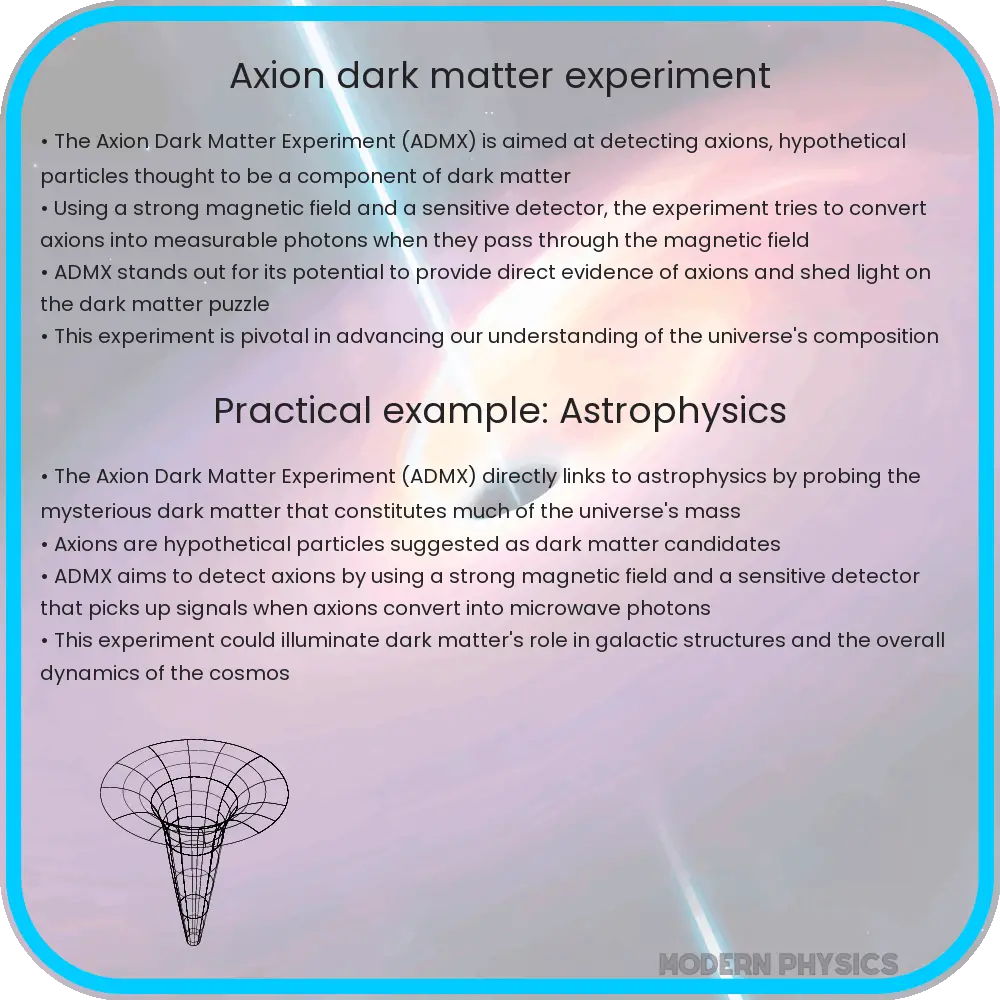
The Axion Dark Matter Experiment aims to detect axions by converting them into microwave photons using a strong magnetic field. This conversion process is predicated on the axion-photon interaction, which, though extremely weak, could be detectable under the right conditions. The experiment utilizes a high-precision resonant cavity immersed in a powerful magnetic field, chilled to near absolute zero to minimize thermal noise.
Technical Insights and Innovations
ADMX’s approach is based on the haloscope detection concept, a method that turns the experiment into a sort of cosmic radio, tuned to frequencies that could indicate the presence of axions. By meticulously scanning through different frequencies within the microwave range, ADMX seeks to identify the telltale signal of axions converting into photons. This requires incredibly sensitive equipment, capable of detecting signals at the quantum level, a feat achieved through cutting-edge quantum amplifiers and cryogenics technology.
The implications of discovering axions go far beyond solving the dark matter puzzle; they could provide new insights into the fundamental forces of nature and the early universe. Therefore, the ADMX is not just a search for dark matter but a gateway to understanding the universe’s hidden components and the laws governing them.
Challenges and Progress in ADMX
The Axion Dark Matter Experiment, while pioneering, faces significant challenges. The primary hurdle is the axion’s elusive nature; its weak interaction with ordinary matter means that even the most sensitive detectors may struggle to confirm its existence. Furthermore, the theoretical mass range for axions is broad, requiring the ADMX to scan a vast frequency range meticulously. Despite these challenges, the ADMX team has made remarkable progress, refining their detection techniques and improving the sensitivity of their equipment to unprecedented levels.
Global Collaboration and Future Prospects
The ADMX is not an isolated effort but part of a global initiative to understand dark matter. Collaborating with institutions and scientists around the world, the experiment benefits from a wide range of expertise and resources. Looking ahead, the future of the ADMX and similar experiments is bright, with plans to further increase sensitivity and scan additional frequency ranges. These efforts are complemented by theoretical advances that narrow down the likely characteristics of axions, guiding experimental searches with greater precision.
Conclusion
The Axion Dark Matter Experiment represents a crucial step forward in our quest to uncover the nature of dark matter. By targeting axions, a prime candidate for this mysterious component of the universe, ADMX moves us closer to understanding the full scope of matter and forces that govern the cosmos. The challenges are significant, reflecting the complexity and subtlety of the universe we inhabit. Yet, the potential rewards are profound, offering not just answers to long-standing questions but also the promise of new physics beyond our current understanding. As ADMX and other experiments continue to refine their search, the prospect of finally bringing dark matter into the light of scientific understanding grows ever more tangible.