
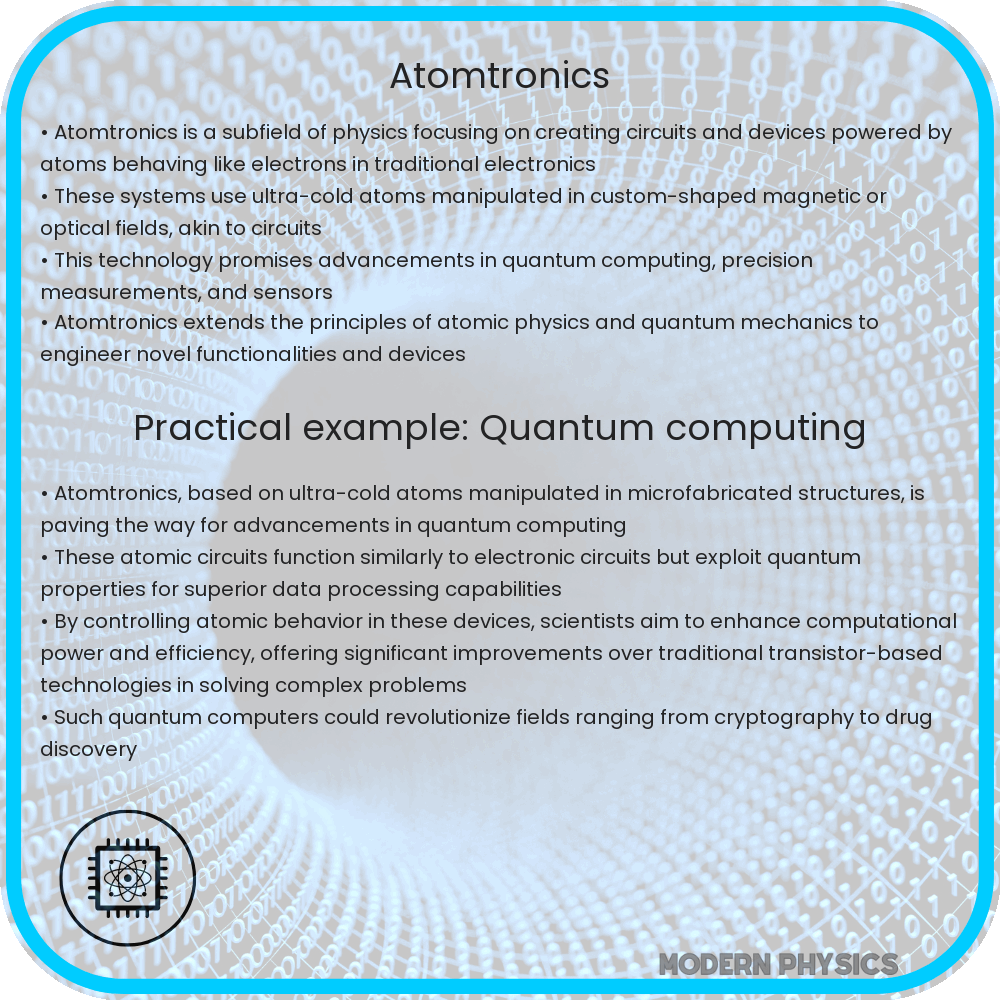
Atomtronics is a field merging quantum physics and technology, using ultra-cold atoms to mimic electronic circuit behavior for advanced technological applications.
Introduction to Atomtronics
Atomtronics is a burgeoning field at the intersection of quantum physics and technology. It leverages the unique properties of atoms, particularly those in ultra-cold quantum gases, to mimic the behavior of electronic circuits and devices. By controlling atomic motion and interactions within engineered magnetic or optical landscapes, researchers can develop new devices that offer functionalities beyond traditional electronics, potentially leading to advancements in quantum computing, sensing, and simulation.
How Atomtronics Function
Atomtronics primarily revolves around using ultra-cold atoms, often bosonic atoms like Rubidium-87, which are cooled to temperatures near absolute zero using laser cooling and evaporative cooling techniques. At these extremely low temperatures, atoms behave according to quantum mechanics, showing wave-like properties rather than behaving like particles. This state of matter where atoms collectively behave like a single quantum entity is known as a Bose-Einstein Condensate (BEC).
In an atomtronic circuit, the BEC is manipulated to flow through circuits and devices that are analogous to electronic systems but are constructed using magnetic fields or laser-generated optical potentials. These circuits are often laid out on “atom chips,” which utilize microfabricated wires that produce magnetic fields when currents pass through them, to guide and control the atomic flow.
Key Functions of Atomtronics
- Quantum Computing: Atomtronics can be used to construct quantum bits, or qubits, the basic unit of quantum information. Unlike traditional binary systems which use bits as the smallest information unit and are limited to states of 0 or 1, qubits can exist simultaneously in multiple states, enabling vastly more complex computing operations.
- Sensing and Metrology: The high sensitivity of atomtronic systems to external forces makes them excellent candidates for precision sensors. Applications include measuring gravitational forces, magnetic fields, and rotation, with potential uses in navigation, geology, and other fields.
- Simulation of Quantum Systems: Atomtronics provides a platform for simulating and studying other complex quantum systems, which are otherwise difficult to realize and study. This includes models of physical phenomena like superconductors and materials with exotic magnetic properties.
Potential Applications and Future Outlook
The potential applications of atomtronics are vast and varied, intersecting with multiple scientific and technological domains. In quantum computing, atomtronics could lead to more stable and coherent qubits, potentially solving problems intractable for classical computers. For sensing applications, atomtronics offers a new era of ultra-precision measurements that could transform everything from GPS technology to geological exploration.
Moreover, the ability to simulate and manipulate complex quantum systems could accelerate the development of new materials with tailored properties, impacting industries from electronics to energy storage. Atomtronics not only promises to expand our understanding of quantum mechanics but also opens the door to technologies that could shape the future of multiple industries.
Challenges and Developmental Hurdles
Despite the promising future of atomtronics, there are several challenges that must be addressed to fully harness its potential. One of the primary difficulties lies in maintaining the ultra-cold conditions necessary for the operation of Bose-Einstein Condensates. Any interaction with the external environment can lead to an increase in temperature, thus disrupting the quantum properties of the atoms.
Another significant challenge is the scalability of atomtronic devices. While individual components like qubits and sensors have been demonstrated in laboratory settings, integrating these into larger, functional systems is a complex engineering challenge. Issues such as coherence time, isolation from environmental noise, and inter-component interaction need to be meticulously managed.
Additionally, developing robust methods for precisely controlling and manipulating atomic states is crucial. This requires advancements in microfabrication techniques and better understanding of quantum control dynamics to ensure the atoms can be directed accurately within the atom chips.
Collaborative Efforts and Interdisciplinary Research
The progression of atomtronics depends significantly on interdisciplinary collaboration. Physicists working alongside material scientists, engineers, and computer scientists can spur innovations that address the technical challenges specific to atomtronics. Furthermore, synergies between theoretical research and experimental methodologies can accelerate the development of practical atomtronic applications.
Fostering partnerships between academia and industry is also essential for translating laboratory-scale successes into commercial technologies. Such collaborations can provide the necessary resources and real-world testing environments critical for advancing atomtronics.
Conclusion
Atomtronics stands at the forefront of quantum technology, offering revolutionary capabilities across computing, sensing, and material science. While challenges such as scalability, environmental sensitivity, and precision control persist, ongoing research and interdisciplinary collaborations continue to push the boundaries of what is possible. As we overcome these hurdles, atomtronics may well pave the way for a new era of technology, profoundly impacting our approach to information processing, measurement, and material design. The journey of bringing atomtronics from the realm of theoretical physics to real-world applications is an exhilarating prospect that promises to reshape our technological landscape.