
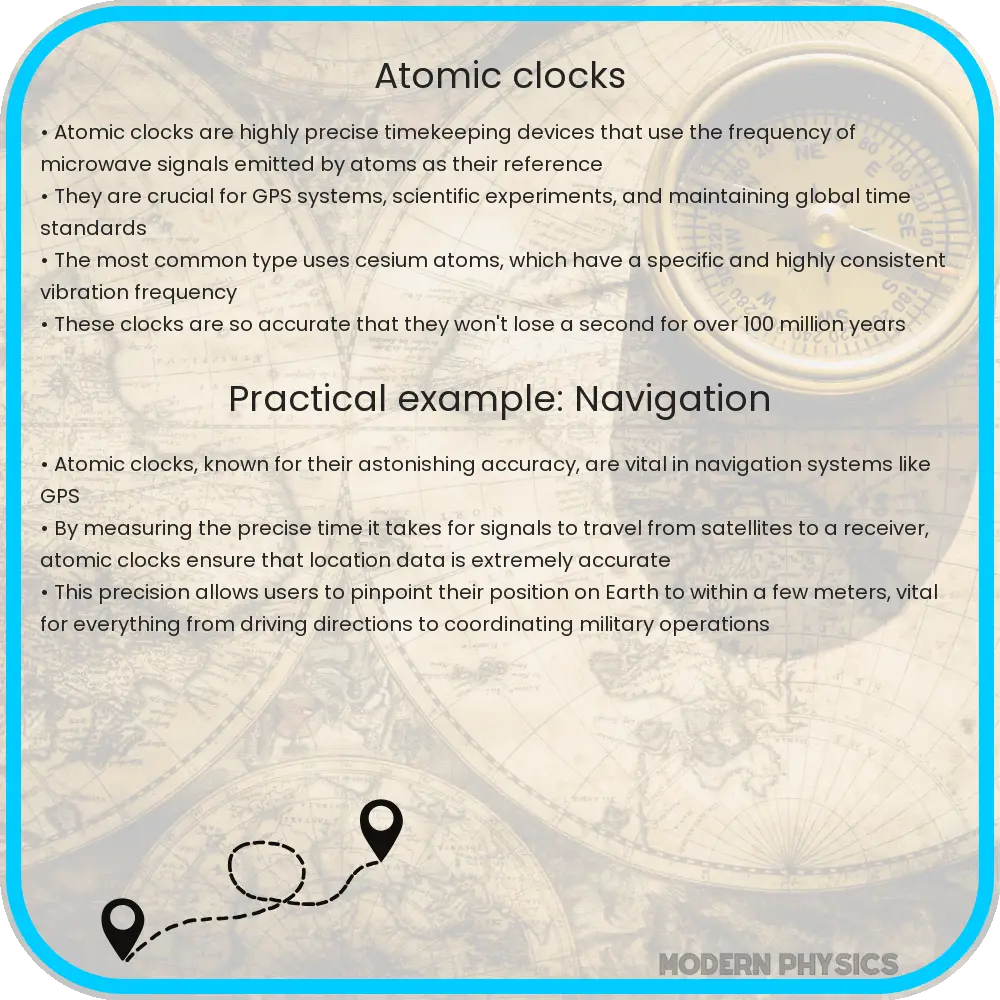
Atomic clocks are precision timekeeping devices using cesium-133 atoms’ vibrations, essential for GPS and network synchronization.
Introduction to Atomic Clocks
Atomic clocks are widely regarded as the most accurate timekeeping devices in existence. These devices do not measure time using mechanical gears or quartz crystals, but instead, they rely on the properties of atoms transitioning between different energy states. The precision offered by atomic clocks plays a crucial role in various aspects of modern technology and science, from global positioning systems (GPS) to the synchronization of computer networks.
How Atomic Clocks Work
At the core of every atomic clock is an oscillator based on the vibration frequencies of atoms. The most common atom used in these clocks is cesium-133. According to the International System of Units (SI), a second is defined as the duration of 9,192,631,770 vibrations of the cesium-133 atom’s resonant frequency. This resonant frequency is provoked when cesium atoms are exposed to microwave radiation, causing electrons to move between two energy levels.
Here’s a simplified breakdown of the process:
- Cesium atoms are heated in an oven and converted into a gas.
- This gas is funneled into a microwave chamber where it encounters microwave radiation.
- If the microwave frequency is precisely set to match the resonant frequency of the cesium atoms, maximum absorption occurs, and the atoms reach a higher energy state.
- The state of these atoms is then measured with detectors, and a feedback mechanism adjusts the microwave oscillator to maintain the resonance condition precisely, maintaining the accuracy of the clock.
The Role of Relativity
The theory of relativity, described by Albert Einstein, states that time is affected by the speed at which an object moves and by the strength of gravitational fields. These effects are significant in the world of atomic clocks, particularly when considering satellites in Earth’s orbit. This has profound implications in GPS technology, where timekeeping must be extraordinarily precise and consistent.
Relativity predicts that clocks move slower in stronger gravitational fields, and because Earth’s gravity decreases with altitude, a clock further from the center of the Earth (like those on GPS satellites) will run faster than one on the ground. Additionally, according to special relativity, moving clocks are measured to tick slower compared to an observer’s frame of reference; this effect also must be considered for satellites orbiting Earth at high velocities.
Time Synchronization and Its Importance
Accurate time synchronization is critical in many fields. For instance, in telecommunication and data networks, time stamps ensure that data packets are properly sequenced and managed. In financial markets, precise time synchronization is crucial for timestamping transactions and fulfilling legal requirements. GPS, which is fundamental to modern navigation, relies on extremely accurate time measurements from atomic clocks aboard satellites to calculate precise locations. The error margin of just a few nanoseconds (billionths of a second) in time measurements can lead to errors in positioning of meters, which is unacceptable in applications requiring high precision.
The synchronization process generally involves comparing the time of a reference clock to the time kept by a secondary clock. Any discrepancy is accounted for by adjusting the secondary clock. This practice allows for the high degree of reliability and precision required in high-performance systems around the world.
Advanced Applications of Atomic Clocks
Aside from their crucial role in GPS and telecommunications, atomic clocks also contribute significantly to other scientific and technological areas. In space exploration, for instance, atomic clocks help in navigating spacecraft and in conducting experiments that require extremely precise timing, such as testing theories of physics and measuring cosmic phenomena. Furthermore, these clocks are vital in the field of quantum computing, where the synchronization of quantum bits (qubits) is essential to maintain quantum coherence across the system.
Challenges and Future Developments
Despite their precision, atomic clocks are not without challenges. Maintaining and calibrating these devices requires sophisticated technology and expertise. Environmental factors such as temperature fluctuations and electromagnetic interference can affect their accuracy. Researchers continually seek ways to overcome these challenges, exploring potentially more stable atoms and advanced laser cooling techniques to enhance the clock’s resistance to external disturbances.
The future of atomic clocks looks promising with the ongoing development of technologies like optical atomic clocks, which use the frequency of light rather than microwaves and promise even greater accuracy and stability. Such advancements could revolutionize how time is measured and may even redefine the second as a unit of time in international standards.
Conclusion
Atomic clocks, with their astounding accuracy, are more than just timekeepers. They form the backbone of modern technological systems like GPS, telecommunications, and beyond. By understanding and improving these intricate devices, scientists and engineers are not only enhancing the precision of time measurement but also enabling a myriad of applications that can advance humanity’s technological capabilities. As we move forward, the enhancements in atomic clock technology will continue to impact various fields, pushing the boundaries of what is scientifically and practically achievable in our interconnected world.