
Explore the fascinating world of synchrotrons, their role in scientific research, advancements in technology, and impact on various industries.
Understanding Synchrotrons: Unveiling the Power of Relativistic Physics in Research
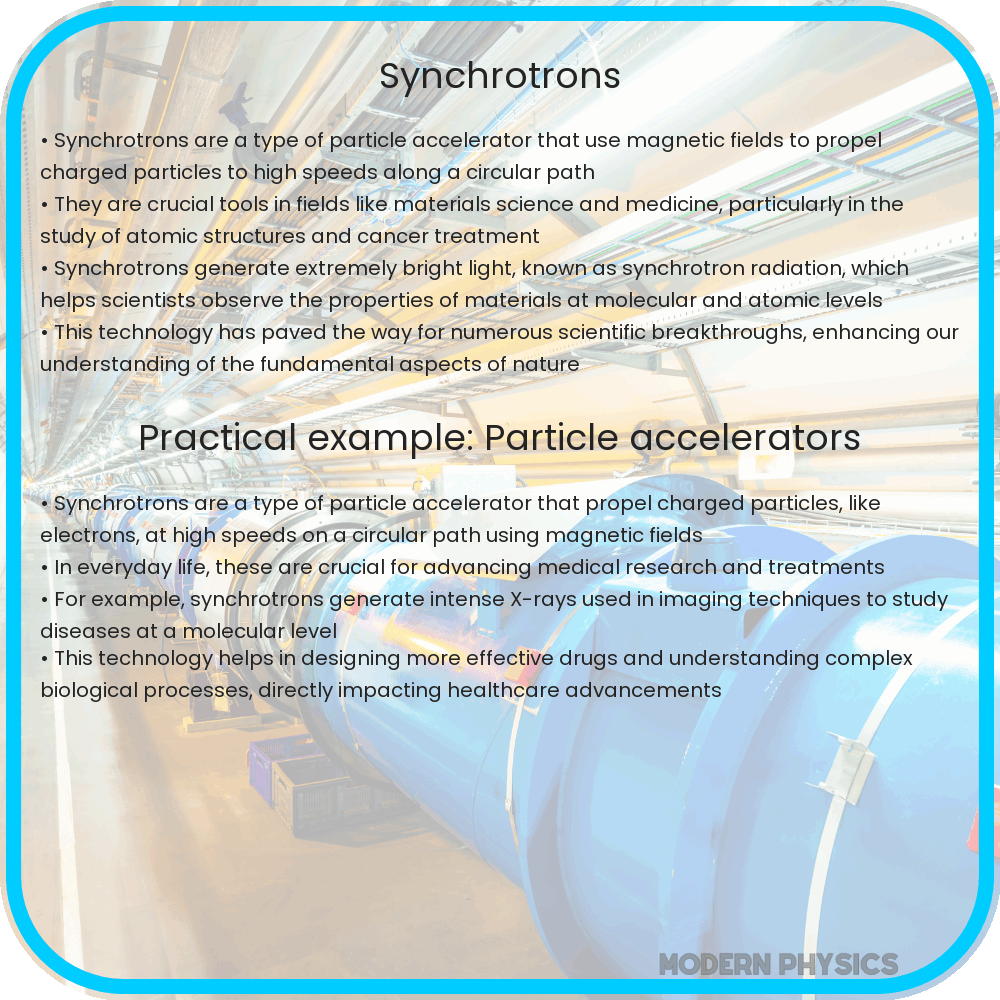
The world of modern physics and research is continuously illuminated by the advancements in synchrotron technology. A synchrotron is a type of circular particle accelerator, in which particles such as electrons are propelled to near-light speeds, harnessing the principles of Einstein’s relativity. This high-power tool has become indispensable in various fields of scientific investigation, from material science to biology.
The Principles of Synchrotrons
At its core, a synchrotron accelerates particles along a circular path using magnetic fields. The particles are injected at high speeds and are kept in a stable orbit by magnetic fields. As they move, these charged particles emit extremely bright light, often in the X-ray spectrum, which is utilized for research. This emitted light, known as synchrotron radiation, is highly valued for its intensity and wide spectrum, providing a powerful probe for examining the atomic and molecular structure of materials.
Relativistic Effects in Synchrotrons
One of the fascinating aspects of synchrotrons is their reliance on principles of relativity. As particles are accelerated to speeds approaching that of light, relativistic effects become significant. According to Einstein’s theory, as an object’s speed approaches the speed of light, its mass effectively increases, and time dilation occurs. These effects are crucial for the proper operation of synchrotrons, as they influence the behavior of particles under acceleration and their interaction with magnetic fields.
Applications in Research
Synchrotrons have a broad range of applications in scientific research. Their intense light beams are used in crystallography to determine the structure of complex molecules, such as proteins, aiding in the development of new pharmaceuticals. In materials science, synchrotron radiation helps in studying the properties of various materials, from superconductors to nanomaterials. Environmental science also benefits from synchrotron light, which can be used to analyze soil and water samples for pollution at the molecular level.
Advancements in Synchrotron Design
Recent advancements in synchrotron design have led to more compact and efficient facilities. These newer generation synchrotrons are capable of producing brighter and more focused beams, enhancing the resolution and sensitivity of the experiments conducted. This progress not only expands the potential applications of synchrotrons but also makes them more accessible to researchers around the world.
The Future of Synchrotrons: Expanding Horizons
Looking forward, the potential of synchrotrons continues to expand. One of the most exciting developments is the integration of artificial intelligence and machine learning in synchrotron research. These technologies enable the analysis of vast amounts of data generated by experiments, leading to quicker and more accurate results. Moreover, AI can optimize the operation of the synchrotron itself, enhancing efficiency and reducing costs.
Challenges and Innovations
Despite their successes, synchrotrons face challenges, particularly in terms of energy consumption and size. The next generation of synchrotrons aims to address these issues by developing more energy-efficient technologies and reducing the physical footprint of the facilities. Innovations like multi-bend achromat lattices are making it possible to design synchrotrons that are both smaller and more powerful, offering brighter beams with a smaller energy input.
Collaborative Efforts and Accessibility
The field of synchrotron science is also witnessing an increase in global collaboration. International partnerships are essential in sharing knowledge, resources, and access to these advanced facilities. This collaborative approach not only advances scientific research but also ensures that researchers from diverse backgrounds and countries can access this cutting-edge technology. Efforts are also being made to make synchrotron facilities more accessible to a broader range of scientists, including those from developing countries, thus democratizing high-end scientific research.
Impact on Society and Industry
Beyond academic research, synchrotrons have a significant impact on industry and society. They are instrumental in developing new materials and technologies, from renewable energy solutions to advanced electronics. In healthcare, synchrotron radiation is pivotal in imaging and therapy, offering new avenues in medical diagnostics and treatment. The environmental sector also benefits from synchrotron-based analyses, aiding in the monitoring and remediation of environmental pollutants.
Conclusion
Synchrotrons represent a remarkable convergence of physics, engineering, and technology, pushing the boundaries of scientific research. By harnessing the power of relativistic physics, these facilities offer unparalleled insights into the fundamental structure of matter. As synchrotrons continue to evolve, integrating advanced technologies and fostering global collaboration, they stand at the forefront of scientific discovery. Their impact extends far beyond the confines of laboratories, influencing various aspects of our lives and driving innovation in countless fields. The future of synchrotron science not only promises continued scientific breakthroughs but also holds the potential to address some of the most pressing challenges facing humanity today.