
Explore the intersection of astrophysics and data science in Astroinformatics, where big data and predictive models unveil the mysteries of the universe.
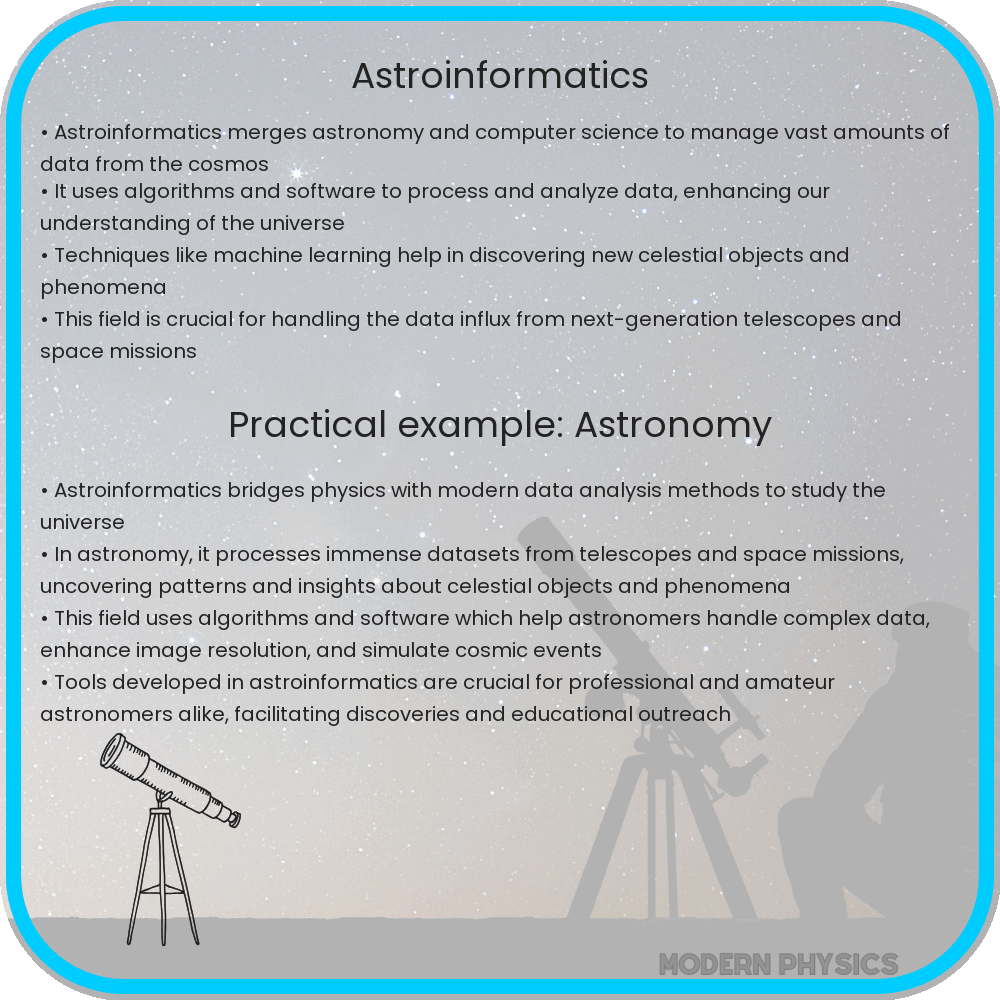
Astroinformatics: Navigating the Cosmos through Big Data and Predictive Models
The burgeoning field of Astroinformatics stands at the intersection of astrophysics and computer science, wielding the tools of big data and predictive modeling to unravel the mysteries of the universe. This innovative discipline leverages the massive volumes of data generated by telescopes and space missions, applying sophisticated algorithms and machine learning techniques to understand cosmic phenomena and forecast astronomical events.
Big Data in Astrophysics
Astrophysics has entered an era of unprecedented data abundance, primarily driven by advances in telescope technology and space exploration. Instruments like the Hubble Space Telescope, the Chandra X-ray Observatory, and the upcoming James Webb Space Telescope produce terabytes of data daily. This data deluge encompasses a wide array of information, including images, spectra, and time series, each holding clues to the behavior and properties of stars, galaxies, and other celestial bodies.
Handling this immense data volume poses significant challenges but also offers unprecedented opportunities for discovery. Astroinformatics employs big data technologies such as Hadoop and Spark, alongside advanced storage solutions, to manage, process, and analyze this information. This enables astronomers to sift through the cosmic haystack with greater efficiency, uncovering needles of insight that advance our understanding of the universe.
Predictive Models in Astrophysics
Predictive modeling is another cornerstone of Astroinformatics, empowering scientists to forecast celestial events and understand complex astrophysical processes. By applying machine learning algorithms to historical and real-time data, researchers can predict phenomena such as solar flares, supernovae, and the orbits of potentially hazardous asteroids. These models are not only vital for advancing scientific knowledge but also for practical applications like satellite safety and deep-space mission planning.
Moreover, predictive models help in deciphering the large-scale structure of the universe and the evolution of galaxies. By simulating different scenarios and comparing them with observational data, astroinformaticians can test theories about dark matter, dark energy, and the very fabric of spacetime itself.
The Role of Machine Learning in Astroinformatics
Machine learning (ML) stands as a pivotal component in the astroinformatics toolkit. Through ML techniques such as supervised, unsupervised, and reinforcement learning, astronomers can identify patterns and correlations within complex datasets that would be impossible for humans to discern unaided. For instance, ML algorithms have been instrumental in classifying galaxies, detecting exoplanets, and identifying gravitational waves. The iterative nature of these algorithms means that as more data becomes available, the models become increasingly accurate and insightful, further propelling the field forward.
Challenges and Future Directions
Despite its significant advances, Astroinformatics is not without its challenges. The sheer scale and complexity of astrophysical data can overwhelm existing computational frameworks, necessitating continuous development in data storage, processing power, and algorithm efficiency. Additionally, the interdisciplinary nature of astroinformatics demands a cohesive blend of expertise from astronomy, computer science, statistics, and other domains, highlighting the need for comprehensive education and collaboration in this field.
Looking ahead, the future of Astroinformatics is bright and brimming with potential. The upcoming era of Extremely Large Telescopes and next-generation space observatories will produce an even larger influx of data, further emphasizing the importance of advanced analytical techniques. Additionally, the integration of artificial intelligence and virtual reality into astroinformatics tools promises to enhance data visualization and interpretation, offering deeper insights into the cosmos than ever before.
Conclusion
Astroinformatics represents a monumental shift in how we approach the cosmos, transforming the deluge of astronomical data into a springboard for discovery and innovation. By harnessing the power of big data, predictive models, and machine learning, this field enables us to navigate the vast complexities of the universe with unprecedented precision and insight. As we continue to expand our technological capabilities and deepen our interdisciplinary collaboration, the horizons of astroinformatics will stretch even further, promising new revelations about the cosmos that awaits our exploration. The journey through data to the stars has just begun, and the future of Astroinformatics is as boundless as the universe itself.