
Learn about acoustic particle velocity sensors, devices that measure sound wave particle motion for accurate acoustic analysis.
Introduction to Acoustic Particle Velocity Sensors
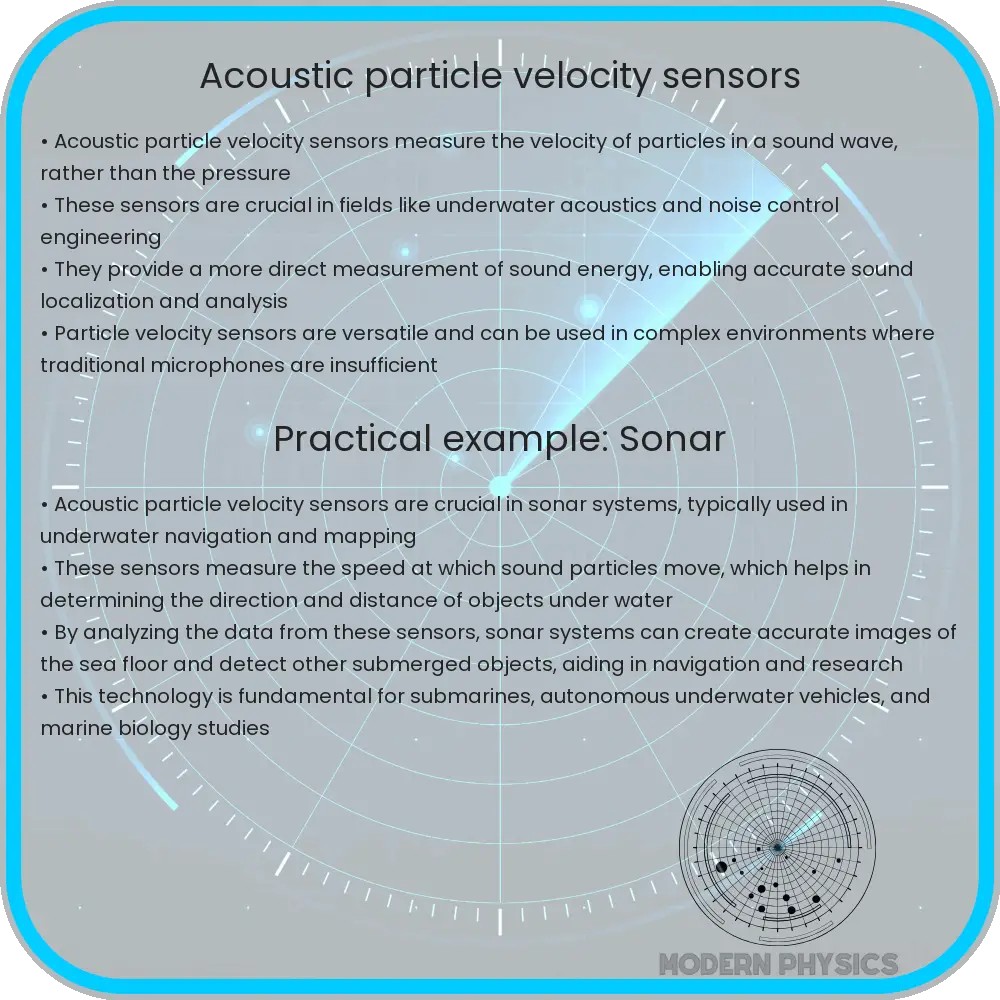
Acoustic particle velocity sensors are specialized devices designed to measure the velocity of particles within a sound wave. Unlike conventional microphones that measure pressure variations, these sensors detect the actual particle motion induced by sound waves. This unique capability enables them to provide more detailed information about the acoustic environment, improving the accuracy and efficacy of sound measurement.
Precision and Sensitivity of Acoustic Particle Velocity Sensors
The precision and sensitivity of acoustic particle velocity sensors are pivotal in numerous applications, ranging from noise control in industrial settings to advanced audio recordings. These sensors exhibit high precision because they directly measure the particle velocity vector, which is less susceptible to the distortions that affect pressure measurements. Sensitivity, on the other hand, refers to their ability to accurately detect and respond to very slight changes in particle velocity, a critical attribute in environments where minimal sound variations must be captured precisely.
Mathematically, the particle velocity \( \vec{v} \) in a sound wave can be expressed as follows:
\[ \vec{v} = \frac{1}{\rho_0 c} \cdot \vec{\nabla} p \]
where \( \rho_0 \) is the density of the medium, \( c \) is the speed of sound in the medium, and \( \vec{\nabla} p \) represents the gradient of the sound pressure.
Applications of Acoustic Particle Velocity Sensors
One of the main applications of acoustic particle velocity sensors is in the field of acoustic vector sensors (AVS), where they are used to capture the directionality of sound waves. This is particularly useful in complex environments where sound sources are numerous and diverse, such as in underwater acoustics or in crowded urban areas. Here, the ability to pinpoint the direction of incoming sound waves facilitates better sound source identification and localization.
Another critical application is in the enhancement of audio quality in electronic devices such as smartphones and smart speakers. By integrating acoustic particle velocity sensors, these devices can better analyze the acoustic environment and optimize audio output to suit specific spatial configurations.
- Environmental Monitoring: Particle velocity sensors are employed to monitor environmental noise levels, contributing to sound pollution studies and helping in the development and enforcement of noise regulation policies.
- Vibro-Acoustic Testing: In industries where machinery health is crucial, such as in aerospace and automotive sectors, these sensors play a vital role in diagnosing and monitoring the vibrational behaviors of different components, preventing failures.
- Medical Applications: In the medical field, these sensors aid in hearing aid technologies and ultrasonic imaging by providing clearer and more precise sound detection capabilities.
With their high precision and sensitivity, acoustic particle velocity sensors are revolutionizing the field of acoustics, opening new doors for technological advancements and improved sound quality in various applications.
Technological Advancements in Acoustic Particle Velocity Sensors
Recent technological advancements have significantly enhanced the performance and application scope of acoustic particle velocity sensors. Innovations in micro-electromechanical systems (MEMS) technology, for instance, have led to the development of smaller, more efficient, and lower-cost sensors. These advancements not only make the sensors more accessible but also increase their integration possibilities in various electronic devices and systems.
Furthermore, the incorporation of artificial intelligence and machine learning techniques has improved the analytical capabilities of these sensors. By processing the velocity data collected, these systems can automatically differentiate between different types of sounds and even identify specific sound signatures, making them extremely useful in security systems and wildlife monitoring.
Challenges and Future Directions
Despite their numerous advantages, acoustic particle velocity sensors face certain challenges. One of the main issues is their sensitivity to environmental factors such as temperature and humidity, which can affect their accuracy. Ongoing research is focused on enhancing the robustness of these sensors to ensure consistent performance in various climatic conditions.
Another challenge is the integration complexity in existing audio systems without compromising the system’s overall design and functionality. Future developments may focus on creating more adaptable designs that can easily be incorporated into different frameworks without significant alterations.
As the demand for better sound quality and more precise acoustic measurements increases, the future of acoustic particle velocity sensors looks promising. Researchers and engineers are continuously exploring new materials and technologies to further enhance these sensors, potentially leading to breakthroughs in acoustic sensing technology.
Conclusion
Acoustic particle velocity sensors represent a significant leap in sound measurement technology. By directly measuring the velocity of sound particles, they offer a level of precision and sensitivity that traditional sound measurement devices cannot match. The wide-ranging applications—from environmental monitoring to enhancing audio experiences in consumer electronics—demonstrate their versatility and importance.
Continued advancements in technology and integration techniques will likely expand their functionalities and reduce limitations, making these sensors an even more integral part of our technologically driven world. Whether in industry, environmental science, or personal electronics, acoustic particle velocity sensors are poised to play a crucial role in the future of sound measurement and analysis.