
Acoustic cameras visualize and analyze sound by capturing time-delayed noises with multiple microphones and using beamforming to map their sources and intensities.
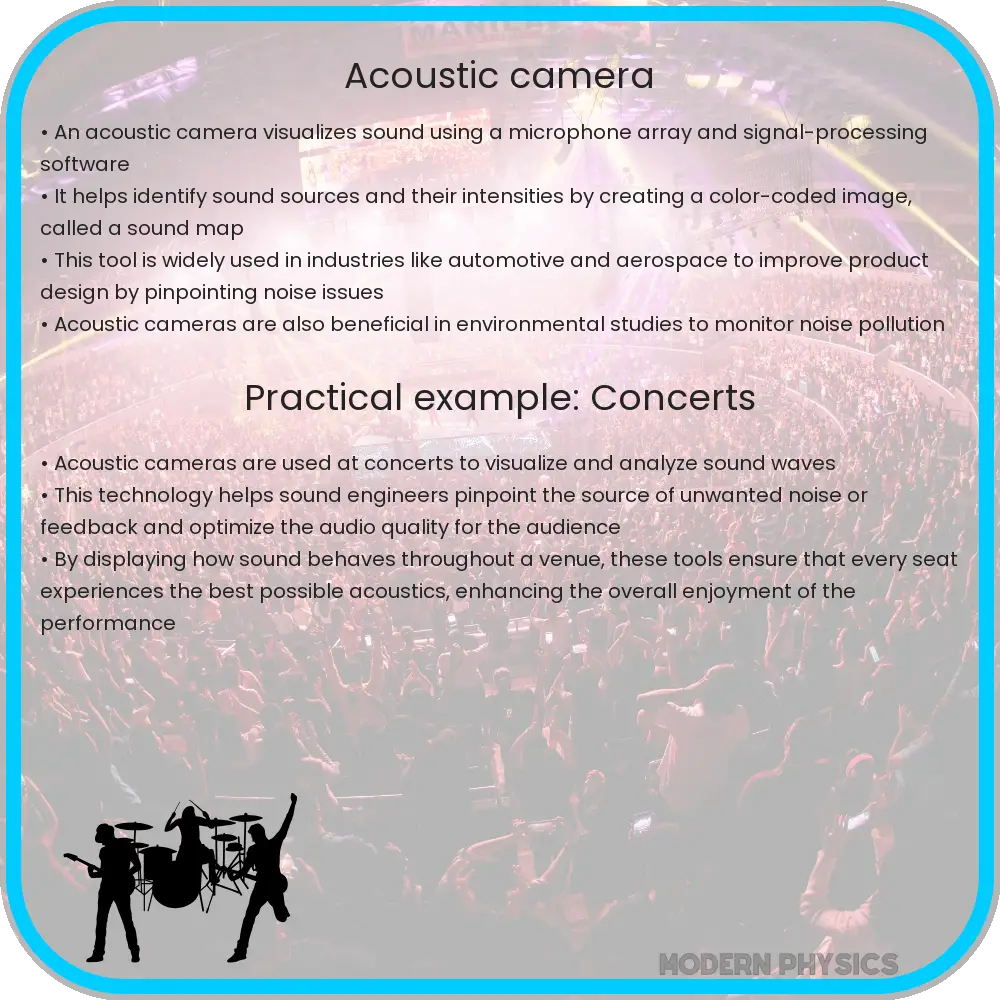
Understanding the Acoustic Camera: A Sound Solution for Noise Mapping, Leak Detection, and Analysis
Acoustic cameras are innovative devices that play a pivotal role in visualizing and analyzing sound. By effectively combining the science of acoustics and state-of-the-art imaging technology, these cameras are revolutionizing how we approach problems involving noise and vibrations. Their applications range from industrial noise mapping to detecting leaks in complex piping systems.
What is an Acoustic Camera?
An acoustic camera is a sophisticated device designed to make sound visible. This technology employs a series of microphones (sometimes numbering in the hundreds) strategically placed around a camera. The microphones capture sound at slightly different times, depending on their distances from the source. Using algorithms that process these time delays – a method known as beamforming – the acoustic camera constructs a visual map that illustrates where sounds are coming from, their intensity, and how they propagate through space.
Applications of Acoustic Cameras
- Noise Mapping: Acoustic cameras are extensively used for creating detailed noise maps in various environments, such as urban areas, manufacturing plants, and transportation systems. These maps help in understanding sound levels across different zones, which is crucial for urban planning, noise control, and regulatory compliance.
- Leak Detection: In industries and utilities, detecting leaks in pressurized systems (such as air, gas, or steam pipes) is crucial for maintaining operational efficiency and safety. Acoustic cameras help pinpoint the exact location of a leak by visualizing the sound emitted by escaping fluids or gasses, often saving time and reducing economic losses.
- Vibration Analysis: Vibration issues in machinery can lead to inefficiencies and failures. By identifying the source and characteristics of unwanted vibrations, acoustic cameras assist in machinery diagnostics, maintenance, and troubleshooting, enhancing the lifespan and performance of equipment.
How Acoustic Cameras Work
At the heart of an acoustic camera’s functionality is the beamforming technique. Consider a sound source at some distance from the camera. Each microphone in the array of the camera captures this sound, but with minor variations in time – a concept known as the time delay of arrival (TDoA). These time delays are intricately linked to the location and distance of the sound source with respect to each microphone.
The acoustic camera’s software computes these delays to construct a coherent sound map. The output is typically represented on a display that overlays sound intensity levels on a visual image of the scene. This allows users to ‘see’ the sound as colored patches or contours superimposed on the photographic image, where each color gradient represents different sound intensity levels.
The general equation used for sound imaging using beamforming can be simplified as:
S(x, y) = Σ Ai * f(ti – τ(x, y))
Here,
- S(x, y) denotes the sound intensity at a point (x, y).
- Ai represents the amplitude of the sound detected by the i-th microphone.
- f(ti – τ(x, y)) is the function describing the sound wave arriving at the i-th microphone with a delay τ(x, y), which depends on the distance between the microphone and the sound source at (x, y).
This mathematical model allows the acoustic camera to accurately visualize sound sources and their propagation patterns, providing valuable insights for noise analysis and mitigation strategies.
Advantages of Using Acoustic Cameras
Acoustic cameras offer several advantages over traditional sound measurement tools. Firstly, their ability to provide real-time visual feedback allows users to immediately identify and assess noise sources. This is particularly useful in dynamic environments where conditions change rapidly. Additionally, because the device is able to pinpoint the location of sound sources, it helps in effectively targeting noise reduction measures, which can be more cost-effective and efficient than general solutions.
Furthermore, acoustic cameras reduce the need for multiple noise measurements and complex setups. With their comprehensive coverage, they can analyze a broad area in a fraction of the time needed for conventional methods. This capability not only saves time but also reduces labor costs and the potential for human error in noise assessment.
Challenges and Limitations
While acoustic cameras are powerful tools, they do come with challenges. High initial investment costs could be a barrier for small businesses or individual users. Additionally, the effectiveness of acoustic cameras can be influenced by environmental conditions such as wind or background noise, which might complicate the accuracy of readings.
Another limitation is the requirement for skilled operation and interpretation of the data produced. It’s critical that those using acoustic cameras have a good understanding of both the technology and acoustics to fully leverage the capabilities of these devices.
Conclusion
Acoustic cameras are transforming the way we approach the analysis and mitigation of noise and vibrations. By making sound visible, these devices not only enhance our understanding but also improve our ability to effectively manage and control noise in various settings. Whether it’s mapping noise in urban areas, detecting leaks in industrial settings, or analyzing vibrations in machinery, acoustic cameras provide a sophisticated yet user-friendly solution.
Despite some challenges, the benefits of using acoustic cameras, such as their ability to save time, reduce costs, and increase the accuracy of noise assessments, far outweigh their limitations. As technology continues to advance, it’s likely that we will see even more innovative applications of acoustic cameras, making them an indispensable tool in noise management and sound analysis.