
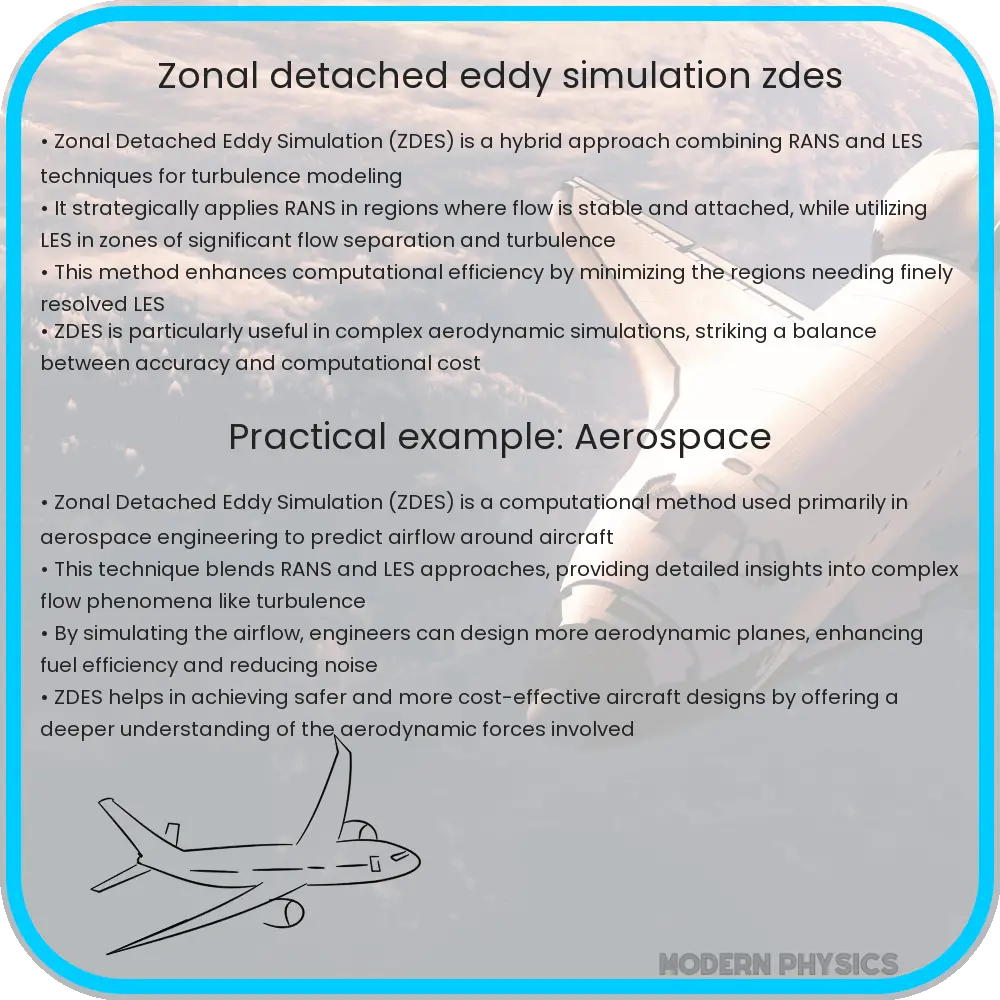
Zonal Detached Eddy Simulation (ZDES) is a hybrid computational model in fluid mechanics that combines elements of RANS and LES for accurate turbulence prediction.
Understanding ZDES: A Leap in Turbulence and Fluid Dynamics Simulation
Zonal Detached Eddy Simulation (ZDES) is a computational method used in the sphere of fluid mechanics, crucial for predicting and analyzing turbulent flows with high accuracy. This innovative approach combines the strengths of various turbulence modeling techniques to provide engineers and scientists with powerful insights into complex fluid behaviors.
Exploring the Basics of Turbulence and Fluid Dynamics
Before diving deep into the intricacies of ZDES, it’s essential to understand some fundamental concepts of fluid dynamics and turbulence. Fluid dynamics is the branch of physics that studies the movement of liquids and gases. Turbulence, a common yet complex phenomenon in fluid dynamics, refers to the chaotic, unpredictable state of fluid flow. It involves random, swirling motions and eddies, which are challenging to predict and quantify accurately using simple models.
The Hybrid Nature of ZDES
ZDES stands as a hybrid model, intelligently integrating elements from both Reynolds-Averaged Navier-Stokes (RANS) and Large Eddy Simulation (LES) models. RANS is efficient for calculating steady flow and dominant turbulent characteristics over long periods, while LES offers detailed, transient information about the smaller scales of turbulence.
The ZDES framework permits the application of RANS near solid boundaries where turbulence is influenced significantly by viscosity and shifts seamlessly to LES in regions away from these boundaries, where larger turbulent structures prevail. This transition is critical in capturing the accurate behavior of fluids without the computational expense of a full LES, which is computationally intensive.
Significance of Accurate Simulation in Engineering
Accurate simulation of turbulent flows is pivotal in numerous engineering applications, from designing aerodynamic vehicles to predicting weather patterns. Inaccuracies in turbulence modeling can lead to faulty designs and unsafe structures. ZDES provides a more realistic and practical approach to understanding and predicting fluid behavior in industrial applications, reducing the trial-and-error method in the design processes and ensuring the reliability and efficiency of engineering projects.
Advantages of ZDES Over Conventional Methods
ZDES offers several advantages over traditional turbulence models:
- Flexibility: By combining RANS and LES, ZDES adapts to various flow conditions, making it versatile across different applications.
- Efficiency: It reduces computational costs significantly by adjusting the level of detail required in different regions of the flow field.
- Accuracy: It enhances the prediction quality, particularly in transitional areas between laminar and turbulent flows, which are typically difficult to model correctly.
The deployment of ZDES in simulation software enhances the ability to predict complex flow phenomena across a broad range of industrial and environmental settings. This sophistication in modeling translates directly into improved designs and operational efficiencies in engineering tasks.
Challenges and Limitations of ZDES
While ZDES has many advantages, it also faces certain challenges and limitations that are important to acknowledge. One major challenge lies in the precise determination of the transition between the RANS and LES regions. Incorrect identification can lead to either excessive computational costs or insufficient model resolution, impacting the overall effectiveness of the simulation.
Additionally, ZDES requires high-quality computational resources and advanced expertise in both the setup and interpretation phases. The complexity of integrating two different modelling approaches can also introduce new sources of errors if not properly managed.
Future Prospects of ZDES in Fluid Dynamics
The ongoing development and refinement of ZDES are promising for the future of fluid dynamics. Continuous improvements in computational power and techniques are likely to enhance the accuracy and reduce the computational load of ZDES, making it even more accessible and applicable. Moreover, integrating machine learning and artificial intelligence could potentially automate parts of the transition between RANS and LES, leading to smarter, adaptive models.
Further research is also crucial in expanding the application scope of ZDES beyond its current uses to include more complex simulations like reactive flows or multiphase flows, which are prevalent in chemical engineering and energy solutions.
Conclusion
Zonal Detached Eddy Simulation represents a significant advancement in the field of turbulence and fluid dynamics. By merging the practicality of RANS with the detailed insights of LES, ZDES offers a versatile, efficient, and accurate tool for simulating complex fluid behaviors. This hybrid approach not only enhances our ability to predict and manage fluid flow in engineering systems but also paves the way for more innovative and reliable applications in various fields.
Despite the challenges and computational demands, the potential of ZDES in improving design efficiency and operational performance in engineering is undeniable. As technology progresses, further enhancements and wider adoption of ZDES will likely revolutionize our approach to understanding and manipulating fluid dynamics in the modern world.