
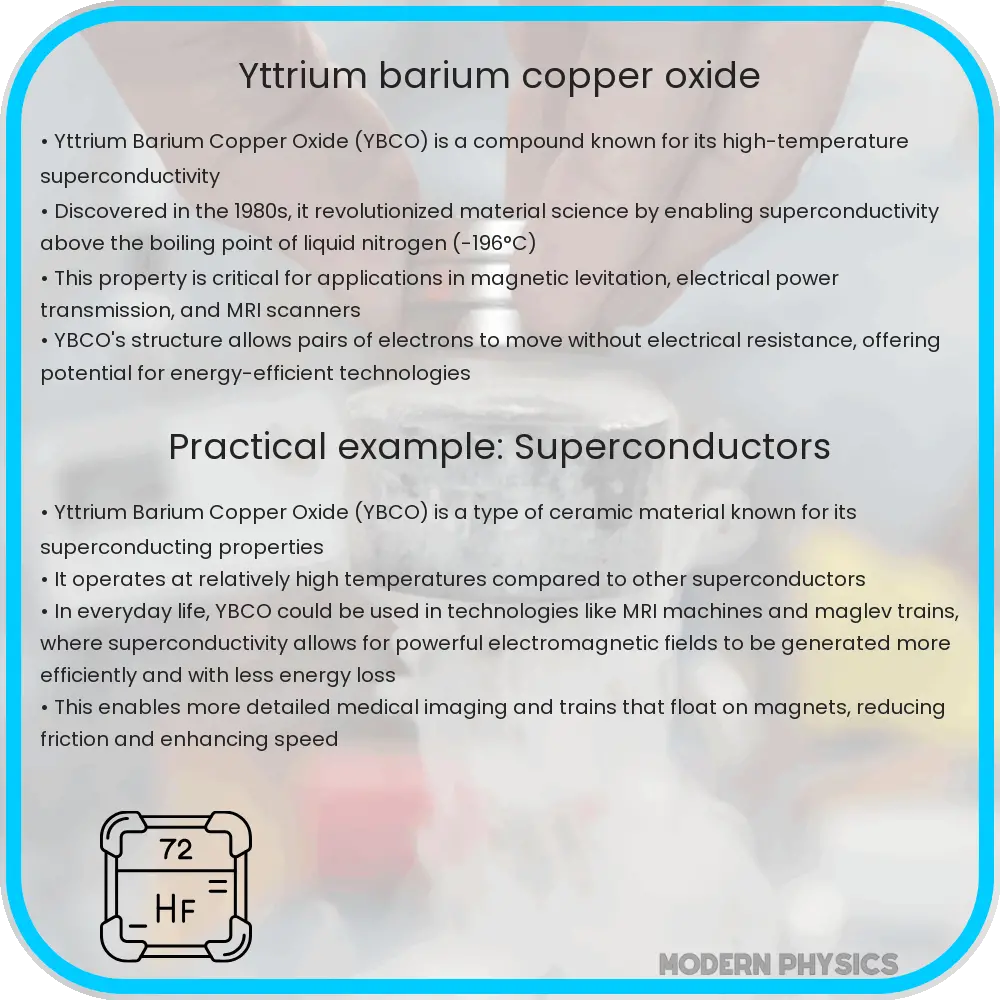
Yttrium Barium Copper Oxide (YBCO) is a high-temperature superconductor known for conducting electricity without resistance at temperatures above liquid nitrogen’s boiling point.
Understanding Yttrium Barium Copper Oxide: A Key Player in Superconductivity
Superconductivity remains one of the most fascinating areas in the field of physics, largely due to its potential to revolutionize industries by replacing conventional conductors with superconductors that can conduct electricity without resistance. Among the materials that exhibit this remarkable property is Yttrium Barium Copper Oxide (YBCO).
Composition of Yttrium Barium Copper Oxide
Yttrium Barium Copper Oxide, represented chemically as YBa2Cu3O7, is a crystalline compound that is part of the family of high-temperature superconductors. The composition of YBCO is particularly notable for including yttrium (Y), barium (Ba), and copper (Cu), along with oxygen (O). This material belongs to the class of cuprate superconductors, which are known for their ability to exhibit superconductivity at temperatures higher than those required by conventional superconductors, such as niobium alloys.
Superconductivity in YBCO
Superconductivity in YBCO was first discovered in 1987, a breakthrough that earned it considerable attention because it remains superconductive at temperatures above the boiling point of liquid nitrogen (-196°C). This is significant because liquid nitrogen is more affordable and easier to handle compared to liquid helium, which is needed for cooling many other superconductors.
The superconducting property of YBCO occurs when it is cooled below a critical temperature (Tc), which is approximately 92 K (-181°C). Below this temperature, YBCO enters a phase where it can conduct electric current with zero electrical resistance and expel magnetic fields, a phenomenon known as the Meissner effect.
Applications of YBCO
The ability to conduct electricity without resistance and its relatively higher critical temperature make YBCO an attractive material for various applications. One of its principal uses is in the manufacturing of magnets that are significantly more powerful than conventional magnets. These superconducting magnets find applications in a variety of fields such as:
- Magnetic Resonance Imaging (MRI) machines in the medical field, where stronger magnets can lead to better images and faster diagnostic capabilities.
- Magnetic levitation (Maglev) trains, where superconductors are used to levitate the train above the tracks, reducing friction and allowing for higher speeds and more efficient travel.
- Particle accelerators in the field of particle physics, where strong and stable magnetic fields are crucial for the acceleration and collision of subatomic particles.
Moreover, YBCO’s properties are being explored for their potential in power transmission systems. Superconducting wires made from YBCO could drastically reduce the losses experienced in conventional power cables, thus increasing efficiency and reducing energy costs and environmental impact.
Exploring the Limitations and Future Directions
While YBCo holds impressive benefits over traditional materials, its utilization in widespread applications is still under development largely due to challenges associated with its synthesis and integration into devices. Handling the material requires careful consideration of its physical and chemical properties to maintain its superconducting characteristics.
Researchers are continuously looking into ways to enhance the performance, affordability, and durability of YBCO and other similar materials through various methods such as doping and discovering new compounds, with the aim of unlocking further practical uses of superconductivity in everyday technology.
The Fabrication of YBCO
Fabricating Yttrium Barium Copper Oxide involves intricate processes that require precise control over material composition and structure. Typically, YBCO is synthesized through techniques such as solid-state reaction where the raw materials are ground, mixed, and then heat-treated at high temperatures. Advanced methods like pulsed laser deposition and chemical vapor deposition can also be employed to create thin films of YBCO, which are essential for some high-tech applications like superconducting quantum interference devices (SQUIDs).
The quality of YBCO significantly affects its superconducting properties. Imperfections in the crystal structure, known as defects, can impede the flow of electric current, thereby diminishing the material’s effectiveness as a superconductor. Consequently, research in material science is heavily focused on improving the synthesis process to achieve higher purity and better structural integrity of YBCO films and bulk materials.
Environmental and Economic Impact
The use of YBCO and other high-temperature superconductors promises substantial environmental benefits. By enabling more efficient electrical systems, from power grids to transportation, the adoption of superconducting materials could significantly reduce the carbon footprint associated with energy production and consumption.
However, the economic aspect of using YBCO is also crucial. Despite its advantages, the cost of producing YBCO is still relatively high due to the complexity of its fabrication and the need for cryogenic systems to maintain its superconductivity. Economies of scale and advancements in technology may, over time, reduce these costs, making the widespread use of YBCO more feasible.
Conclusion
Yttrium Barium Copper Oxide stands out as a pivotal material in the field of superconductivity, pushing the boundaries of how we understand and utilize this remarkable physical phenomenon. With its ability to operate at higher temperatures and its potential in various high-impact applications, YBCO is at the forefront of redefining technology. Although challenges remain in terms of fabrication, cost, and integration, ongoing research and development are making steady progress towards overcoming these barriers. The journey of YBCO from a laboratory curiosity to a cornerstone of future technologies continues to inspire both scientists and engineers towards achieving a more efficient and technologically advanced future.