
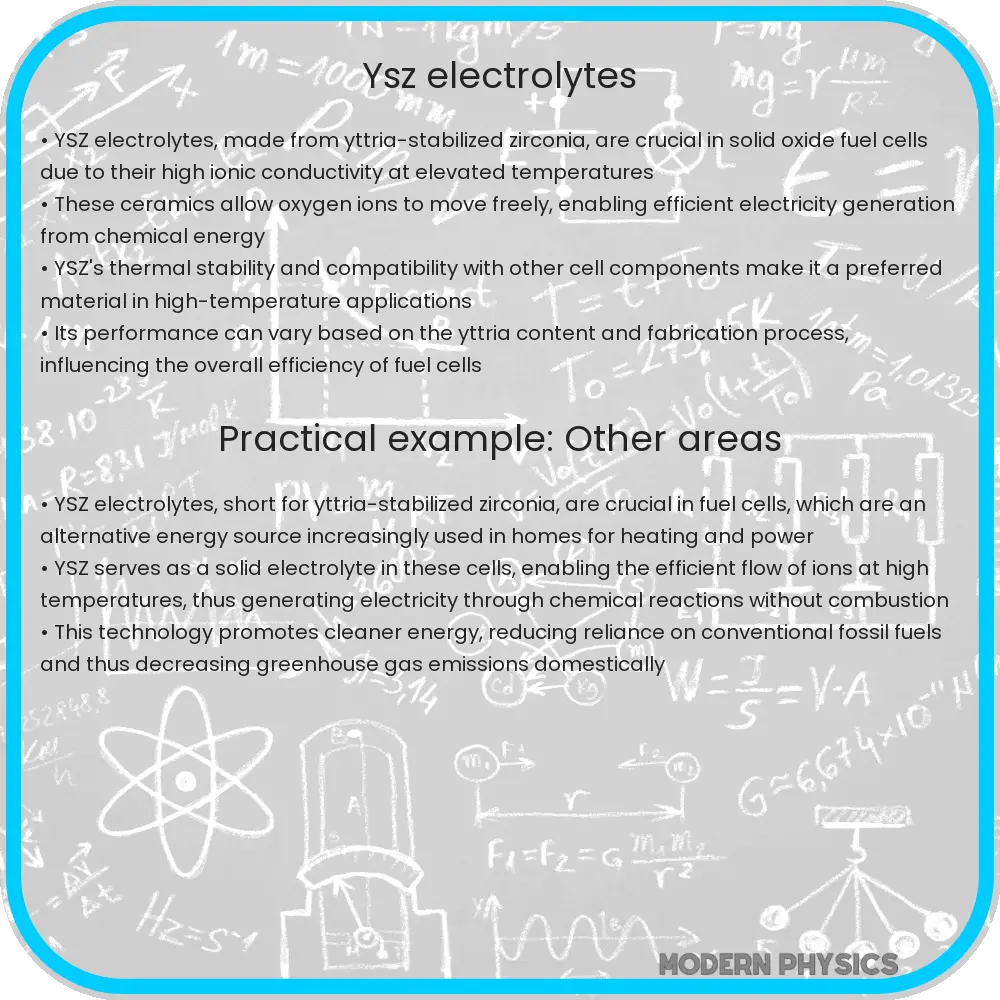
Yttria-stabilized zirconia (YSZ) is a ceramic material used for its ionic conductivity and stability in high-temperature applications like solid oxide fuel cells.
Introduction to YSZ Electrolytes
Yttria-stabilized zirconia (YSZ) is a ceramic material that has become a staple in various high-technology applications, particularly in solid oxide fuel cells (SOFCs). It’s widely used due to its impressive ionic conductivity, durability, and chemical stability at high temperatures. This article explores the characteristics of YSZ electrolytes, focusing on their stability, conductivity, and durability.
Chemical Stability of YSZ
YSZ is a combination of zirconium dioxide (ZrO2) and yttrium oxide (Y2O3), typically containing about 8 to 10 mole percent yttria. This composition is not arbitrary; the addition of yttria significantly enhances the thermal and structural stability of zirconia by stabilizing the high-temperature cubic crystal structure of ZrO2 at room temperature. The stabilization is necessary to prevent the phase transformation of zirconia that can lead to volume changes and mechanical failure. Having a stable structure at high temperatures, YSZ does not interact chemically with most substances, making it an excellent material for harsh environments, such as those found in SOFCs.
YSZ Conductivity
Oxygen ion conductivity is a crucial property for electrolyte materials in fuel cells. YSZ exhibits exceptional ionic conductivity due to vacancies created in its crystal lattice. At high temperatures, oxygen atoms can leave the lattice, creating vacancies that allow other oxygen ions to move through the crystal structure, thereby conducting electricity. The conductivity of YSZ is closely linked to its yittria content and the operating temperature. Typically, the ionic conductivity increases as the temperature rises, reaching an optimum between 700oC to 1000oC.
Durability of YSZ Electrolytes
The durability of YSZ in SOFC applications is one of its most valued qualities. YSZ electrolytes must withstand not just high temperatures but also the fluctuating operating conditions of fuel cells, which can induce thermal stresses. YSZ’s unique crystallographic structure provides a level of mechanical compliance and resistance to cracking under thermal stress, making it highly durable. Moreover, YSZ is resistant to degradation from carbon deposition and sulfur poisoning, which are common problems in other types of electrolytes used in fuel cells.
To further appreciate the practical applications and limitations of YSZ electrolytes in real-world engineering, let us explore some specific examples and discuss recent advancements and research in this field.
Real-World Applications of YSZ Electrolytes
YSZ electrolytes are predominantly used in solid oxide fuel cells (SOFCs), but their usage spans beyond that. They also find applications in oxygen sensors and high-temperature oxygen pumps due to their high ionic conductivity. In SOFCs, YSZ forms the crucial barrier between the fuel and oxidant, facilitating the movement of oxygen ions from the cathode side to the anode side, where they can react with hydrogen or carbon monoxide to generate electricity. This characteristic is vital for the efficiency and performance of fuel cells.
Recent Advancements in YSZ Technology
Research in the field of YSZ electrolytes continues to focus on enhancing their performance at lower temperatures to improve the overall efficiency and longevity of fuel cells. Recent advancements include doping with various oxides to enhance the ionic conductivity at lower temperatures and exploring nanostructuring of YSZ to increase the surface area, thereby enhancing the ionic transport. These innovations aim to reduce the operating temperature of SOFCs, which could lead to a broader range of applications and improved economic feasibility.
Future Outlook
The future of YSZ electrolytes looks promising with continuous research and development aimed at overcoming current limitations. Efforts to decrease the operational temperature of YSZ-based SOFCs and enhance durability under less rigorous conditions are potential areas of growth. This could lead to more widespread adoption in both industrial and commercial setups, where efficiency, longevity, and sustainability are crucial. Furthermore, as the global energy landscape shifts towards more renewable and cleaner sources, YSZ electrolytes will play a pivotal role in the integration of solid oxide fuel cells into the energy matrix.
Conclusion
Yttria-stabilized zirconia (YSZ) electrolytes are cornerstones in the development of high-performance solid oxide fuel cells, providing unmatched ionic conductivity, resilience under high operational temperatures, and excellent chemical stability. Their role extends beyond power generation; they are also critical in sensing and high-temperature pumping applications. Ongoing innovations and research geared towards improving their efficiency at lower temperatures and enhancing their physical properties suggest a bright future for YSZ electrolytes in advanced energy systems. As technology progresses, YSZ is expected to remain at the forefront, heralding a new era of energy solutions that are not only powerful but also environmentally friendly and sustainable.