
Explore York time slicing in general relativity: Insights into spacetime, gravitational waves, and the universe’s mysteries in astrophysics.
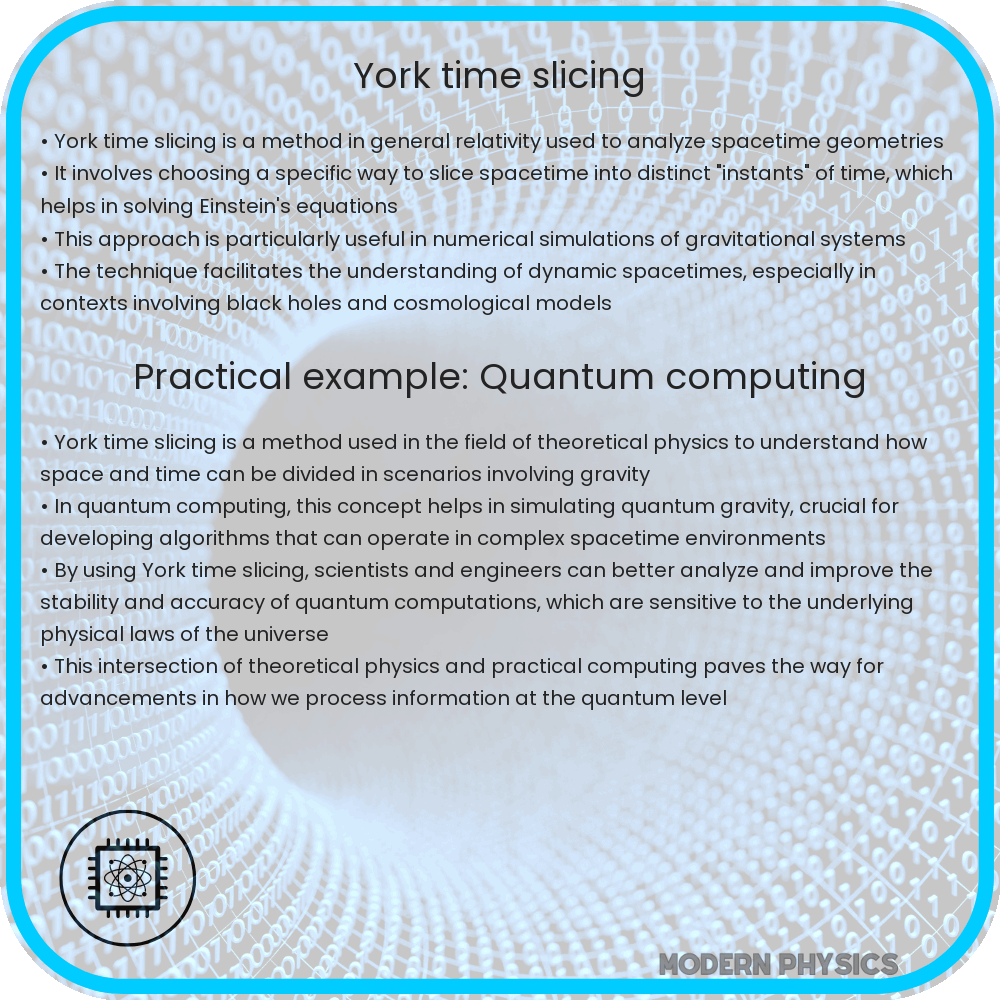
Exploring York Time Slicing in the Realm of General Relativity
The concept of York time slicing, a fascinating aspect within the field of general relativity, offers profound insights into our understanding of the spacetime continuum. General relativity, a theory developed by Albert Einstein, revolutionized our comprehension of gravity not as a force, but as a curvature of spacetime caused by mass and energy. This theory is encapsulated in the famous equation:
Rμν – ½gμνR + Λgμν = 8πGTμν
Here, Rμν and R represent the Ricci curvature tensor and scalar, gμν the metric tensor, Λ the cosmological constant, G Newton’s gravitational constant, and Tμν the stress-energy tensor.
Understanding York Time Slicing
York time slicing, named after the physicist James W. York, is a specific method for slicing spacetime into distinct “layers” or “slices. These slices, technically known as hypersurfaces, are used to analyze the evolution of gravitational fields in spacetime. This approach is particularly useful in numerical relativity, a branch that employs numerical methods and algorithms to solve the complex equations of general relativity.
One of the key aspects of York time slicing is its focus on the initial value problem in general relativity. This problem involves determining the future evolution of spacetime given initial data. York’s method provides a way to set this initial data on a hypersurface in a consistent manner with the Einstein field equations, thus ensuring a physically realistic evolution of spacetime.
Applications and Significance
The application of York time slicing is pivotal in the study of gravitational waves, black holes, and neutron stars. By dissecting the spacetime continuum into manageable segments, physicists can simulate and understand the dynamics of these celestial phenomena more accurately. This method has been instrumental in the progress of gravitational wave astronomy, which observes the ripples in spacetime caused by massive accelerating objects like colliding black holes.
Moreover, York time slicing aids in tackling the complexities inherent in the topology of spacetime. It simplifies the mathematical treatment of spacetime’s curvature and evolution, offering clearer insights into phenomena like black hole mergers and the warping of spacetime near massive objects.
Challenges and Future Prospects
Despite its substantial contributions, the application of York time slicing in general relativity faces several challenges. One of the primary issues is the computational intensity required to solve the Einstein field equations, especially in scenarios involving highly dynamic and complex spacetimes, such as those near the event horizon of a black hole. Moreover, the method demands a high degree of precision in setting initial conditions to accurately predict future spacetime evolution, a task that becomes increasingly difficult in highly nonlinear gravitational fields.
Future prospects in this field are directed towards enhancing computational techniques and algorithms for better handling of the vast amount of data and the complexity of calculations required. Researchers are also exploring the integration of quantum mechanics with general relativity, an endeavor that could potentially lead to a more comprehensive theory of quantum gravity. York time slicing could play a crucial role in this integration by providing a clearer framework for analyzing spacetime at both macroscopic and microscopic scales.
Conclusion
York time slicing within the framework of general relativity represents a significant advancement in our understanding of the universe’s fabric. It not only facilitates a deeper comprehension of gravitational phenomena but also bridges theoretical predictions with observational astronomy, particularly in the realm of gravitational waves. While it presents computational and theoretical challenges, its continued refinement and application are crucial for unraveling the mysteries of the cosmos.
The interplay of York time slicing and general relativity exemplifies the beauty and complexity of astrophysical research. As we stand on the cusp of new discoveries in gravitational wave astronomy and quantum gravity, York’s method continues to be an invaluable tool in deciphering the enigmatic dance of spacetime. Its role in the future of astrophysics and cosmology is not just promising; it’s essential. In the quest to understand our universe, York time slicing serves as a guiding light, illuminating paths through the complex tapestry of spacetime and gravity.