
Explore the Yarkovsky Effect and its impact on asteroid orbits, understanding its causes, consequences, and the challenges in predicting asteroid paths for Earth’s safety.
Understanding the Yarkovsky Effect in Asteroids
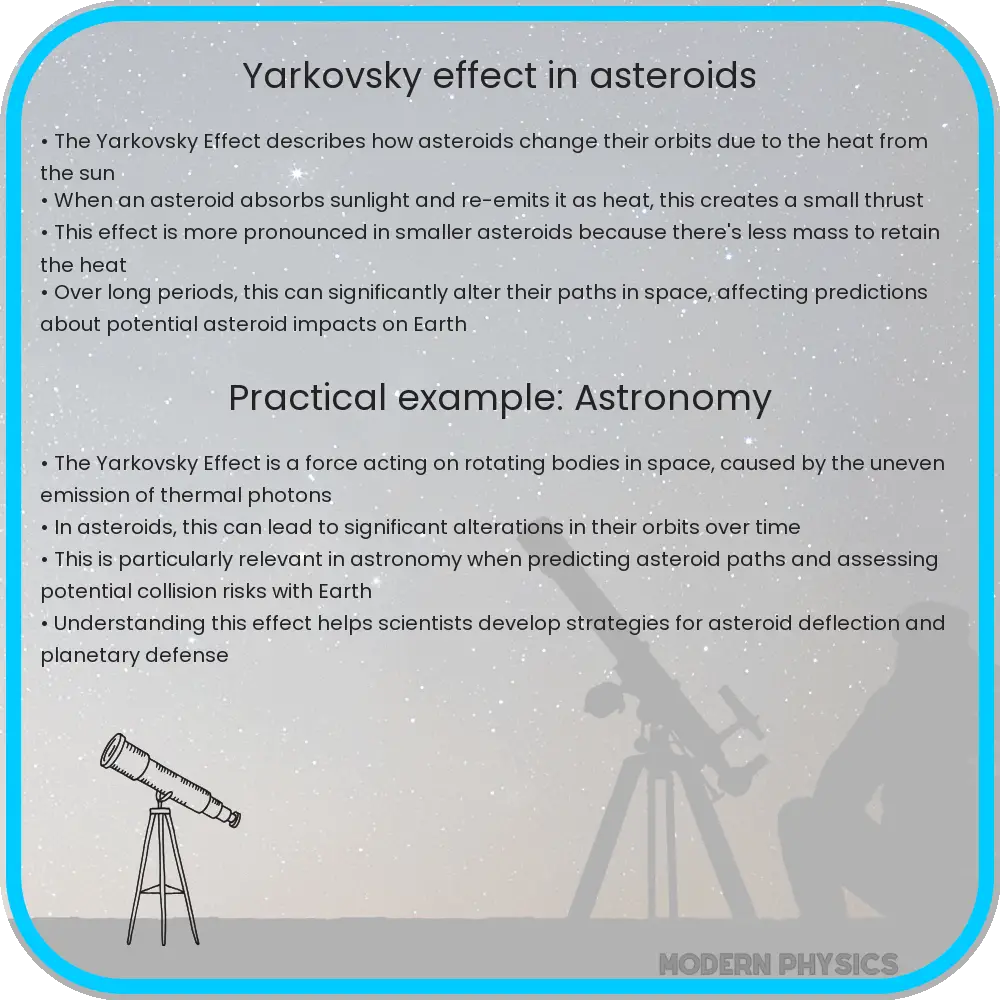
The Yarkovsky Effect is a subtle but significant force affecting the movement of asteroids in space. This phenomenon occurs due to the uneven heating and cooling of an asteroid’s surface, primarily caused by the Sun’s radiation. Understanding this effect is crucial for predicting the paths of asteroids and assessing their impact risk on Earth.
Causes of the Yarkovsky Effect
The Yarkovsky Effect arises from two main processes: the absorption of sunlight and the re-emission of heat. During the day, an asteroid’s surface absorbs solar radiation, and at night, it releases this energy back into space in the form of heat. However, due to the asteroid’s rotation and shape, this re-emission is not uniform. The differential in temperature across the asteroid’s surface leads to a small but measurable force that can alter its orbit over time.
Impacts of the Yarkovsky Effect
The primary impact of the Yarkovsky Effect is the gradual change in an asteroid’s orbit. Over years and decades, this can lead to significant shifts, making long-term predictions of asteroid paths challenging. The effect is more pronounced in smaller asteroids, typically those under a kilometer in diameter, due to their larger surface area-to-mass ratio.
Predicting the Yarkovsky Effect
Predicting the influence of the Yarkovsky Effect on an asteroid requires understanding its size, shape, rotational properties, and thermal characteristics. Advanced computational models and observations, such as infrared measurements, are used to estimate the effect’s magnitude and direction on the asteroid’s trajectory. These predictions are crucial for assessing potential Earth impacts, especially for near-Earth objects (NEOs).
Despite its challenges, accurately assessing the Yarkovsky Effect is essential for our planetary defense efforts. By improving our understanding and prediction capabilities, we can better assess the risks posed by asteroids and develop more effective strategies to mitigate potential impacts.
Challenges in Assessing the Yarkovsky Effect
While the Yarkovsky Effect is a recognized phenomenon, accurately measuring and predicting its impact remains challenging. The primary difficulty lies in the precise determination of an asteroid’s physical and thermal properties. Variations in an asteroid’s shape, composition, and surface texture can significantly influence the strength and direction of the effect. Additionally, the long-term nature of the Yarkovsky Effect requires continuous observation and tracking of asteroids over extended periods to understand its cumulative impact on their orbits.
Future Directions in Yarkovsky Effect Research
The ongoing advancement in space technology and observational techniques offers promising prospects for better understanding the Yarkovsky Effect. Future missions to asteroids, such as NASA’s OSIRIS-REx, aim to collect detailed data on asteroid characteristics that influence the Yarkovsky Effect. Furthermore, improvements in computational modeling and the growing network of ground-based observatories will enhance our ability to predict the Yarkovsky-induced changes in asteroid orbits more accurately.
Conclusion
The Yarkovsky Effect, though subtle, plays a significant role in the dynamics of asteroid movement. Understanding this phenomenon is crucial for accurately predicting the orbits of asteroids, particularly those that could pose a threat to Earth. Despite the challenges in measuring and predicting the Yarkovsky Effect, ongoing research and technological advancements continue to improve our understanding of this cosmic force. By advancing our knowledge and predictive capabilities, we can better prepare for and mitigate the potential risks posed by near-Earth objects, safeguarding our planet from possible asteroid impacts.