
Explore the intricacies of Yang-Mills Theory in QED, its impact on gauge symmetry, the mass gap problem, and the unification of fundamental forces.
Understanding Yang-Mills Theory in Quantum Electrodynamics (QED)
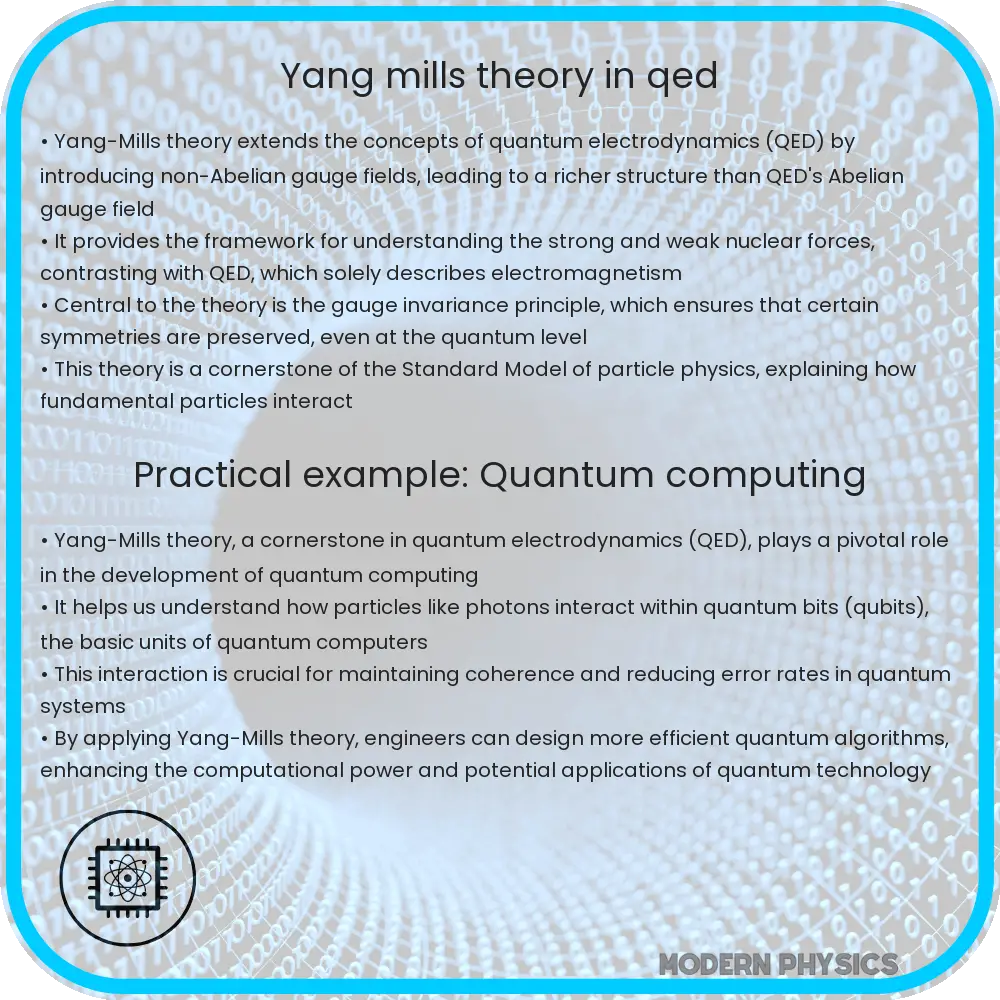
Yang-Mills Theory represents a cornerstone in our understanding of quantum field theory, particularly within the framework of Quantum Electrodynamics (QED). This theory extends the concept of gauge symmetry, a fundamental principle in particle physics, to non-Abelian gauge groups. Originally developed by Chen Ning Yang and Robert Mills, this theory sought to generalize the electromagnetic gauge symmetry of QED to include the strong and weak nuclear forces.
Gauge Symmetry and Its Role in QED
Gauge symmetry is a pivotal concept in field theories, especially in QED. In simple terms, it implies that certain transformations can be made in the field equations without altering the physical phenomena they describe. QED, which deals with the interactions between photons and charged particles, relies heavily on the U(1) gauge symmetry. This symmetry underpins the electromagnetic force, describing how charged particles like electrons and protons interact via the exchange of photons.
The Mass Gap Problem in Yang-Mills Theory
A central challenge in Yang-Mills Theory, and indeed in all of quantum field theory, is the “mass gap” problem. This problem involves the unexplained difference in energy between the lowest energy state (the vacuum) and the first excited state. In simple terms, it’s the gap between the ground state of a quantum system and the lowest energy state above it. For a theory to be physically realistic, this mass gap must exist, ensuring that particles have positive masses. The existence of a mass gap in Yang-Mills theory is essential for explaining the confinement of quarks within protons and neutrons, a phenomenon that is observed but not yet fully understood in quantum chromodynamics (QCD), a subset of Yang-Mills Theory.
Yang-Mills Theory and the Unification of Forces
One of the most intriguing aspects of Yang-Mills Theory is its potential in unifying the fundamental forces of nature. In the standard model of particle physics, the electromagnetic, weak, and strong nuclear forces are described using the framework of gauge theories. Yang-Mills Theory, with its extension to non-Abelian gauge groups, provides a mathematical structure that could potentially unify these disparate forces under a single theoretical framework. This unification is a key goal in the field of theoretical physics, aiming to create a coherent and comprehensive understanding of the fundamental interactions in the universe.
Exploring Non-Abelian Gauge Theories in Yang-Mills Theory
At the heart of Yang-Mills Theory is the extension of gauge symmetry to non-Abelian gauge groups. Unlike the Abelian group used in QED, where gauge transformations commute, non-Abelian groups feature transformations that do not necessarily commute. This characteristic leads to more complex interactions, such as those seen in quantum chromodynamics (QCD), the theory describing the strong nuclear force. QCD, a subset of Yang-Mills Theory, models the interactions between quarks and gluons, and explains phenomena like color confinement and asymptotic freedom, fundamental aspects of nuclear physics.
Implications of Yang-Mills Theory in Modern Physics
The implications of Yang-Mills Theory are profound in modern physics. It has not only provided a framework for understanding the strong and weak nuclear forces but also has implications in various fields like condensed matter physics, nuclear physics, and the ongoing quest for a Theory of Everything. The adaptability of Yang-Mills Theory to different contexts and its ability to describe a wide range of phenomena make it a powerful tool in theoretical physics.
Challenges and Future Directions
Despite its successes, Yang-Mills Theory faces several challenges. The mass gap problem remains unresolved, and the theory’s application to gravity is still in its infancy. Additionally, the unification of all fundamental forces, including gravity, into a single theory remains a distant goal. Future research in string theory, loop quantum gravity, and other areas may provide insights into these challenges, potentially leading to breakthroughs in our understanding of the universe.
Conclusion
Yang-Mills Theory, particularly its role in QED and the broader context of quantum field theory, represents a significant milestone in our understanding of the fundamental forces of nature. Its introduction of non-Abelian gauge symmetry has been instrumental in modeling the strong and weak nuclear forces and has opened doors to potential unifications of fundamental forces. Despite its complexities and unresolved challenges, Yang-Mills Theory continues to be a vital area of research in theoretical physics, holding promises for deeper insights into the workings of our universe. As research progresses, it may not only solve longstanding puzzles like the mass gap problem but also pave the way for new theories that could revolutionize our understanding of matter, energy, and the fabric of spacetime itself.