
Explore the enigmatic world of WIMPzilla, a potential key to unlocking dark matter and universe secrets. Delve into its challenges and future prospects.
Unraveling the Mystery of WIMPzilla
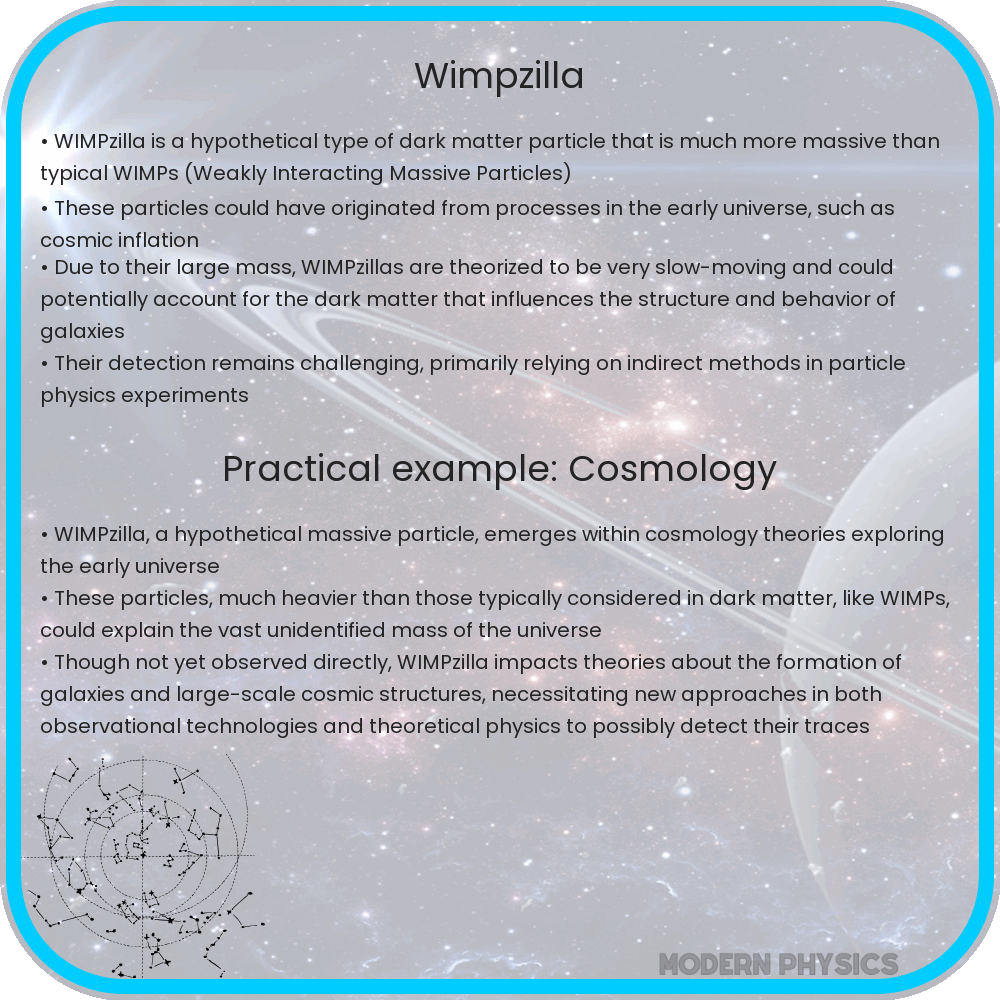
The quest to understand the universe’s dark matter is one of the most intriguing challenges in modern astrophysics. Among the various candidates proposed to explain this enigmatic component of the cosmos, the hypothetical particle known as “WIMPzilla” stands out due to its unique characteristics and implications for the early universe. WIMPzilla represents a class of particles that are not only massive but also interact weakly with ordinary matter, making them extremely difficult to detect.
Characteristics of WIMPzilla
WIMPzilla particles diverge significantly from the more commonly discussed Weakly Interacting Massive Particles (WIMPs). While WIMPs are typically considered to have masses near the electroweak scale (about 100 GeV/c2), WIMPzilla particles could be as heavy as 1015 GeV/c2 or beyond. This immense mass implies that they could have been produced by different mechanisms in the early universe, such as during inflationary periods or phase transitions.
Dark Matter and WIMPzilla
The existence of WIMPzilla could provide a compelling explanation for dark matter, which constitutes about 27% of the universe’s total mass and energy. Unlike conventional WIMPs, which would freeze out of thermal equilibrium in the early universe, WIMPzilla particles are theorized to be produced non-thermally. This means they could be remnants from the very early universe, providing a unique window into the conditions and processes that prevailed during that epoch.
Challenges in Detecting WIMPzilla
Despite their theoretical appeal, WIMPzilla particles pose significant detection challenges. Their weak interaction with ordinary matter and their potentially very high masses make them nearly invisible to current detection methods. However, their existence could be inferred indirectly through their gravitational effects on cosmic structures or through the detection of rare decay products.
As scientists continue to explore the cosmos and develop new technologies, the hunt for WIMPzilla and other dark matter candidates remains a central pursuit in unraveling the secrets of the universe.
Exploring the Implications of WIMPzilla
The theoretical implications of WIMPzilla particles extend beyond just the realm of dark matter. Their existence would have profound effects on the standard model of particle physics and our understanding of the early universe. For instance, confirming WIMPzilla as a major component of dark matter would suggest that the early universe could have been a place of extreme energies and processes, far beyond what is achievable in current particle accelerators. Additionally, it would provide insights into the nature of inflation and other phase transitions in the early cosmos.
Future Prospects in WIMPzilla Research
The pursuit of WIMPzilla is not just a theoretical endeavor; it has practical implications for the field of particle physics and cosmology. As detection technologies advance, new experimental setups, such as ultra-sensitive detectors located deep underground or in space, are being developed to catch these elusive particles. Moreover, interdisciplinary approaches combining astrophysics, particle physics, and cosmology are essential to enhance our chances of detecting WIMPzilla particles and understanding their role in the cosmic saga.
Additionally, advancements in computational physics are enabling more precise simulations of the early universe, offering potential indirect evidence for WIMPzilla particles through anomalies in cosmic microwave background radiation or in the distribution of galaxies and dark matter structures across the universe.
Conclusion
The quest for WIMPzilla represents one of the most fascinating frontiers in modern science, embodying the intersection of theoretical physics, cosmology, and cutting-edge technology. Although these particles remain hypothetical, their potential to unravel the mysteries of dark matter and the early universe continues to drive research and debate within the scientific community. Discovering WIMPzilla would not only reshape our understanding of the cosmos but also mark a monumental step in the quest to understand the fundamental components and forces shaping our universe. As we stand on the cusp of these potential discoveries, the journey to uncover the secrets of WIMPzilla and its cosmic brethren remains a compelling testament to human curiosity and our unending quest for knowledge.