
Explore the fascinating process of white dwarf crystallization, its impact on astrophysics, and how it unlocks secrets of the universe’s age and stellar evolution.
White Dwarf Crystallization: Unveiling the Mysteries of Aging Stars
White dwarfs, the remnants of stars that have completed their nuclear burning stages, represent the final phase in the lifecycle of medium to low-mass stars. These stellar corpses are fascinating subjects of study in astrophysics, particularly regarding their cooling process. A pivotal aspect of this process is the crystallization of white dwarfs, a phenomenon that significantly influences their thermal evolution and, consequently, our understanding of the age and dynamics of the universe.
The Crystallization Process
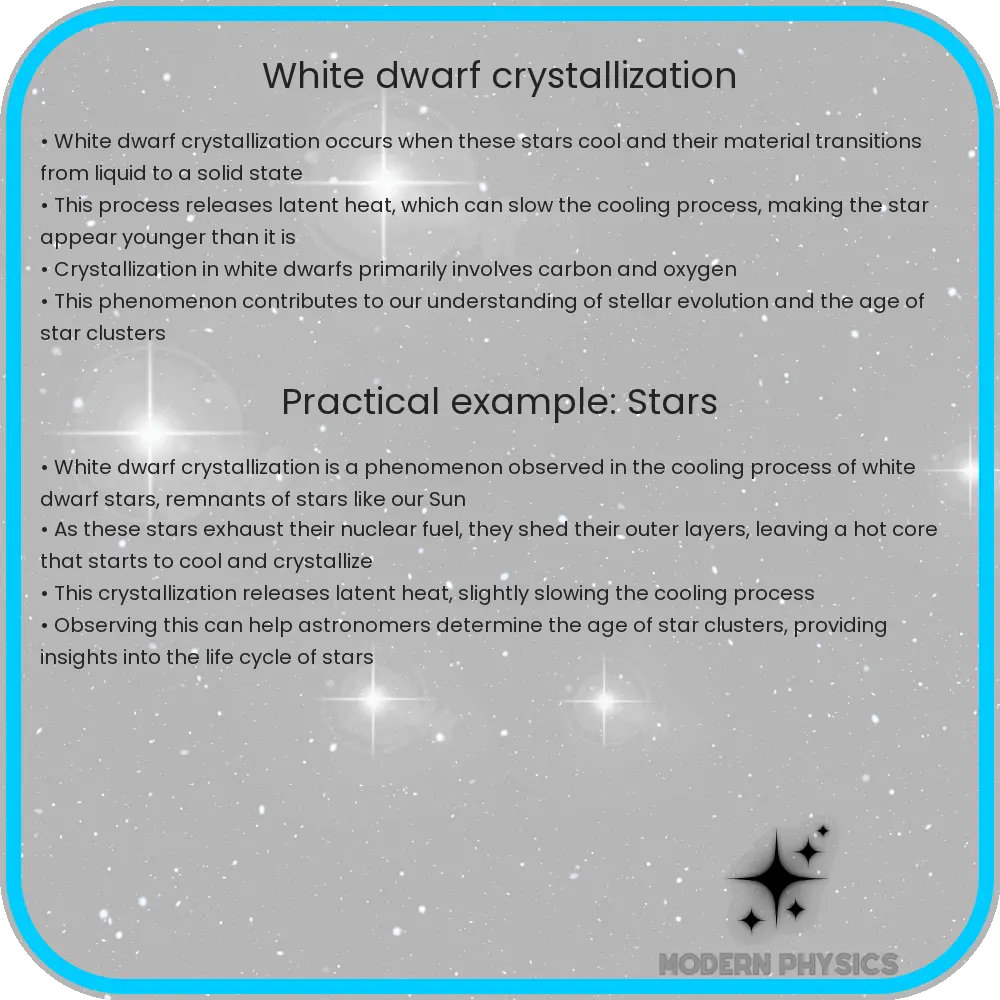
As a white dwarf cools, its core temperature drops, leading to the solidification of its constituent matter. This transition from liquid to solid is analogous to the freezing of water, albeit under much more extreme conditions. The crystallization process in white dwarfs predominantly involves the precipitation of carbon and oxygen, elements that were produced during the star’s earlier nuclear fusion stages. Due to the immense gravity within these stars, the crystallization initiates from the center and progresses outward, forming a solid core enveloped by a fluid mantle.
Implications in Astrophysics
The crystallization of white dwarfs serves as a cosmic clock, providing insights into the age of stellar populations. This process releases latent heat, slowing down the cooling rate and thereby extending the white dwarf’s lifespan on the Hertzsprung-Russell diagram. By observing these cooling rates and comparing them with theoretical models, astronomers can estimate the ages of various stellar cohorts, contributing to our understanding of galactic evolution.
- Gravitational Sedimentation: During crystallization, heavier elements like oxygen tend to sink towards the star’s center, while lighter elements like carbon float upwards. This differentiation affects the white dwarf’s chemical composition and cooling trajectory.
- Seismological Effects: The phase transition can induce changes in the star’s structure, potentially triggering seismic activities. These vibrations, akin to earthquakes, provide astrophysicists with clues about the internal composition and crystallization progress of white dwarfs.
- Impact on Cosmology: Understanding the crystallization process aids in refining the cosmic distance ladder. White dwarfs act as standard candles; hence, precise measurements of their luminosity and temperature help in determining distances to globular clusters and nearby galaxies.
Challenges and Future Directions
The study of white dwarf crystallization presents numerous challenges, primarily due to the limitations in observing these dim objects. Detecting the subtle signatures of crystallization requires highly sensitive instruments and innovative observational techniques. Advances in telescope technology and data analysis methods are crucial for improving the accuracy of these measurements. Additionally, theoretical models of white dwarf evolution must continuously be refined to incorporate new physical insights and observational data.
Conclusion
The crystallization of white dwarfs is a key phenomenon in the field of astrophysics, offering valuable insights into the life cycle of stars, the dynamics of stellar remnants, and the age of the cosmos. As white dwarfs transition from fluid to solid states, they provide a unique window into the processes occurring in extreme conditions not replicable on Earth. Despite the observational and theoretical challenges, ongoing research in this area holds the promise of unraveling more secrets of the universe, enhancing our understanding of stellar evolution, and refining our measurements of cosmic timescales. The crystallization of white dwarfs not only enriches our knowledge of the stars themselves but also serves as a beacon, guiding astronomers in the quest to comprehend the vast, enigmatic expanse of the cosmos.