
Explore the world of Whispering Gallery Mode Sensors: their precision, applications in biomedical research, environmental monitoring, and future prospects.
Understanding Whispering Gallery Mode Sensors
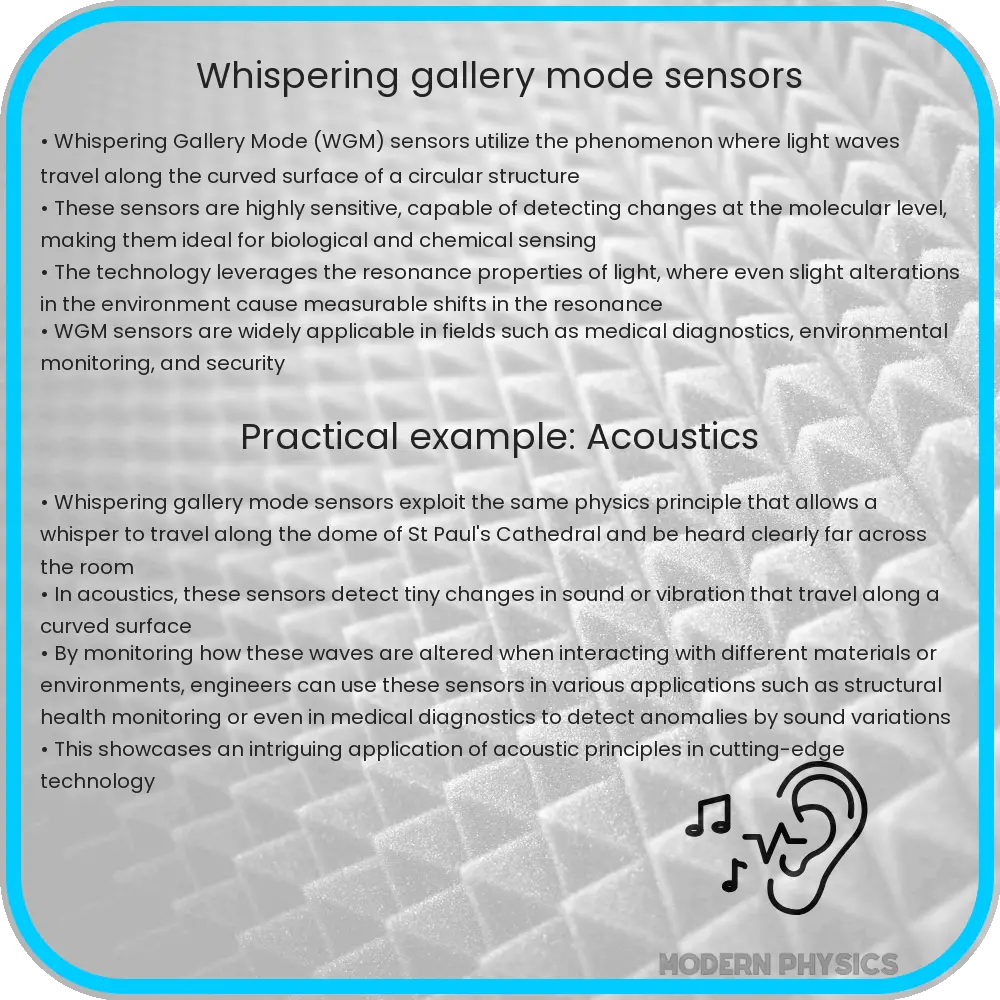
Whispering Gallery Mode (WGM) sensors represent a fascinating and rapidly evolving area of photonic technology. These sensors utilize the optical phenomena known as whispering gallery modes, first observed in the famous dome of St. Paul’s Cathedral in London, where sounds whisper along the wall can be clearly heard across the dome. In a similar vein, WGM sensors exploit the way light waves travel along the surface of a tiny circular structure, such as a microsphere, microdisk, or a microtoroid.
The principle behind WGM sensors is relatively straightforward yet ingenious. Light inside these tiny structures gets trapped by total internal reflection, causing it to circulate along the periphery. The circulating light creates standing wave patterns, or modes, which are extremely sensitive to changes in the environment. When molecules, such as those of a gas or a liquid, come into contact with the surface of the sensor, they slightly alter the optical path of the circulating light. This change can be measured with great precision, making WGM sensors incredibly sensitive.
Advantages of WGM Sensors
One of the key advantages of WGM sensors is their remarkable sensitivity. They can detect changes at the nanoscale, making them suitable for a variety of applications, from detecting single virus particles to monitoring environmental changes. Furthermore, their small size and the ability to integrate them into microchips make them highly compatible with existing technology.
Another significant advantage is the speed at which these sensors operate. WGM sensors can provide real-time monitoring and fast detection, which is crucial in applications where time is of the essence, such as in medical diagnostics or environmental monitoring.
Moreover, the optical nature of WGM sensors makes them inherently suitable for remote sensing applications. Since they operate on light, they can be connected to optical fibers, allowing for remote monitoring and data collection over long distances without significant loss of signal.
The versatility of WGM sensors is also noteworthy. They can be tailored to detect a wide range of substances by modifying the surface of the microstructure. For example, coating the surface with specific antibodies allows the sensor to detect particular types of proteins or pathogens, making them highly adaptable to different detection requirements.
Applications of Whispering Gallery Mode Sensors
Whispering Gallery Mode sensors find applications in various fields due to their precision and versatility. In the field of biomedical research, they are used for detecting biomarkers, viruses, and bacteria, contributing significantly to early disease detection and diagnosis. In environmental monitoring, these sensors play a crucial role in detecting pollutants and toxic substances, aiding in the preservation of ecosystems.
Another promising application is in the realm of telecommunications. Due to their high-quality optical resonances, WGM sensors can enhance optical communication systems. They can be used to stabilize laser frequencies, a crucial aspect in high-speed optical communication networks.
Furthermore, in the field of chemistry, WGM sensors enable the detection of chemical reactions at the molecular level. This ability is vital for understanding complex chemical processes, potentially revolutionizing the way chemical research is conducted.
Future Prospects and Challenges
Looking towards the future, the potential of WGM sensors continues to expand. Research is underway to enhance their sensitivity and selectivity further, opening doors to even more sophisticated applications. However, challenges remain, particularly in terms of integrating these sensors into more complex systems and improving their robustness for various environmental conditions.
Moreover, as with any emerging technology, the cost of production and implementation poses a challenge. Efforts are ongoing to make WGM sensors more economically viable for widespread use, ensuring they are accessible for a broader range of applications.
Conclusion
In conclusion, Whispering Gallery Mode sensors represent a breakthrough in precision measurement and detection technology. Their unparalleled sensitivity, speed, and adaptability to various applications make them a cornerstone in the advancement of optical sensing technology. As research and development continue, we can expect to see WGM sensors becoming an integral part of many technological solutions, from environmental monitoring to healthcare diagnostics, redefining the limits of what is detectable and measurable. The future of WGM sensors is bright, promising a new era in the field of precision optics and sensing technology.