
Explore the Westergaard Stress Function’s role in Continuum Mechanics for material stress analysis, crack propagation, and engineering design.
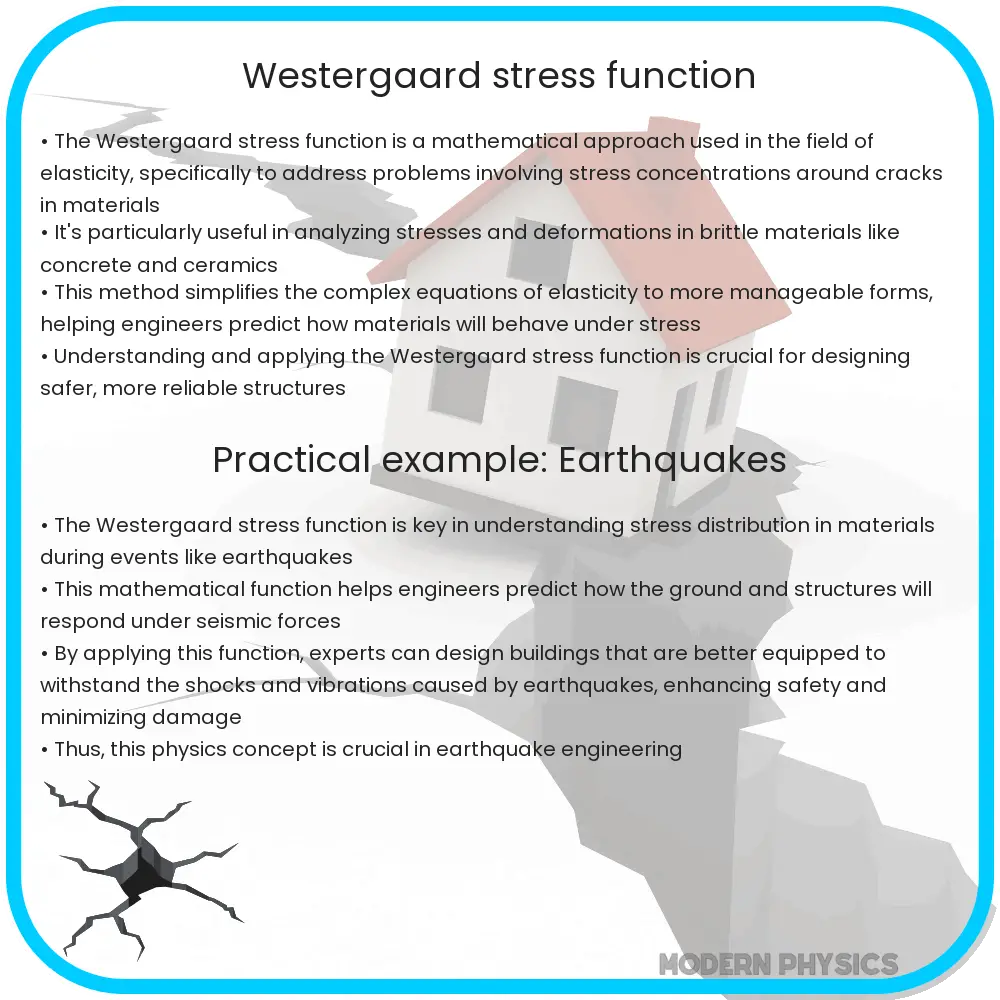
Understanding the Westergaard Stress Function in Continuum Mechanics
Continuum Mechanics, a fundamental branch of mechanics, deals with the analysis of the physical properties of materials considered as continuous masses. The Westergaard Stress Function, a critical concept in this field, offers a comprehensive approach for analyzing stress in materials under various conditions. This function, named after Danish engineer Jørgen Westergaard, has become a cornerstone in the study of material stress, particularly in the context of elasticity and fracture mechanics.
Theoretical Background
The Westergaard Stress Function arises from the need to solve complex stress problems in materials, especially those involving elastic deformations. It is particularly useful in addressing issues in plane stress and plane strain conditions. The function is formulated on the basis of potential theory and complex variable methods. The general expression of the Westergaard Stress Function, Z(x,y), for a two-dimensional problem is given as:
Z(x,y) = \(\phi(x + iy) + x \psi(x + iy)\), where \(\phi\) and \(\psi\) are analytic functions of the complex variable \(x + iy\), representing the coordinate points in the material’s plane.
Applications in Continuum Mechanics
The versatility of the Westergaard Stress Function is evident in its wide range of applications. It is particularly effective in analyzing stress concentrations around cracks or other discontinuities in materials. This makes it invaluable in fracture mechanics, where understanding the stress distribution near crack tips is crucial for predicting material failure.
Analytical Approach
Using the Westergaard Stress Function, engineers and scientists can derive stress components in a material. The function helps in simplifying the complex equations of elasticity, converting them into more manageable forms. For instance, the stress components in a two-dimensional elasticity problem can be expressed as:
- \(\sigma_x = Re[Z(x,y) + \overline{Z'(x,y)}]\)
- \(\sigma_y = Re[Z(x,y) – \overline{Z'(x,y)}]\)
- \(\tau_{xy} = -Im[Z'(x,y)]\)
Here, \(\sigma_x\) and \(\sigma_y\) represent normal stresses, while \(\tau_{xy}\) denotes the shear stress. The prime (‘) indicates differentiation with respect to the complex variable.
Conclusion
The Westergaard Stress Function remains a fundamental tool in the field of Continuum Mechanics. Its ability to model stress distribution in materials under various conditions has not only deepened our understanding of material behavior but also significantly contributed to the development of safer and more efficient engineering designs.
Advanced Implications of the Westergaard Stress Function
The application of the Westergaard Stress Function extends beyond basic stress analysis, playing a pivotal role in the advancement of material science and engineering. Its implications are particularly significant in the study of crack propagation and fatigue in materials. By analyzing the stress intensity factors at the crack tips, this function aids in predicting the growth and direction of crack propagation, which is essential for assessing the longevity and safety of structural components.
Integration with Numerical Methods
In modern engineering practices, the Westergaard Stress Function is often integrated with numerical methods like Finite Element Analysis (FEA). This integration allows for a more detailed and accurate analysis of complex structures, where analytical solutions become impractical. FEA, combined with the theoretical insights provided by the Westergaard function, enhances the precision in predicting stress distribution, especially in components with irregular geometries or under non-uniform loading conditions.
Role in Material Design and Innovation
The insights gained from the Westergaard Stress Function have also fueled innovation in material design. Understanding stress distribution at a micro-level has led to the development of materials with improved strength and durability. This is particularly crucial in fields like aerospace and automotive engineering, where material efficiency directly impacts performance and safety.
Educational and Research Implications
In academic circles, the Westergaard Stress Function is a fundamental topic in courses related to material science and structural engineering. It not only provides students with a robust theoretical foundation but also equips them with practical tools for solving real-world problems. Moreover, ongoing research continues to expand the applications of this function, exploring new frontiers in material science and engineering.
Conclusion
The Westergaard Stress Function stands as a testament to the confluence of theoretical insight and practical application in the field of Continuum Mechanics. Its role in advancing our understanding of stress analysis cannot be overstated. From aiding in the design of safer and more efficient structures to driving innovation in material science, its impact is far-reaching. As we continue to push the boundaries of engineering and material science, the principles and applications of the Westergaard Stress Function will undoubtedly remain at the forefront, guiding future advancements and discoveries.