
Explore the innovative world of wavefront engineering, a key to precision and control in optics, driving advancements in imaging, manufacturing, and communication.
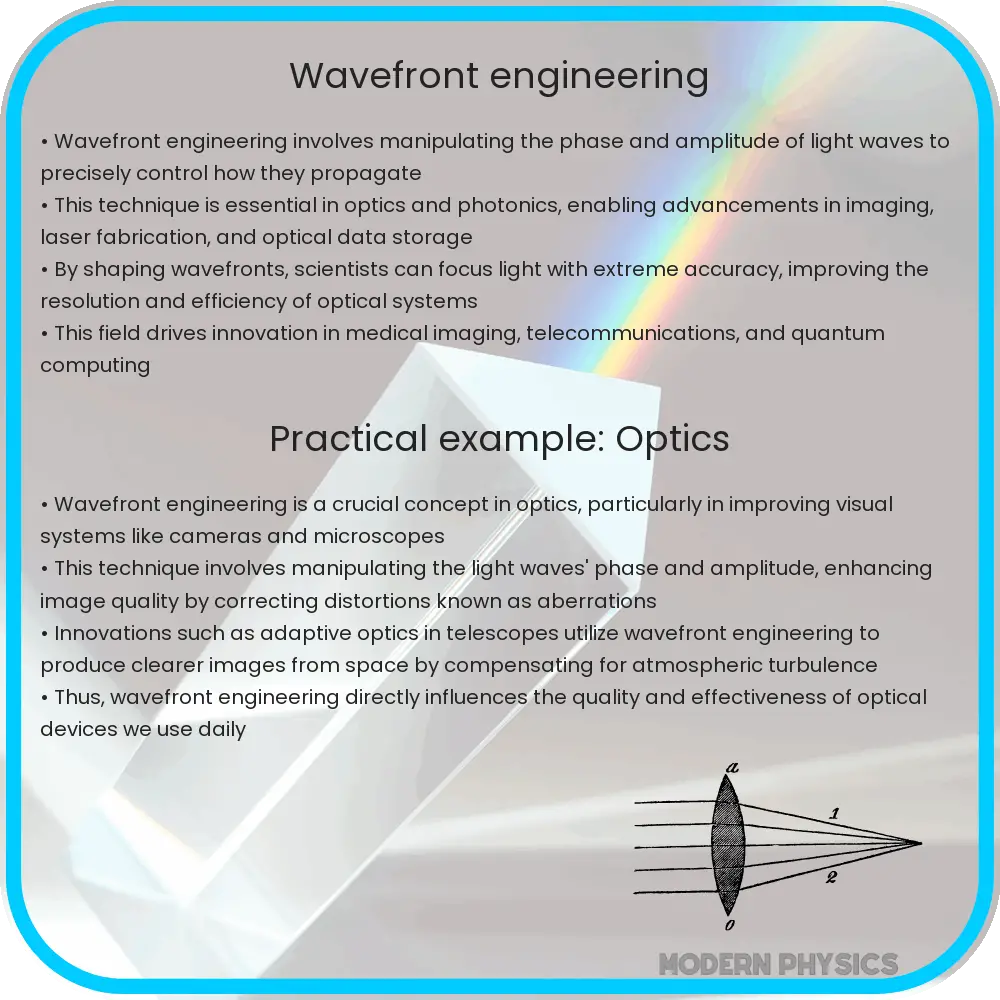
Wavefront Engineering: A Gateway to Advanced Optical Solutions
Wavefront engineering stands at the forefront of optical technology, offering unprecedented precision and control in the manipulation of light. This innovative field combines principles from physics, engineering, and mathematics to shape the wavefronts of light beams. The ability to precisely control these wavefronts opens up a myriad of applications in areas such as microscopy, laser-based manufacturing, and optical communications.
The Essence of Wavefront Engineering
At its core, wavefront engineering involves the manipulation of the phase and amplitude of light waves to achieve desired outcomes. This is accomplished through the use of adaptive optics, diffractive optical elements, and spatial light modulators. By adjusting these parameters, engineers can correct aberrations, focus light with extreme precision, and even create complex light patterns for advanced imaging techniques.
Applications and Innovations
The applications of wavefront engineering are vast and varied. In the realm of microscopy, it allows for super-resolution imaging, enabling scientists to observe details at the molecular level that were previously beyond the limits of optical microscopes. In laser manufacturing, the precise control of the laser beam’s shape and intensity leads to improved product quality and efficiency in processes such as cutting, engraving, and additive manufacturing. Furthermore, in optical communications, wavefront engineering enhances the capacity and reliability of data transmission by compensating for distortions encountered over long distances.
Challenges and Solutions
Despite its potential, wavefront engineering faces several challenges. The complexity of controlling light at such fine scales requires advanced algorithms and computational resources. Moreover, the materials and devices used for wavefront manipulation, like spatial light modulators, must meet high standards of precision and efficiency. Innovations in material science and computational techniques continue to address these challenges, pushing the boundaries of what is possible in optical engineering.
As we delve deeper into the capabilities and applications of wavefront engineering, it’s clear that this field is pivotal in advancing optical technologies. Its contributions to precision, control, and innovation pave the way for breakthroughs that will redefine our interaction with light and its applications across various industries.
Advancing Precision with Wavefront Engineering
Wavefront engineering’s role in enhancing precision in optical systems cannot be overstated. By tailoring the propagation of light down to the wavefront level, engineers can achieve an extraordinary level of control over optical phenomena. This precision facilitates the development of highly sensitive instrumentation for scientific research, such as interferometers and spectrometers, which rely on the accurate manipulation of light to measure physical properties and phenomena with unparalleled accuracy.
Future Prospects and Emerging Technologies
The future of wavefront engineering is bright, with ongoing research pushing the envelope of what’s achievable. Emerging technologies, such as quantum optics and photonics, stand to benefit significantly from advancements in wavefront control. Quantum computing, for instance, requires precise manipulation of quantum states, often represented by light waves. Wavefront engineering could thus play a critical role in the development of quantum information processing and communication systems.
Moreover, the integration of artificial intelligence and machine learning with wavefront engineering opens new avenues for automated and optimized optical designs. These technologies can help in real-time adaptive optics systems, where wavefront corrections need to be applied dynamically in response to changing environmental conditions or in evolving experimental setups.
Enabling Innovation Across Disciplines
Wavefront engineering is not just about the control of light; it’s a key enabler of innovation across a wide range of disciplines. From improving the resolution of astronomical telescopes to enhancing the precision of medical diagnostics through advanced imaging techniques, the impact of wavefront engineering is far-reaching. It exemplifies how fundamental scientific principles can be harnessed to drive technological advancements that benefit society as a whole.
Conclusion
In conclusion, wavefront engineering represents a critical intersection of physics, engineering, and technology, offering groundbreaking tools for the manipulation and control of light. Its applications span numerous fields, driving innovation in optical communications, manufacturing, and beyond. As we continue to explore the possibilities opened by precise wavefront control, we can expect to see significant advancements in both existing and emerging technologies. The journey of wavefront engineering is one of endless discovery, promising to unlock new capabilities and applications that we are only beginning to imagine. With its blend of precision, control, and innovation, wavefront engineering is poised to light the way forward into a brighter, more precise future in optics and photonics.