
Explore the vortex glass state in superconductors, its theoretical background, impacts, applications, and future research directions in our detailed article.
Understanding the Vortex Glass State
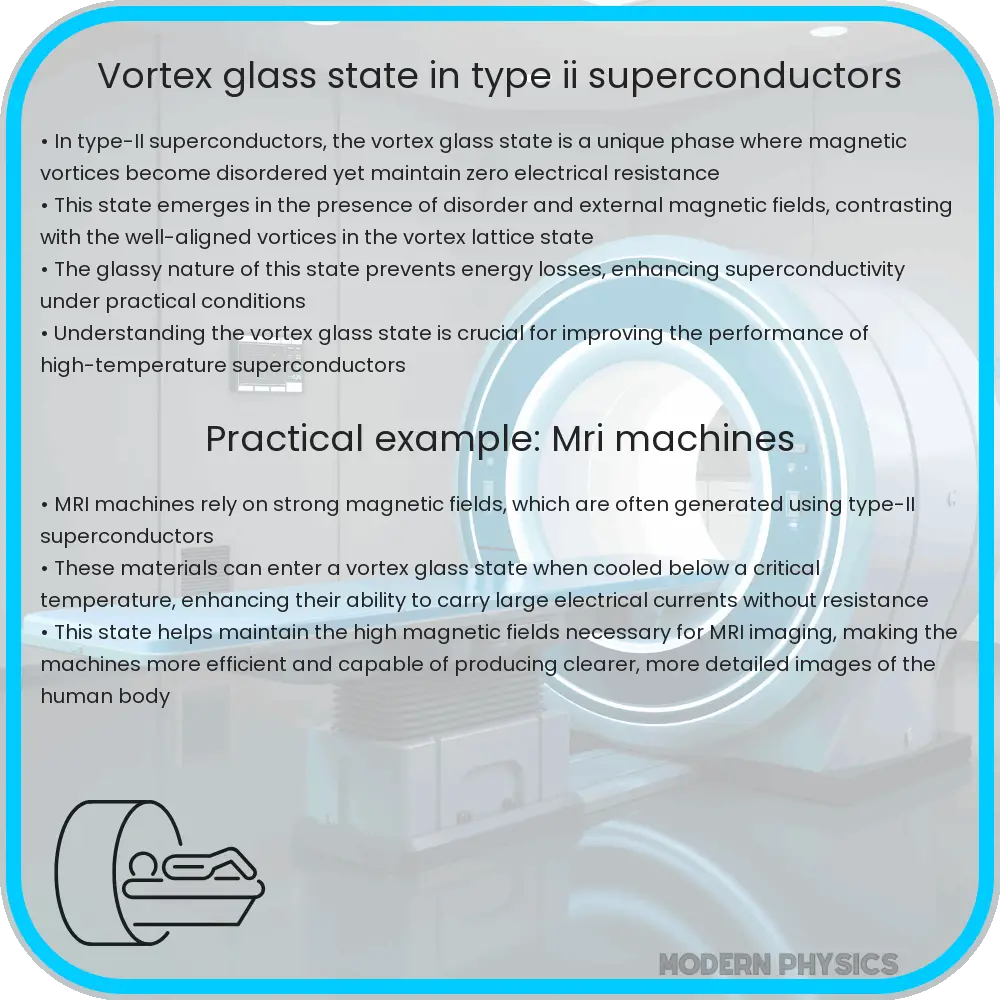
The vortex glass state is a complex and fascinating phenomenon observed in type-II superconductors under certain conditions. Superconductors are materials that can conduct electricity without resistance below a critical temperature. However, in type-II superconductors, the presence of an external magnetic field can lead to the formation of magnetic vortices. These vortices interact with the lattice imperfections or defects within the superconductor, leading to a unique state of matter known as the vortex glass state.
In this state, the vortices are not arranged in a regular lattice but are instead frozen in a disordered fashion, similar to how atoms are arranged in glass. This results from the competition between the repulsive interactions among vortices and their interactions with pinning sites (defects) in the material. The vortex glass state is characterized by zero electrical resistance and a significant suppression of vortex motion.
Theoretical Background
The theoretical understanding of the vortex glass state is based on the concept of phase transitions and critical phenomena. The transition from a liquid-like vortex state to a vortex glass state as the temperature or magnetic field is varied resembles phase transitions seen in other systems. However, unlike conventional phase transitions, the transition to a vortex glass state does not involve symmetry breaking but is instead a transition driven by disorder and fluctuations.
The theory of vortex glass was developed to explain the unusual magnetic and transport properties of high-temperature superconductors in a magnetic field. It predicts that there is a finite temperature below which an amorphous solid state of vortices, the vortex glass, forms and exhibits long-range phase coherence without periodic order.
Impact and Applications
The study of the vortex glass state has significant implications for the field of superconductivity and its applications. Understanding and controlling the vortex dynamics in superconductors can lead to the development of more efficient and powerful superconducting magnets, power transmission lines, and other electronic devices. The ability to maintain the superconducting state under high magnetic fields is crucial for applications such as magnetic resonance imaging (MRI) and particle accelerators.
Practical Applications of Vortex Glass Theory
One of the key applications of vortex glass theory lies in enhancing the performance of superconducting devices. By optimizing the density and distribution of pinning centers within superconductors, engineers can design materials that maintain superconductivity under higher magnetic fields and temperatures. This is crucial for developing more efficient and compact superconducting magnets used in various high-tech applications, including MRI machines, maglev trains, and particle accelerators.
Moreover, the vortex glass state plays a significant role in the development of fault current limiters, which are essential for stabilizing power grids. Superconducting fault current limiters can quickly react to sudden surges in electrical current, preventing equipment damage and power outages. Understanding vortex behavior in superconductors allows for the design of devices that operate more reliably under varying electrical loads and conditions.
Future Research Directions
Despite the advancements in understanding the vortex glass state, there are still many unanswered questions and challenges. Future research is aimed at uncovering the microscopic details of vortex pinning and dynamics, developing materials with enhanced superconducting properties, and understanding the transition mechanisms between different vortex states. Additionally, the exploration of vortex glass behavior in novel superconducting materials could lead to the discovery of new physics and applications.
Another promising research direction involves the integration of vortex glass state concepts with other emerging technologies, such as quantum computing and nanotechnology. The unique properties of the vortex glass state could contribute to the development of new quantum computing architectures and enhance the performance of nanoscale superconducting devices.
Conclusion
The vortex glass state represents a unique and complex phase of matter that emerges under specific conditions in type-II superconductors. Its study not only enriches our understanding of superconductivity and phase transitions but also has significant practical implications. By harnessing the peculiar properties of the vortex glass state, scientists and engineers can improve the performance and efficiency of superconducting materials and devices, paving the way for advancements in technology and industry. As research continues, the exploration of the vortex glass state is expected to unlock new possibilities in the realm of low-temperature physics and applied superconductivity, contributing to the development of future technologies.