
Vortex Generator Vanes, aerodynamic devices that enhance vehicle performance by managing airflow, reducing drag, and improving stability.
Understanding Vortex Generator Vanes
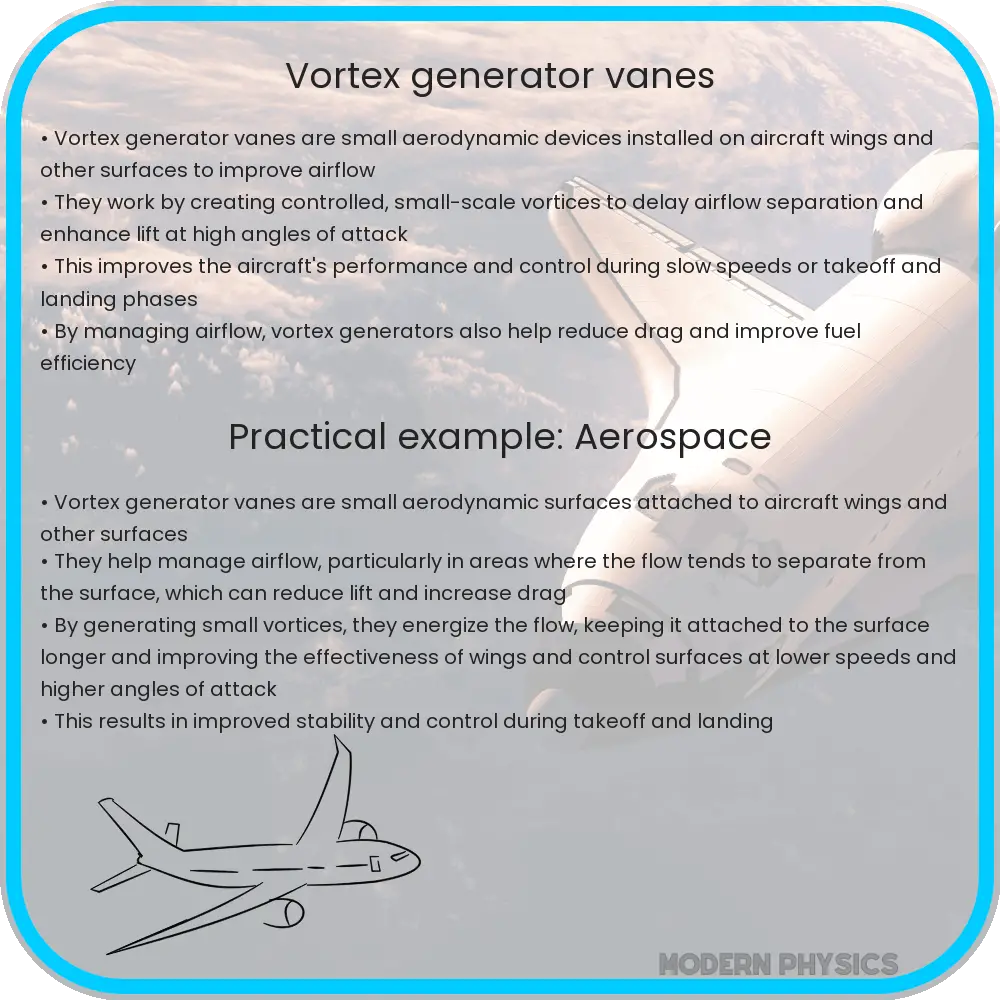
Vortex Generator Vanes (VGs) are small, aerodynamic devices that can be attached to the surface of an aircraft, car, or any fluid-dynamic body to improve its performance by managing airflow. Despite their small size, they play a significant role in enhancing flow characteristics around the body of the vehicle, reducing drag and improving stability.
How Vortex Generator Vanes Work
VGs work by disturbing the airflow in a beneficial way. They are typically small fins placed perpendicular to the flow direction. When air flows over these devices, it separates from the surface and creates a tiny vortex — a spinning column of air. This process helps in managing the boundary layer of air, which is the thin layer of air directly adjacent to the surface of the object in question.
The primary function of the vortex is to mix high-energy air from outside the boundary layer with the slower, low-energy air close to the surface. This mixing prevents the boundary layer from becoming too thick, which can increase friction drag and reduce aerodynamic efficiency. By keeping the boundary layer thinner, VGs allow the flow to remain attached to the surface for a longer distance, reducing flow separation, and consequently, drag.
Benefits of Using Vortex Generator Vanes
- Reduction in Drag: By delaying flow separation, vortex generators can reduce aerodynamic drag which is a vital factor in increasing the efficiency of vehicles, especially at high speeds.
- Improved Stability: VGs enhance the stability of vehicles by ensuring more predictable and controlled airflow across the surface, which is particularly useful in complex maneuvers and adverse weather conditions.
- Enhanced Flow: They improve the effectiveness of aerodynamic surfaces like wings and spoilers by helping maintain lift at lower speeds and higher angles of attack, thus broadening operational conditions.
This ability to control the flow dynamics makes VGs invaluable in various engineering domains, from aviation, where they help in maintaining control at lower speeds, to automotive engineering, where they contribute to the stability and efficiency of cars, particularly in racing scenarios.
Applications in Real World Engineering
In aviation, vortex generator vanes are often seen on the wings and vertical tails of aircraft. They help in reducing stall speeds, which increases safety during takeoff and landing. In automobiles, particularly in high-performance cars and racing vehicles, VGs are used to manipulate airflow to reduce drag and increase downforce, thus enhancing grip and stability at high speeds.
Moreover, their application isn’t just limited to transportation. VGs also find their applications in wind turbines, where they help in improving the efficiency of the turbines by reducing blade stall and promoting smoother air flow over the blades. This optimization leads to a more consistent generation of power and enhances the overall performance of the turbine.
Installation and Design Considerations
When integrating VGs into a design, several factors must be considered to ensure optimal performance. The size, shape, and placement of VGs are critical and vary depending on the specific requirements of the vehicle or structure. Incorrect installation could lead to inefficiencies or even adverse effects on the flow dynamics.
For example, the angle at which VGs are installed relative to the airflow direction affects their efficiency. Typically, they are aligned at a slight angle to the local airflow to maximize the creation of beneficial vortices. Computational fluid dynamics (CFD) tools are often used in the design phase to simulate and optimize the placement and angle of VGs before physical testing.
Material selection is also crucial as the VGs must withstand various environmental stresses without degrading. In aviation, materials that resist corrosion and can handle temperature extremes are preferred. In automobile applications, materials that can endure constant exposure to moisture, dirt, and road debris are necessary.
Challenges and Future Prospects
Despite the benefits, VGs come with their set of challenges. They can sometimes increase surface roughness, leading to a minor increase in parasitic drag, which is a drag that does not contribute to lift production. Engineers must balance this trade-off carefully to net overall positive gains in performance.
Looking ahead, advancements in materials science and aerodynamics promise the development of more refined and efficient VGs. Researchers are exploring biologically inspired designs and nano-materials that could further minimize the drawbacks and maximize the performance of vortex generators.
Conclusion
Vortex Generator Vanes represent a fascinating blend of simple design and profound impact on vehicle aerodynamics and performance. By strategically manipulating airflow, these small devices deliver significant reductions in drag and enhance stability, thus broadening the operational envelope of various vehicles and structures. In the ongoing pursuit of efficiency and performance in the engineering world, VGs stand out as a prime example of how understanding and leveraging the principles of fluid dynamics can lead to innovative solutions. As technology progresses, the potential for VGs in various applications looks promising, steering us toward safer, more efficient, and environmentally friendly engineering solutions.