
Explore the Virial Theorem’s role in understanding galaxy dynamics, structure, and evolution, including its application in measuring mass and dark matter distribution.
Understanding the Virial Theorem in Galaxies
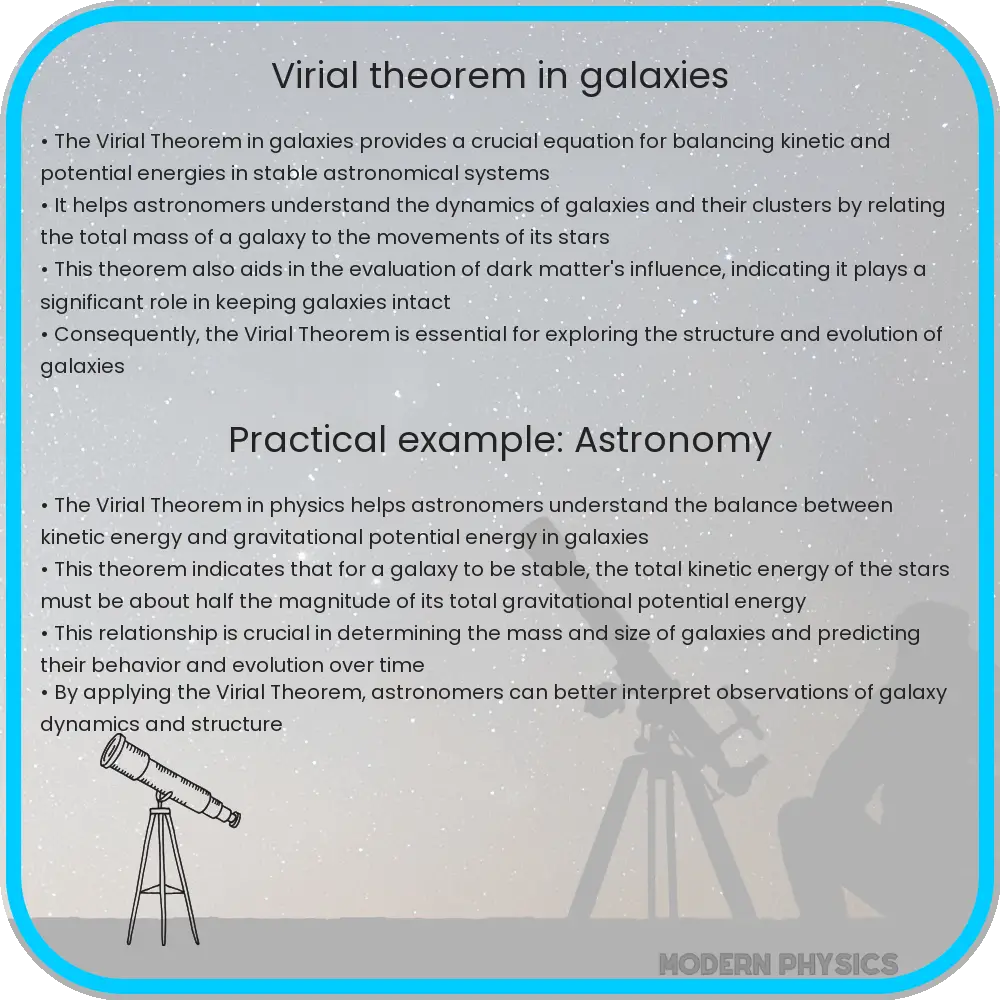
The Virial Theorem is a fundamental principle in astrophysics that plays a crucial role in understanding the dynamics, structure, and evolution of galaxies. It provides a link between the kinetic energy (K) of a system, due to the motion of its constituents, and its gravitational potential energy (U), reflecting the structure and mass distribution of the system. In the context of galaxies, this theorem is instrumental in deciphering the balance between the movement of stars and interstellar matter and the gravitational forces acting upon them.
Galactic Dynamics and the Virial Theorem
In galaxies, the Virial Theorem is expressed as 2K + U = 0, where K represents the total kinetic energy of the system, and U symbolizes the total potential energy. This relation indicates that, for a galaxy in a steady state, the kinetic energy should be half the magnitude of the gravitational potential energy, but with an opposite sign. This balance is crucial for the stability of galaxies, preventing them from either collapsing under their own gravity or dispersing into space.
The Structure and Composition of Galaxies
Galaxies consist of stars, dust, gas, and dark matter, each contributing to the total mass and affecting the gravitational potential. The Virial Theorem helps astronomers deduce the ‘missing mass’, often referred to as dark matter, that cannot be seen through telescopes but has a significant gravitational effect. By analyzing the velocities of stars and gas clouds within a galaxy, astronomers can apply the Virial Theorem to estimate the total mass, including this unseen matter.
Implications on Galaxy Evolution
The application of the Virial Theorem extends beyond the present state of galaxies; it also sheds light on their past and future evolutionary paths. By understanding the energy balance within galaxies, astronomers can infer their formation processes, interactions, and eventual fate in the cosmological context. This theorem, therefore, serves as a critical tool in the quest to understand the lifecycle of galaxies in the universe.
Applications of the Virial Theorem in Observational Astronomy
One of the most significant applications of the Virial Theorem in astronomy is in the observation and study of galaxy clusters. These large groups of galaxies, bound by gravity, provide an ideal setting for applying the Virial Theorem to determine the mass distribution on even larger scales. Observational data, such as the velocities of galaxies within a cluster, can be used to infer the total mass, revealing important information about the amount and distribution of both visible and dark matter.
Challenges and Limitations
Despite its widespread application, the Virial Theorem is not without its limitations. Its accuracy depends on the assumption that the system is in virial equilibrium, which may not always be the case, especially in younger or more dynamically active galaxies and galaxy clusters. Furthermore, external forces, such as tidal forces from neighboring structures, can disrupt the equilibrium, leading to less reliable estimations. These factors necessitate careful application and interpretation of the theorem in different astrophysical contexts.
Future Prospects
The future of studying galaxies through the lens of the Virial Theorem is promising, thanks to advancements in telescope technology, observational techniques, and computational models. These developments will enable more precise measurements and a better understanding of the complex dynamics within galaxies. Additionally, as our understanding of dark matter and dark energy evolves, so too will our interpretation of the Virial Theorem’s implications in galactic dynamics and cosmology.
Conclusion
The Virial Theorem remains a cornerstone in the study of galactic dynamics, structure, and evolution. By providing a fundamental link between kinetic and potential energies, it offers invaluable insights into the balance of forces within galaxies and the distribution of visible and dark matter. Despite its limitations, the theorem’s applications in observational astronomy continue to deepen our understanding of the universe. As we stand on the brink of new astronomical discoveries, the Virial Theorem will undoubtedly continue to play a pivotal role in unraveling the mysteries of galaxies and the larger cosmos.