
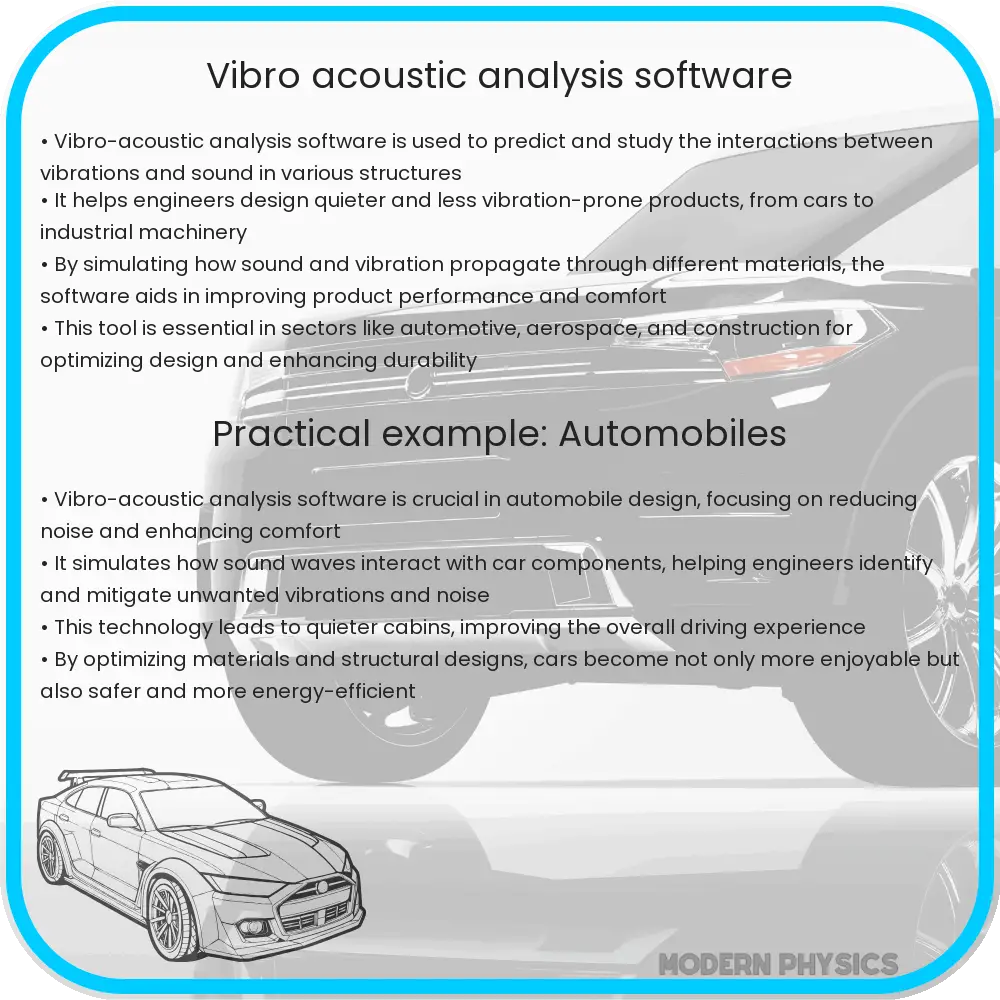
Vibro-acoustic analysis software is used in engineering to model how vibrations and sound interact with materials and structures, ensuring precision and efficiency.
Understanding Vibro-Acoustic Analysis Software
Vibro-acoustic analysis is a critical aspect of modern engineering, especially in fields such as aerospace, automotive, and construction where noise reduction and material integrity are key concerns. Vibro-acoustic analysis software helps engineers and scientists understand how vibrations and sound waves interact with materials and structures. This article explores the precision, efficiency, and integration of this type of software, making complex concepts approachable and illustrating its real-world applications.
Precision in Vibro-Acoustic Analysis
The precision of vibro-acoustic analysis software is crucial because even small discrepancies in data can lead to drastically different outcomes. Precision in this context means the software’s ability to accurately model and predict how sound and vibrations travel through different mediums and how these interactions affect materials at various frequencies. Advanced algorithms and high-fidelity numerical methods are used to ensure that these predictions are as accurate as possible.
- Finite Element Analysis (FEA) allows for detailed modeling of structural responses to stressors.
- Boundary Element Methods (BEM) are used for high-frequency acoustics where FEA could be less effective.
- Statistical Energy Analysis (SEA) deals with complex overall energy exchanges in large systems, beneficial in early design stages.
Efficiency of Tools
While precision is important, the efficiency of vibro-acoustic software is also key to its practical application. Efficient software not only performs computations quickly but also allows easy modifications to models, facilitating rapid prototyping and iterative design processes. Efficiency can often be enhanced by:
- Optimized computing algorithms minimizing the computational load.
- User-friendly interfaces that simplify the setting up and running of analyses.
- Integration capabilities with other software tools, which streamline the design and analysis workflow.
Integration with Other Systems
Integration capabilities of vibro-acoustic analysis software with other engineering tools is another vital feature. This interoperability helps in maintaining a fluid workflow from the initial design phase right through to testing and validation. Common integrations include:
- Computer-Aided Design (CAD) systems, which allow direct import of geometrical data into analysis software.
- Data management systems that organize and control different versions of simulation data, ensuring a smooth flow and consistency across different stages of the product development lifecycle.
- Real-time data acquisition systems for monitoring and adjusting simulations based on actual performance data.
Real-World Applications of Vibro-Acoustic Analysis
The practical usage of vibro-acoustic analysis spans multiple industries, offering solutions to common problems by predicting and mitigating noise and vibration issues. For instance:
- In the automotive industry, engineers use vibro-acoustic analysis to design quieter engines and reduce road noise, enhancing passenger comfort.
- In aerospace, it is crucial for ensuring the structural integrity of spacecraft and aircraft, minimizing risks associated with high-frequency vibrations during launch or flight.
- In consumer electronics, manufacturers analyze small-scale vibrations to better design wearables and handheld devices that are durable and user-friendly.
This type of analysis not only improves the quality and durability of products but also aids in complying with environmental noise regulations, which are becoming increasingly stringent across the globe.
Challenges and Future Directions
Despite its many benefits, vibro-acoustic analysis also faces challenges, primarily related to the complexity of accurately simulating real-world environments. Future developments are likely to focus on improving the scalability of models and enhancing the integration with emerging technologies such as artificial intelligence and machine learning. These advancements could lead to even more precise and efficient analyses.
- Enhancing computational power to handle larger and more complex models.
- Incorporating AI to predict outcomes more quickly and accurately, potentially reducing the need for lengthy prototype testing.
- Improving user interfaces to make advanced analysis more accessible to non-specialists.
In conclusion, vibro-acoustic analysis software plays a pivotal role in modern engineering, offering the tools necessary to tackle complex challenges in noise and vibration control. Its precision, efficiency, and integration capabilities make it indispensable in industries ranging from automotive to aerospace. As technology advances, the future of vibro-acoustic analysis looks promising, with potential for enhanced capabilities and broader applications.
For students, professionals, or anyone interested in mastering the basics of physics and engineering principles, understanding how vibro-acoustic analysis works and its importance in real-world applications can be a rewarding endeavor. This knowledge not only demystifies the processes behind everyday products but also opens up new avenues for innovation in design and manufacturing.