
Explore the fundamentals and applications of vapor-liquid critical properties, covering accuracy, prediction methods, and advanced analysis.
Vapor-Liquid Critical Properties: Understanding the Fundamentals
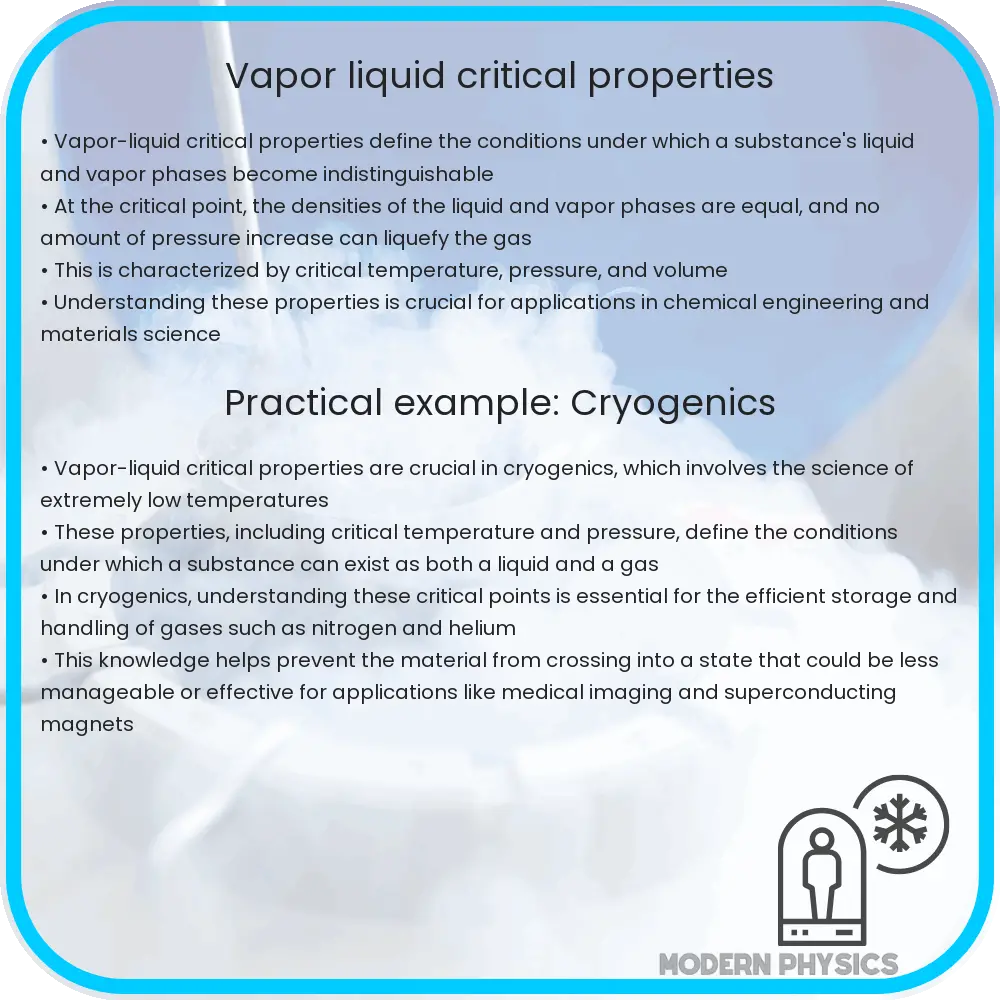
The study of vapor-liquid critical properties is a cornerstone in the field of thermodynamics and material science. These properties are essential for understanding the behavior of substances at their critical points, where the distinction between the liquid and gas phases becomes indistinguishable. This article delves into the accuracy, prediction, and analysis of vapor-liquid critical properties, offering insights for both academic and industrial applications.
Accuracy in Measuring Critical Properties
Accurate determination of critical properties such as critical temperature (Tc), critical pressure (Pc), and critical volume (Vc) is vital for the design and operation of various industrial processes. The precision of these measurements affects the development of phase diagrams, which are instrumental in predicting the behavior of substances under different conditions. Modern techniques like high-resolution spectroscopy and molecular simulation have significantly enhanced the accuracy of critical property measurements, enabling more reliable predictions and analyses.
Prediction Methods
Predicting critical properties is crucial in scenarios where experimental determination is impractical or impossible. Various models and equations of state (EOS), such as the Van der Waals EOS and Peng-Robinson EOS, are used for this purpose. These models incorporate intermolecular forces and predict phase behavior by relating P, V, and T. Despite their utility, the accuracy of these predictions often depends on the substance in question and the conditions under which the data is extrapolated.
Analysis and Applications
Analyzing vapor-liquid critical properties is not just a theoretical exercise; it has practical implications in industries like petrochemical, pharmaceuticals, and environmental engineering. For instance, understanding the critical properties of hydrocarbons helps in optimizing extraction and refining processes. In pharmaceuticals, critical property analysis assists in designing effective drug delivery systems, particularly for volatile compounds.
Moreover, environmental studies often leverage knowledge of critical properties to assess the impact of pollutants in the atmosphere, aiding in the development of more effective strategies for pollution control and environmental protection.
Continued advancements in computational methods and experimental techniques are opening new frontiers in the accurate prediction and analysis of vapor-liquid critical properties. These developments not only enhance our fundamental understanding of phase behavior but also drive innovation across various scientific and industrial domains.
Advanced Computational Methods in Critical Property Analysis
Recent advancements in computational chemistry have revolutionized the analysis of vapor-liquid critical properties. Techniques like molecular dynamics (MD) and Monte Carlo (MC) simulations provide in-depth insights into molecular interactions and phase behavior at the microscopic level. These methods allow for the exploration of critical phenomena in complex mixtures and biomolecules, which were previously challenging to analyze using traditional approaches.
Challenges and Future Directions
Despite significant progress, challenges remain in accurately predicting and analyzing vapor-liquid critical properties for complex systems. Discrepancies between experimental data and theoretical models often arise, especially for substances with non-ideal behavior. Future research is directed towards improving the predictive power of models, particularly for high molecular weight compounds and mixtures with multiple components. The integration of machine learning and artificial intelligence in this field holds promise for developing more robust and accurate predictive models.
Environmental and Safety Considerations
Understanding the critical properties of substances is not only important for industrial applications but also for environmental and safety considerations. Knowledge of these properties is crucial in assessing the risks associated with the handling and storage of volatile and hazardous materials. It enables the development of safer processes and the implementation of effective emergency response strategies in case of accidental releases.
Conclusion
The study of vapor-liquid critical properties plays a pivotal role in various scientific and industrial fields. Accurate measurement, prediction, and analysis of these properties are essential for the efficient design and operation of processes, safety management, and environmental protection. As computational and experimental methodologies continue to evolve, the precision and scope of critical property analysis will undoubtedly expand. This will lead to a deeper understanding of phase behavior and foster innovations across diverse sectors, from energy production to pharmaceuticals. Embracing these advancements and addressing the ongoing challenges will be crucial for future progress in this vital area of research and application.