
Explore the mechanics, benefits, and acoustic control of the ultrasonic soldering iron, a tool revolutionizing precision soldering in various industries.
Understanding the Ultrasonic Soldering Iron: Precision, Speed & Acoustic Control
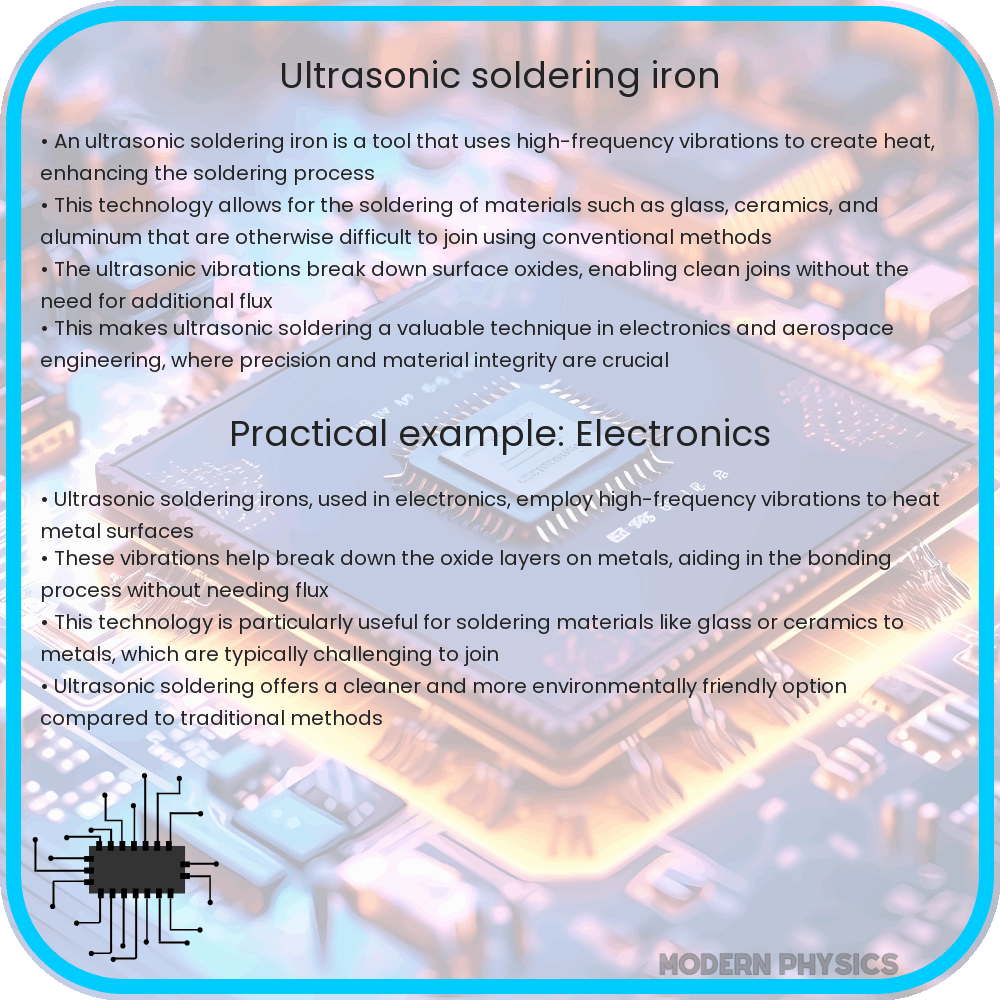
The ultrasonic soldering iron represents a significant advancement in soldering technology, offering unparalleled precision, speed, and control in various industrial and electronics applications. This innovative tool uses ultrasonic energy to achieve better wetting and adhesion of molten solder to difficult-to-solder materials like glass, ceramics, and oxidized metals. In this article, we will explore the mechanics and benefits of the ultrasonic soldering iron, and how it integrates acoustic control to enhance soldering processes.
How Ultrasonic Soldering Iron Works
Traditional soldering irons rely mainly on heat conducted through a metallic tip to melt solder, allowing it to flow into the joint between components. In contrast, an ultrasonic soldering iron incorporates an ultrasonic transducer that generates high-frequency acoustic vibrations. These vibrations are then transmitted to the soldering tip. Here’s a breakdown of its mechanics:
- Generation of Ultrasonic Waves: The ultrasonic transducer, typically piezoelectric, converts electrical energy into mechanical vibrations at ultrasonic frequencies (typically above 20 kHz).
- Transmission to the Soldering Tip: These vibrations travel through the soldering tool to the tip, which vibrates at a microscopic level.
- Vibration of the Soldering Tip: As the solder melts, the tip’s vibrations assist in dispersing the molten solder, enhancing its ability to wet and bond with the surfaces of the materials being joined.
The result is a significantly enhanced soldering process, which allows for the joining of materials that are otherwise challenging to bond using conventional soldering techniques.
Benefits of Ultrasonic Soldering
The integration of ultrasonic technology in soldering irons brings several key advantages:
- Improved Wetting Action: The ultrasonic vibrations improve the flow of solder, enabling it to better wet and adhere to the surfaces of the materials. This is particularly useful for materials with high surface energy that do not easily take to conventional solders.
- No Need for Flux: Traditional soldering often requires a chemical flux to prepare surfaces, which can be messy and potentially corrosive. Ultrasonic soldering typically eliminates the need for flux, since the vibrations remove surface oxides and impurities, facilitating cleaner and stronger joints.
- Speed and Efficiency: Ultrasonic soldering can be faster than traditional methods, as it reduces the need for extensive surface preparation and can cool down more quickly.
- Precision and Control: The high degree of control over the soldering tip’s vibrations allows for precise solder placement, crucial in complex electronics assemblies.
These benefits make ultrasonic soldering an ideal choice for applications requiring high strength, precision, and cleanliness in the soldered joints. It finds particular use in aerospace, automotive, and electronics sectors where reliability and efficacy are paramount.
Acoustic Control in Ultrasonic Soldering
One of the distinctive features of ultrasonic soldering irons is their ability to control the amplitude and frequency of the ultrasonic vibrations. By adjusting these parameters, technicians can tailor the soldering process to the specific requirements of the materials and the application. Here’s how acoustic control plays a crucial role:
Acoustic control allows the operator to optimize the energy delivered to the soldering point. Lower amplitudes are typically used for delicate components, while higher amplitudes can be effective for larger, more robust applications. Similarly, the frequency of vibrations can be adjusted to manage the level of agitation and heating in the solder, affecting both the speed and quality of the joint formation.
Applications of Ultrasonic Soldering Irons
Given the unique capabilities of ultrasonic soldering irons, they are employed in a range of specific applications:
- Solar Panels: Ultrasonic soldering enables the effective bonding of metallic contacts to the fragile surfaces of solar cells, which are typically made from materials like silicon that are sensitive to high temperatures.
- Electronics Manufacturing: In the production of complex electronic devices, precise control over soldering is crucial. The ultrasonic soldering iron allows for better flow control and stronger joints, which is essential for the durability and functionality of these devices.
- Automotive Sensors: Ultrasonic soldering is used in automotive manufacturing to create reliable and strong connections in sensors that must withstand harsh environmental conditions.
- Medical Devices: The need for high-purity joints in medical electronics, where contamination could have serious consequences, makes ultrasonic soldering a preferred technique.
The versatility of the ultrasonic soldering iron makes it invaluable in such specialized industries, pushing forward innovations in efficiency and reliability.
Environmental and Safety Considerations
Ultrasonic soldering also contributes to environmental and workplace safety. By eliminating the need for flux, which often contains harmful chemicals, it reduces exposure to toxic substances. The process also tends to generate less waste and fewer emissions compared to traditional soldering techniques. This advantage is important in industries that are under pressure to comply with environmental regulations and workplace safety standards.
Conclusion
The ultrasonic soldering iron is more than just an innovative tool; it is a pivotal development in the realm of soldering technology. By harnessing the power of ultrasonic energy, this device facilitates stronger, cleaner, and more reliable solder joints, especially in materials that were once considered challenging. The precision and speed offered by acoustic control significantly enhance production effectiveness in industries ranging from aerospace to electronics. Furthermore, the environmental and operational safety benefits underscore the ultrasonic soldering iron’s role as a forward-thinking solution in modern manufacturing processes. As technology continues to evolve, the potential applications of ultrasonic soldering are likely to expand, contributing greatly to advancements in engineering and assembly techniques.