
Explore ultracentrifugation in biophysics: a crucial technique for separating biomolecules, with insights into methods, applications, and future directions in research.
Ultracentrifugation: A Cornerstone Technique in Biophysics
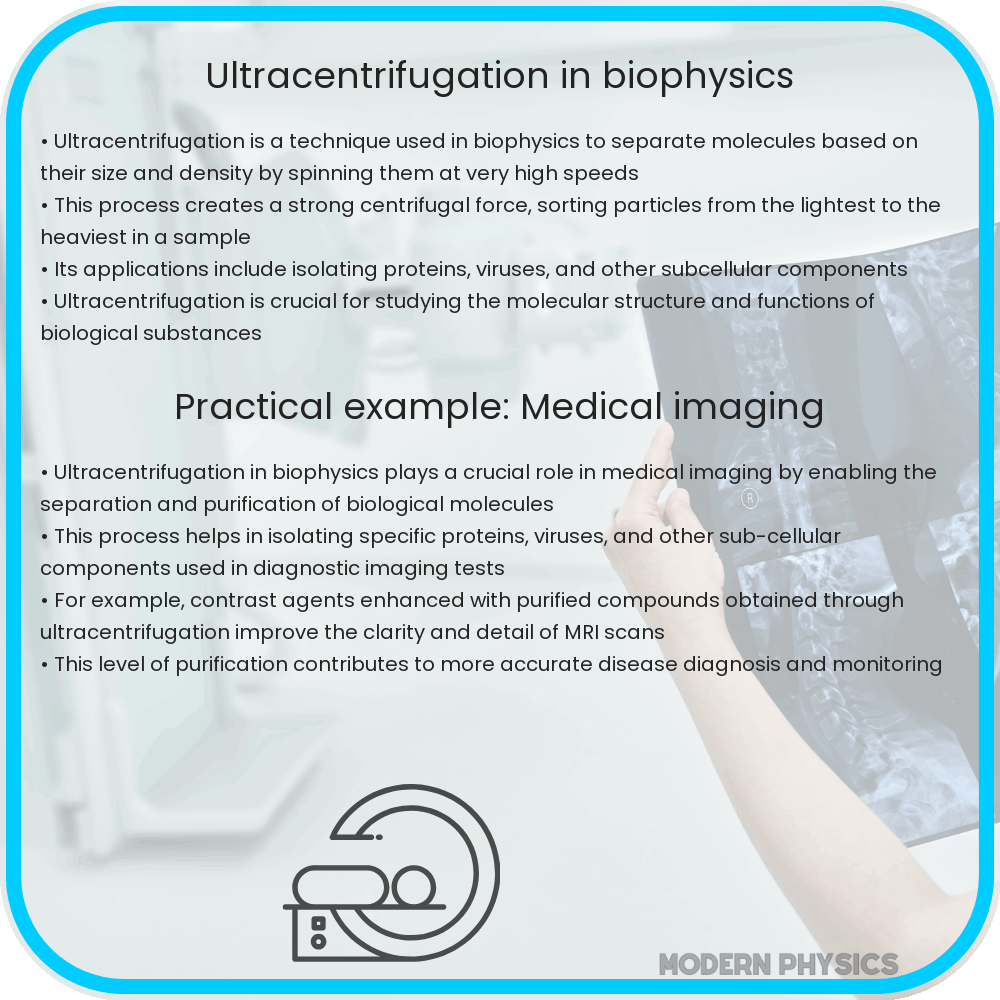
Ultracentrifugation is a sophisticated technique utilized in the field of biophysics for separating complex mixtures based on the sedimentation rate of particles under high centrifugal forces. This method exploits the principles of sedimentation, where particles of different sizes and densities settle at different rates when subjected to centrifugal force. The development of ultracentrifugation has significantly advanced the study of biomolecules, enabling the detailed analysis of their properties and functions.
Methods of Ultracentrifugation
There are two primary methods of ultracentrifugation: analytical and preparative. Analytical ultracentrifugation (AUC) is used for analyzing the size, shape, and interaction of particles in a mixture. It provides detailed information about molecular weight, sedimentation, and diffusion coefficients. Preparative ultracentrifugation, on the other hand, is employed for separating and purifying components of a mixture, allowing for the collection of specific fractions for further analysis.
Applications in Biophysical Research
Ultracentrifugation has found numerous applications in the field of biophysics. It is pivotal in the study of viruses, ribosomes, nucleic acids, and other biomacromolecules. For instance, it enables the separation of ribosomal subunits for genetic and protein synthesis studies. Additionally, it plays a crucial role in the purification of plasmid DNA, essential for genetic engineering and molecular cloning.
Analysis and Interpretation of Results
The analysis of ultracentrifugation results is intricate, requiring an understanding of sedimentation behavior under various conditions. Sedimentation velocity experiments, a part of AUC, analyze how particles sediment through a solution over time, providing insights into particle size and shape. Sedimentation equilibrium experiments, another facet of AUC, assess the distribution of particles at equilibrium, giving information about molecular weights and interaction energies. These analyses contribute to a comprehensive understanding of the biological macromolecules under study.
In summary, ultracentrifugation is an indispensable method in biophysics, offering deep insights into the structure and function of biomolecules. Through its diverse applications and detailed analysis capabilities, it continues to facilitate significant advancements in biological and medical research.
Enhancing Research with Ultracentrifugation
The versatility of ultracentrifugation extends beyond conventional biophysical research to innovative applications in nanotechnology and material science. By isolating nanoparticles and assessing their size distribution, researchers can harness ultracentrifugation for the development of targeted drug delivery systems and the fabrication of advanced materials. Furthermore, its utility in lipidomics — the comprehensive analysis of a cell’s lipid profile — has been instrumental in understanding cellular processes and disease mechanisms.
Technical Considerations and Challenges
Despite its widespread use, ultracentrifugation poses several technical challenges. The high-speed operation requires meticulous calibration and maintenance of ultracentrifuge equipment to prevent mechanical failures. Sample preparation is equally critical, as the presence of impurities or improper sample density can skew results. Moreover, the interpretation of ultracentrifugation data demands a high level of expertise, making it essential for researchers to possess a thorough understanding of the principles underlying sedimentation processes.
Future Directions
The future of ultracentrifugation in biophysics looks promising, with ongoing advancements in ultracentrifuge technology and analytical techniques. Innovations in rotor design and detection systems are expected to increase resolution and sensitivity, allowing for more precise measurements of biomolecular properties. Additionally, the integration of ultracentrifugation data with computational modeling and bioinformatics is likely to enhance our understanding of complex biological systems, paving the way for breakthroughs in biotechnology and medicine.
Conclusion
Ultracentrifugation stands as a fundamental technique in biophysics, offering unparalleled precision in the separation and analysis of biomolecules. Its applications span a wide range of research areas, from molecular biology to nanotechnology, reflecting its versatility and adaptability. Despite technical challenges, ongoing innovations promise to expand its capabilities further, underscoring its critical role in advancing scientific knowledge and technological progress. As researchers continue to push the boundaries of what is possible with ultracentrifugation, its contributions to science and industry are set to grow, solidifying its place as an essential tool in the quest to understand and manipulate the molecular foundations of life.