
Explore the origins, spectral characteristics, and cosmological significance of Type Ia Supernovae, key astronomical events for understanding the universe’s expansion.
Understanding Type Ia Supernovae
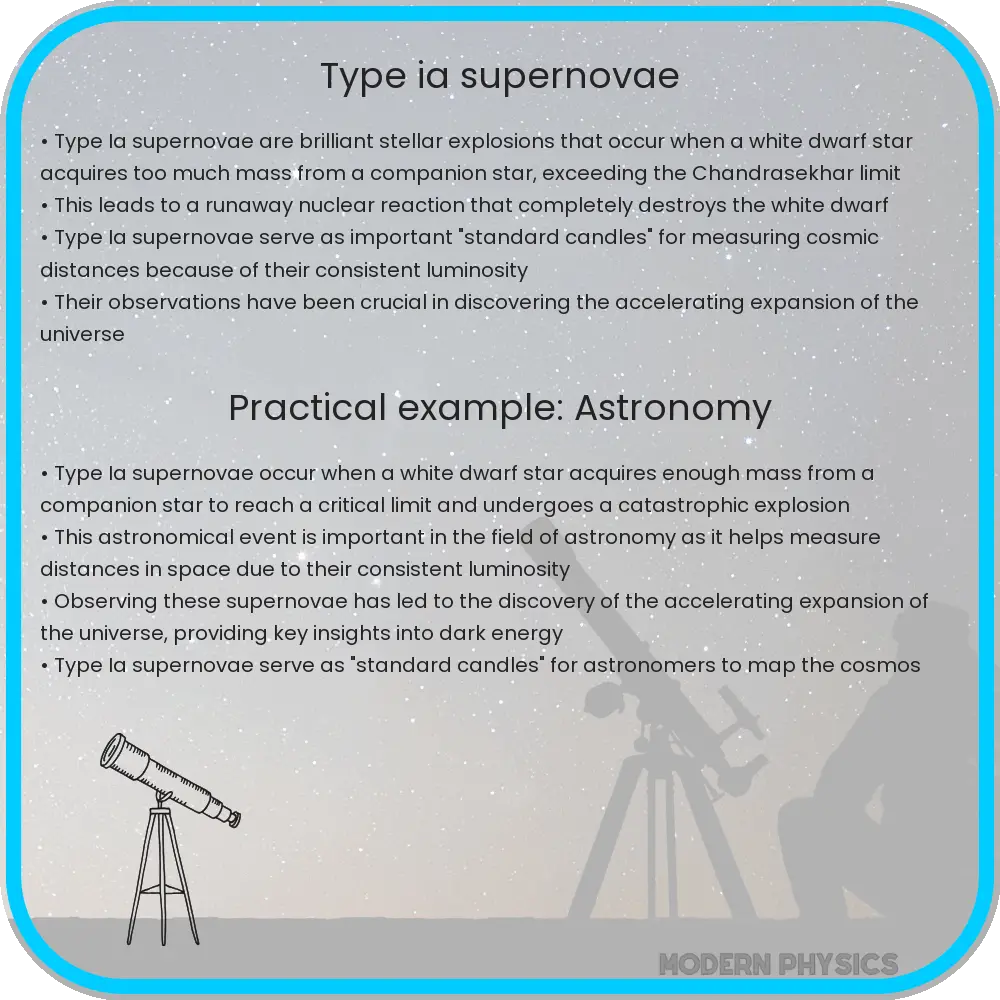
Type Ia supernovae are among the most powerful and illuminating events in the universe. These astronomical phenomena occur in binary star systems, where one of the stars is a white dwarf. The white dwarf accretes matter from its companion star, leading to a critical mass and triggering a thermonuclear explosion. This cataclysmic event results in the complete destruction of the white dwarf and emits an immense amount of light, making it visible across vast cosmic distances.
Origins of Type Ia Supernovae
The genesis of Type Ia supernovae lies in the dynamics of binary star systems. When a star exhausts its nuclear fuel, it may become a white dwarf, a dense remnant composed primarily of electron-degenerate matter. In binary systems, if the white dwarf’s gravity pulls material away from its companion star, it can set the stage for a supernova. This process, known as accretion, continues until the white dwarf approaches the Chandrasekhar limit, approximately 1.4 times the mass of the Sun. Beyond this point, the star can no longer support the additional pressure, leading to a runaway nuclear fusion reaction.
Spectral Characteristics of Type Ia Supernovae
Type Ia supernovae display distinctive spectral signatures that set them apart from other types of supernovae. Their spectra lack the lines of hydrogen (H) and show strong silicon (Si) lines near maximum light. These features are crucial for classifying supernovae and understanding their underlying mechanisms. The absence of hydrogen indicates that the progenitor star is a white dwarf, while the presence of silicon supports the theory of thermonuclear combustion.
Role in Cosmology
Type Ia supernovae have had a profound impact on cosmology, particularly in measuring cosmic distances. Due to their consistent peak luminosity, these supernovae serve as standard candles, allowing astronomers to gauge the scale of the universe. The discovery that distant Type Ia supernovae appeared dimmer than expected led to the groundbreaking conclusion that the universe’s expansion is accelerating, a finding that has profound implications for the understanding of dark energy.
Challenges in Type Ia Supernova Research
Despite their importance in cosmology, Type Ia supernovae are not completely understood. One of the main challenges is identifying the precise nature of the binary systems that lead to these explosions. Theories include single-degenerate systems, where a white dwarf accretes matter from a non-degenerate star, and double-degenerate systems, involving two colliding white dwarfs. Additionally, variations in the chemical composition of the progenitor system can lead to differences in the observed luminosity of supernovae, complicating their use as standard candles.
Advancements in Observational Techniques
Recent advancements in astronomical observation and data analysis have led to significant improvements in the study of Type Ia supernovae. High-resolution telescopes and automated sky surveys are identifying supernovae earlier in their explosion process, providing valuable data on their development and the surrounding environment. These insights help refine models of supernova explosions and improve their reliability as cosmological tools. Moreover, the use of spectroscopy and light curve analysis has become more sophisticated, enabling more precise measurements of distance and better understanding of the universe’s expansion rate.
Conclusion
Type Ia supernovae remain one of the most intriguing and vital phenomena in astrophysics and cosmology. Their role as standard candles has made them indispensable in measuring cosmic distances and contributed to the discovery of the accelerating expansion of the universe. However, challenges remain in fully understanding their origins and mechanisms. Ongoing research and technological advancements promise to unravel these mysteries, leading to more accurate cosmological measurements and a deeper understanding of the universe’s structure and evolution. As we continue to observe and analyze these celestial events, Type Ia supernovae will undoubtedly continue to illuminate the darkest corners of our universe, guiding us toward new frontiers in space and time.