
Explore Twistor Theory’s insights into Quantum Field Theory, its impact on spacetime understanding, and its potential for unifying physics.
Understanding Twistor Theory: A New Perspective in Quantum Field Theory
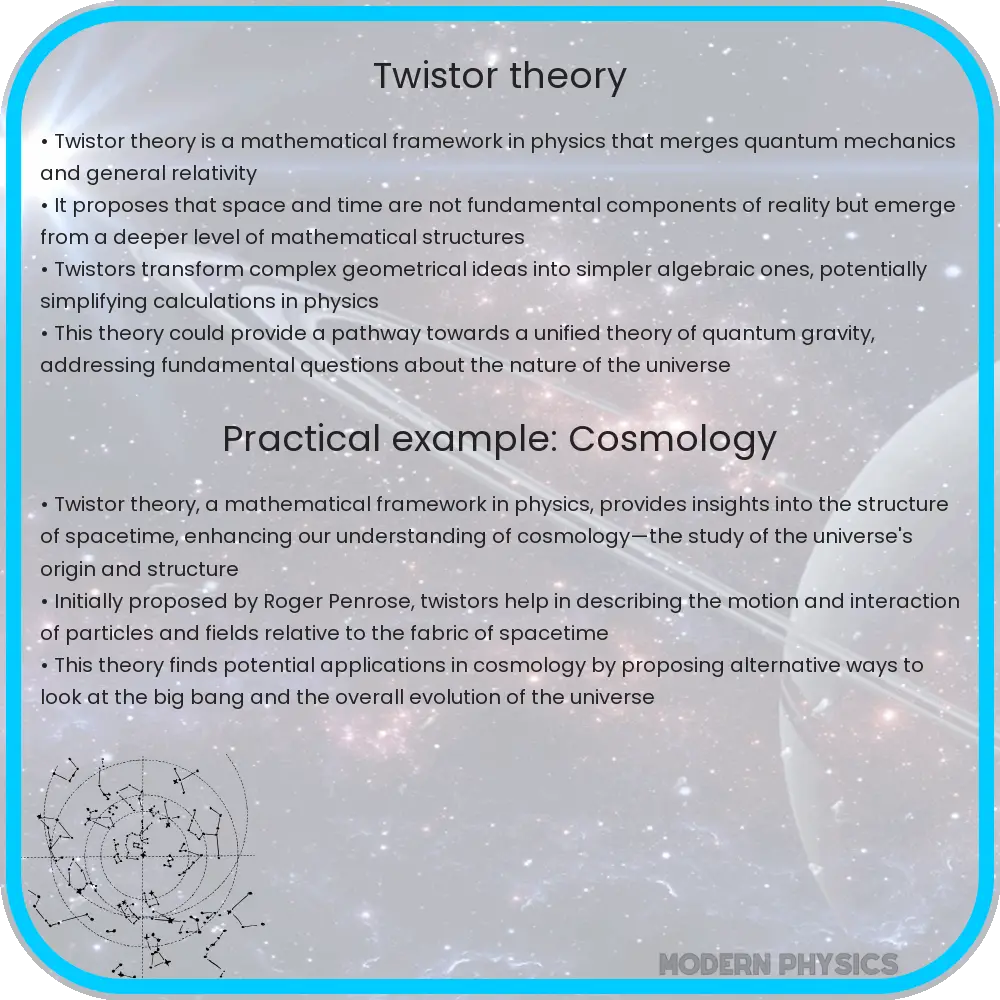
Twistor theory, a novel mathematical framework in theoretical physics, offers unique insights into quantum field theory (QFT) and the fabric of spacetime. Conceived by Roger Penrose in the 1960s, this theory endeavors to provide a more intuitive understanding of the quantum world by merging geometry with the principles of quantum mechanics. Unlike traditional QFT, which uses the standard spacetime coordinates, twistor theory employs ‘twistors’ – complex mathematical objects that represent points in a complex space known as ‘twistor space’.
At its core, twistor theory reimagines the fundamental elements of space and time. Instead of treating them as separate entities, it unifies them into a single geometric entity. This unification leads to a different approach in addressing problems in quantum physics, particularly in the realms of particle interactions and quantum gravity.
Mathematical Foundations of Twistor Theory
Mathematically, a twistor is represented as a point in the complex projective space \(\mathbb{CP}^3\), a four-dimensional complex vector space. This representation transcends the conventional four-dimensional spacetime used in general relativity and QFT. Twistors encapsulate information about the momentum and angular momentum of particles in a geometric manner, allowing for a more profound understanding of their quantum behavior.
One of the most significant applications of twistor theory is in simplifying complex quantum calculations. Traditional calculations in QFT, especially those involving particle interactions, can be extremely intricate and computationally demanding. Twistor theory, through its unique geometric perspective, provides tools for more streamlined and intuitive calculations. For instance, the ‘twistor diagrams’ offer a simpler way of visualizing particle interactions compared to the Feynman diagrams in standard QFT.
In addition, twistor theory has spurred new research in the quest for a unified theory of quantum gravity. By redefining the geometric structure of spacetime, it provides a fresh approach to integrate gravity with quantum mechanics, a long-standing challenge in theoretical physics. This has led to the development of various models and theories that attempt to reconcile the two domains.
Despite its promising prospects, twistor theory is not without its challenges. The translation of its abstract mathematical concepts into observable physical phenomena remains a complex task. Moreover, integrating twistor theory with the Standard Model of particle physics requires further research and refinement.
Nevertheless, the insights and tools provided by twistor theory continue to enrich the field of quantum physics. Its unique approach to understanding the quantum world not only complements existing theories but also opens new avenues for exploration and discovery.
Advancements and Future Directions in Twistor Theory
The journey of twistor theory from a conceptual framework to a tool for practical computation in quantum field theory (QFT) has seen significant advancements. Researchers have successfully applied twistor methods to simplify and solve complex problems in QFT, leading to more efficient and elegant solutions. These applications have been particularly fruitful in the context of scattering amplitudes, where twistor theory has provided new insights into the interactions of subatomic particles.
Furthermore, twistor theory has been instrumental in the development of new mathematical models. These models have contributed to a deeper understanding of the geometry of spacetime and the behavior of particles at the quantum level. One notable example is the Penrose transform, which links certain functions in twistor space to solutions of massless field equations in spacetime. This transformation has profound implications for the study of space, time, and light.
The interplay between twistor theory and string theory is another area of growing interest. Researchers are exploring the connections between these two theories to address some of the most fundamental questions in physics. This synergy has the potential to shed light on the nature of quantum gravity and the unification of fundamental forces.
Challenges and Critiques of Twistor Theory
Despite its potential, twistor theory faces several challenges. One major hurdle is the lack of experimental evidence directly supporting the theory. As with many theoretical frameworks in advanced physics, testing the predictions of twistor theory requires experimental technologies that are currently beyond our reach. This makes empirical validation difficult, leaving the theory more in the realm of mathematical physics than observable phenomena.
Moreover, some critics argue that the mathematical complexity of twistor theory makes it less accessible and harder to integrate with more established theories in physics. The abstract nature of twistor space and its relation to the physical world continue to be subjects of debate within the scientific community.
Conclusion
Twistor theory represents a bold and innovative step in the quest to understand the quantum world. Its unique approach to merging geometry with quantum mechanics offers a fresh perspective on the nature of spacetime and particle interactions. While it presents significant theoretical and experimental challenges, its contributions to mathematical physics and potential to unlock new understandings of quantum phenomena make it a valuable and intriguing area of study. As research continues to evolve, twistor theory holds the promise of deepening our comprehension of the universe and possibly leading to breakthroughs in our quest for a unified theory of physics.