
Explore Einstein’s theory of relativity and velocity transformation, understanding time dilation and the constant speed of light in the universe.
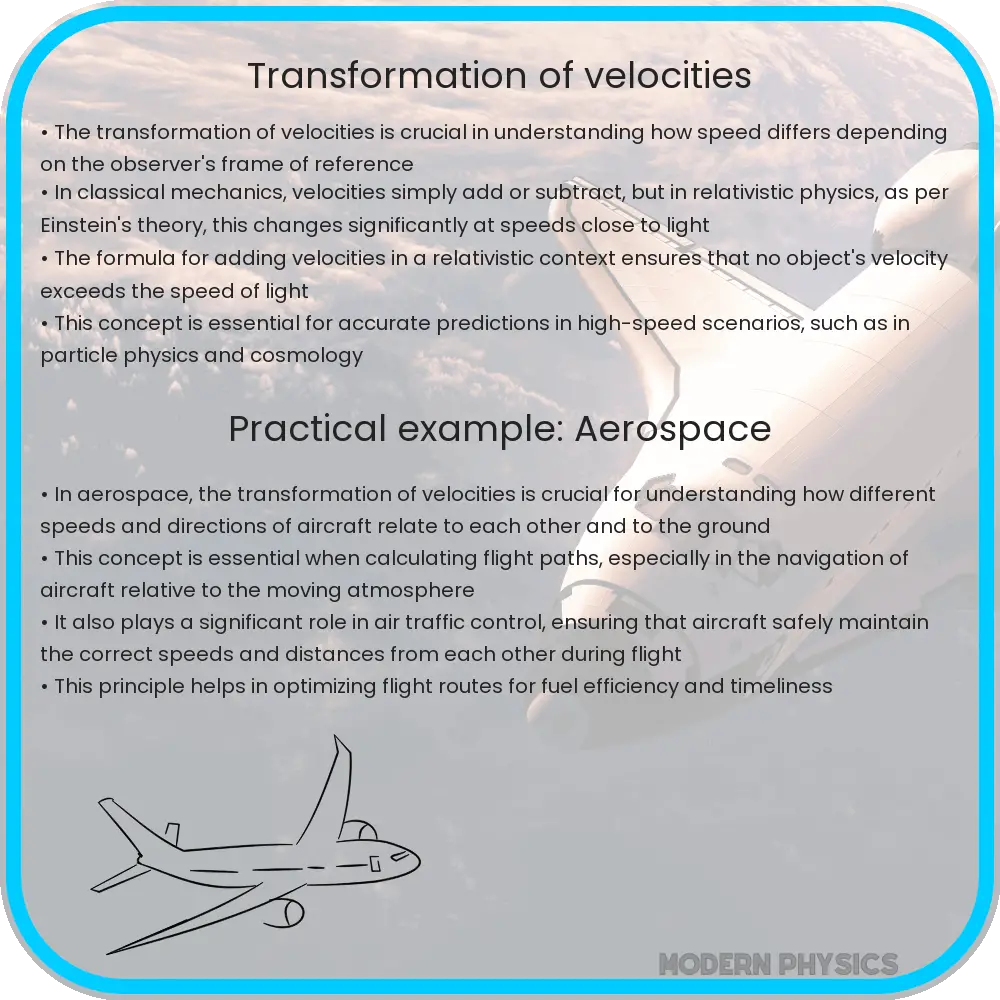
Understanding the Transformation of Velocities in Einstein’s Theory
The concept of the transformation of velocities occupies a central place in Albert Einstein’s theory of relativity, revolutionizing our understanding of time, space, and motion. This article delves into the intricacies of this transformation, particularly how it intertwines with the constancy of the speed of light and the relativity of time.
The Foundation: Speed of Light as a Constant
At the heart of Einstein’s theory is the postulate that the speed of light in a vacuum is constant and is the same for all observers, regardless of their motion. This speed, approximately \(3 \times 10^{8}\) meters per second, is denoted as \(c\). This constancy challenges the Newtonian mechanics, where velocities simply add up. For instance, if a train moves at 60 km/h and a person walks forward in it at 5 km/h, their speed relative to the ground is 65 km/h. However, when dealing with speeds close to that of light, such simple addition doesn’t hold true.
Relativity of Simultaneity and Time Dilation
One of the remarkable implications of the constant speed of light is the relativity of simultaneity. Events that appear simultaneous to one observer might not be so for another observer moving at a different velocity. This leads to the phenomenon of time dilation, where time appears to slow down for an object moving close to the speed of light relative to a stationary observer. This effect is mathematically represented by the Lorentz transformation.
Velocity Transformation in Special Relativity
Einstein’s special theory of relativity presents a formula for transforming velocities. This transformation is essential for understanding how different observers, moving at different velocities, perceive each other’s motion. The formula for velocity transformation is:
\[ v’ = \frac{v + u}{1 + \frac{uv}{c^2}} \]
Here, \(v’\) is the velocity of an object as measured by an observer moving at velocity \(u\) relative to another observer for whom the object’s velocity is \(v\). The denominator incorporates the factor \( \frac{uv}{c^2} \), reflecting the influence of the high speeds close to that of light.
This transformation leads to fascinating outcomes, like the impossibility of any object exceeding the speed of light, as per the relativistic velocity addition. As the velocity of an object approaches the speed of light, the energy required for further acceleration grows infinitely, making it impossible to reach or exceed the speed of light.
The Implications of Velocity Transformation
The transformation of velocities in Einstein’s theory has profound implications for our understanding of the universe. It elucidates why the speed of light acts as a cosmic speed limit, a concept that seems counterintuitive in our everyday experience but is fundamental in the realm of high-speed physics. As objects accelerate closer to the speed of light, their mass effectively increases, demanding more and more energy for further acceleration. This relationship between mass, energy, and speed is encapsulated in the famous equation \(E = mc^2\), where \(E\) is energy, \(m\) is mass, and \(c\) is the speed of light.
Experimental Validation and Modern Applications
The predictions of Einstein’s theories have been repeatedly confirmed through rigorous experiments. For instance, time dilation has been experimentally verified using precise atomic clocks on fast-moving planes. Moreover, these principles have practical applications. The Global Positioning System (GPS), which requires extreme precision in timing, accounts for time dilation effects due to both the speeds of the satellites and the gravitational field of the Earth.
Conclusion
In summary, the transformation of velocities in Einstein’s theory of relativity presents a radical departure from the classical notions of time and space. It reveals a universe where time can stretch, and distances shrink, and where the speed of light binds the cosmic fabric of reality. This theory not only deepens our understanding of the physical universe but also showcases the beauty and elegance of physics, tying together concepts of time, space, velocity, and energy into a coherent and mathematically precise framework. As we continue to explore the cosmos and delve into the realms of high-energy physics, Einstein’s insights remain as relevant and revolutionary as they were a century ago, continuing to guide our exploration of the fundamental laws of the universe.